RankRizz

Colour and magnetic behaviour of complexes from CFT — JEE Main Previous Year Questions

Colour and magnetic behaviour of complexes from CFT has been asked 145 times in JEE Main, in 17 different years between 2004 and 2026, and in all of the last five exam years (2022–2026), 102 questions in all. That is 39% of Coordination Compounds, its most-asked topic. Last asked in JEE Main 08 Apr 2026, Shift 2. 112 are multiple choice and 33 numerical-value; 13 easy, 117 medium and 8 hard by our difficulty labels. All of them are below, newest first, free to read.

Questions

145

Years asked

17

Since

2004

Of the chapter

39%

Every Colour and magnetic behaviour of complexes from CFT question

121–140 OF 145 · NEWEST FIRST

JEE MAIN 2020 · 07 JAN S2Colour and magnetic behaviour of complexes from CFT

Among the statements (a) - (d), the incorrect ones are:
(a) Octahedral Co(III) complexes with strong field ligands have very high magnetic moments
(b) When Δ0<P\Delta_0 < P, the d-electron configuration of Co(III) in an octahedral complex is teg4eg2t_{eg}^4 e_g^2
(c) Wavelength of light absorbed by [Co(en)3_3]3+^{3+} is lower than that of [CoF6_6]3−^{3-}
(d) If the Δ0\Delta_0 for an octahedral complex of Co(III) is 18,000 cm−1^{-1}, the Δt\Delta_t for its tetrahedral complex with the same ligand will be 16,000 cm−1^{-1}.

  1. A

    (a) and (d) only

  2. B

    (c) and (d) only

  3. C

    (a) and (b) only

  4. D

    (b) and (c) only

JEE MAIN 2019 · 12 APR S1Colour and magnetic behaviour of complexes from CFT

The complex ion that will lose its crystal field stabilization energy upon oxidation of metal to +3 state is:

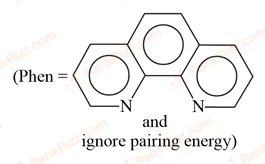
Figure for JEE Main 2019 Chemistry question on Colour and magnetic behaviour of complexes from CFT

(Phen = phenanthroline, ignore pairing energy)

  1. A

    [Ni(phen)3_3]2+^{2+}

  2. B

    [Fe(phen)3_3]2+^{2+}

  3. C

    [Co(phen)3_3]2+^{2+}

  4. D

    [Zn(phen)3_3]2+^{2+}

JEE MAIN 2019 · 12 APR S1Colour and magnetic behaviour of complexes from CFT

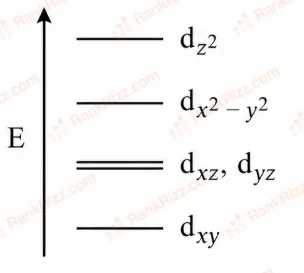
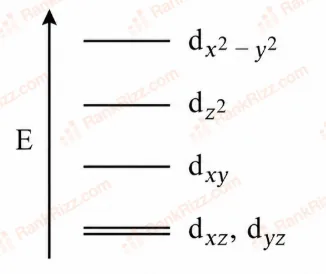
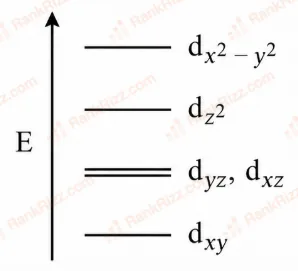
Complete removal of both the axial ligands (along the z-axis) from an octahedral complex leads to which of the following splitting patterns? (relative orbital energies not on scale).

  1. A
    Figure for JEE Main 2019 Chemistry question on Colour and magnetic behaviour of complexes from CFT
  2. B
    Figure for JEE Main 2019 Chemistry question on Colour and magnetic behaviour of complexes from CFT
  3. C
    Figure for JEE Main 2019 Chemistry question on Colour and magnetic behaviour of complexes from CFT
  4. D
    Figure for JEE Main 2019 Chemistry question on Colour and magnetic behaviour of complexes from CFT
JEE MAIN 2019 · 10 APR S1Colour and magnetic behaviour of complexes from CFT

Three complexes,
[CoCl(NH3_3)5_5]2+^{2+}(I), [Co(NH3_3)5_5H2_2O]3+^{3+}(II) and [Co(NH3_3)6_6]3+^{3+}(III)
absorb light in the visible region. The correct order of the wavelength of light absorbed by them is:

  1. A

    (II) > (I) > (III)

  2. B

    (III) > (II) > (I)

  3. C

    (I) > (II) > (III)

  4. D

    (III) > (I) > (II)

JEE MAIN 2019 · 10 APR S2Colour and magnetic behaviour of complexes from CFT

The incorrect statement is.

  1. A

    The spin-only magnetic moments of [FeH2_2O6_6]2+^{2+} and [CrH2_2O6_6]2+^{2+} are nearly similar.

  2. B

    The spin-only magnetic moment of [NiNH34_{3_{4}}H2_2O2]2+_{2}]^{2+} is 2.83 BM.

  3. C

    The gemstone, ruby, has Cr3+^{3+} ions occupying the octahedral sites of beryl.

  4. D

    The color of [CoClNH35_{3_{5}}]2+^{2+} is violet as it absorbs the yellow light.

JEE MAIN 2019 · 10 APR S2Colour and magnetic behaviour of complexes from CFT

The crystal field stabilization energy (CFSE) of [FeH2_2O6_6]Cl2_2 and K2_2[NiCl4_4], respectively, are:

  1. A

    −0.4Δ0-0.4\Delta_0 and −1.2Δt-1.2\Delta_t

  2. B

    −2.4Δ0-2.4\Delta_0 and −1.2Δt-1.2\Delta_t

  3. C

    −0.4Δ0-0.4\Delta_0 and −0.8Δt-0.8\Delta_t

  4. D

    −0.6Δ0-0.6\Delta_0 and −0.8Δt-0.8\Delta_t

JEE MAIN 2019 · 09 APR S1Colour and magnetic behaviour of complexes from CFT

The degenerate orbitals of [Cr(H2_2O)6_6]3+^{3+} are:

  1. A

    dx2−y2d_{x^2-y^2} and dxyd_{xy}

  2. B

    dz2d_{z^2} and dxzd_{xz}

  3. C

    dyzd_{yz} and dz2d_{z^2}

  4. D

    dxzd_{xz} and dyzd_{yz}

JEE MAIN 2019 · 08 APR S1Colour and magnetic behaviour of complexes from CFT

The correct order of the spin-only magnetic moment of metal ions in the following low-spin complexes, [V(CN)6_6]4−^{4-}, [Fe(CN)6_6]4−^{4-}, [Ru(NH3_3)6_6]3+^{3+} and [Cr(NH3_3)6_6]2+^{2+}, is:

  1. A

    V2+>Cr2+>Ru3+>Fe2+V^{2+} > Cr^{2+} > Ru^{3+} > Fe^{2+}

  2. B

    Cr2+>V2+>Ru3+>Fe2+Cr^{2+} > V^{2+} > Ru^{3+} > Fe^{2+}

  3. C

    Cr2+>Ru3+>Fe2+>V2+Cr^{2+} > Ru^{3+} > Fe^{2+} > V^{2+}

  4. D

    V2+>Ru3+>Cr2+>Fe2+V^{2+} > Ru^{3+} > Cr^{2+} > Fe^{2+}

JEE MAIN 2019 · 12 JAN S1Colour and magnetic behaviour of complexes from CFT

The pair of metal ions that can give a spin only magnetic moment of 3.9 BM for the complex [M(H2O)6]Cl2[M(H_2O)_6]Cl_2, is:

  1. A

    Co2+Co^{2+} and Fe2+Fe^{2+}

  2. B

    V2+V^{2+} and Fe2+Fe^{2+}

  3. C

    Cr2+Cr^{2+} and Mn2+Mn^{2+}

  4. D

    V2+V^{2+} and Co2+Co^{2+}

JEE MAIN 2019 · 09 JAN S1Colour and magnetic behaviour of complexes from CFT

Two complexes [CrH2O)6]Cl3[CrH_2O)_6]Cl_3 (A) and [Cr(NH3)6]Cl3[Cr(NH_3)_6]Cl_3 (B) are violet and yellow coloured, respectively. The incorrect statement regarding them is:

  1. A

    Both are paramagnetic with three unpaired electrons

  2. B

    Δ0\Delta_0 value of A is less than that of B

  3. C

    Δ0\Delta_0 values of A and B are calculated from the energies violet and yellow light, respectively.

  4. D

    Both absorb energies corresponding to their complementary colors.

JEE MAIN 2019 · 09 JAN S2Colour and magnetic behaviour of complexes from CFT

Homoleptic octahedral complexes of a metal ion M3+M^{3+} with three monodentate ligands L1L_1, L2L_2 and L3L_3 absorb wavelengths in the region of green, blue and red respectively. The increasing order of the ligand strength is:

  1. A

    L3>L1>L2L_3 > L_1 > L_2

  2. B

    L1>L2>L3L_1 > L_2 > L_3

  3. C

    L2>L1>L3L_2 > L_1 > L_3

  4. D

    L3>L2>L1L_3 > L_2 > L_1

JEE MAIN 2019 · 09 JAN S2Colour and magnetic behaviour of complexes from CFT

The complex that has highest crystal field splitting energy (Δ)(\Delta), is:

  1. A

    K3[Co(CN)6]K_3[Co(CN)_6]

  2. B

    [Co(NH3)5Cl]  Cl2[Co(NH_3)_5Cl] \; Cl_2

  3. C

    [Co(NH3)5(H2O)]Cl3[Co(NH_3)_5(H_2O)]Cl_3

  4. D

    K2[CoCl4]K_2[CoCl_4]

JEE MAIN 2016 · 09 APR ONLINEColour and magnetic behaviour of complexes from CFT

Identify the correct trend given below:
(Atomic No. = Ti : 22, Cr : 24 and Mo : 42)

  1. A

    Δ\Delta of [Cr(H2O)6]2+>[Mo(H2O)6]2+[Cr(H_2O)_6]^{2+} > [Mo(H_2O)_6]^{2+} and Δ\Delta of [Ti(H2O)6]3+>[Ti(H2O)6]2+[Ti(H_2O)_6]^{3+} > [Ti(H_2O)_6]^{2+}

  2. B

    Δ\Delta of [Cr(H2O)6]2+>[Mo(H2O)6]2+[Cr(H_2O)_6]^{2+} > [Mo(H_2O)_6]^{2+} and Δ\Delta of [Ti(H2O)6]3+<[Ti(H2O)6]2+[Ti(H_2O)_6]^{3+} < [Ti(H_2O)_6]^{2+}

  3. C

    Δ\Delta of [Cr(H2O)6]2+<[Mo(H2O)6]2+[Cr(H_2O)_6]^{2+} < [Mo(H_2O)_6]^{2+} and Δ\Delta of [Ti(H2O)6]3+>[Ti(H2O)6]2+[Ti(H_2O)_6]^{3+} > [Ti(H_2O)_6]^{2+}

  4. D

    Δ\Delta of [Cr(H2O)6]2+<[Mo(H2O)6]2+[Cr(H_2O)_6]^{2+} < [Mo(H_2O)_6]^{2+} and Δ\Delta of [Ti(H2O)6]3+<[Ti(H2O)6]2+[Ti(H_2O)_6]^{3+} < [Ti(H_2O)_6]^{2+}

JEE MAIN 2015 · 11 APR ONLINEColour and magnetic behaviour of complexes from CFT

Which of the following complex ions has electrons that are symmetrically filled in both t2gt_{2g} and ege_g orbitals?

  1. A

    [Co(NH3)6]2+[Co(NH_3)_6]^{2+}

  2. B

    [Mn(CN)6]4−[Mn(CN)_6]^{4-}

  3. C

    [CoF6]3−[CoF_6]^{3-}

  4. D

    [FeF6]3−[FeF_6]^{3-}

JEE MAIN 2015 · 04 APR OFFLINEColour and magnetic behaviour of complexes from CFT

Which one of the following compounds is not a yellow colored compound?

  1. A

    BaCrO4BaCrO_4

  2. B

    Zn2[Fe(CN)6]Zn_2[Fe(CN)_6]

  3. C

    K3[Co(NO2)6]K_3[Co(NO_2)_6]

  4. D

    (NH4)3[As(Mo3O10)4](NH_4)_3[As(Mo_3O_{10})_4]

JEE MAIN 2014 · 12 APR ONLINEColour and magnetic behaviour of complexes from CFT

Among the following species the one which causes the highest CFSE, Δ0\Delta_0 as a ligand is:

  1. A

    CN−^-

  2. B

    NH3_3

  3. C

    F−^-

  4. D

    CO

JEE MAIN 2014 · 12 APR ONLINEColour and magnetic behaviour of complexes from CFT

Which one of the following complexes will most likely absorb visible light? (At. nos. Sc = 21, Ti = 22, V = 23, Zn = 30)

  1. A

    [Sc(H2_2O)6_6]3+^{3+}

  2. B

    [Ti(NH3_3)6_6]4+^{4+}

  3. C

    [V(NH3_3)6_6]3+^{3+}

  4. D

    [Zn(NH3_3)6_6]2+^{2+}

JEE MAIN 2014 · 06 APR OFFLINEColour and magnetic behaviour of complexes from CFT

The octahedral complex of a metal ion M3+M^{3+} with four monodentate ligands L1L_1, L2L_2, L3L_3 and L4L_4 absorb wavelengths in the region of red, green, yellow and blue, respectively. The increasing order of ligand strength of the four ligands is:

  1. A

    L4<L3<L2<L1L_4 < L_3 < L_2 < L_1

  2. B

    L1<L3<L2<L4L_1 < L_3 < L_2 < L_4

  3. C

    L3<L2<L4<L1L_3 < L_2 < L_4 < L_1

  4. D

    L1<L2<L4<L3L_1 < L_2 < L_4 < L_3

JEE MAIN 2013 · 25 APR ONLINEColour and magnetic behaviour of complexes from CFT

In which of the following octahedral complex species the magnitude of Δ0\Delta_0 will be maximum?

  1. A

    [Co(H2O)6]2+[Co(H_2O)_6]^{2+}

  2. B

    [Co(CN)6]3−[Co(CN)_6]^{3-}

  3. C

    [Co(C2O4)3]3−[Co(C_2O_4)_3]^{3-}

  4. D

    [Co(NH3)6]3+[Co(NH_3)_6]^{3+}

JEE MAIN 2012Colour and magnetic behaviour of complexes from CFT

The dd-electron configurations of Cr2+,Mn2+,Fe2+\text{Cr}^{2+}, \text{Mn}^{2+}, \text{Fe}^{2+} and Co2+\text{Co}^{2+} are d4,d5,d6d^4, d^5, d^6 and d7d^7 respectively. Which one of the following will exhibit the lowest paramagnetic behaviour? (Atomic no. Cr = 24, Mn = 25, Fe = 26, Co = 27).

  1. A

    [Co(H2O)6]2+[\text{Co}(\text{H}_2\text{O})_6]^{2+}

  2. B

    [Cr(H2O)6]2+[\text{Cr}(\text{H}_2\text{O})_6]^{2+}

  3. C

    [Mn(H2O)6]2+[\text{Mn}(\text{H}_2\text{O})_6]^{2+}

  4. D

    [Fe(H2O)6]2+[\text{Fe}(\text{H}_2\text{O})_6]^{2+}