RankRizz

Colour and magnetic behaviour of complexes from CFT — JEE Main Previous Year Questions

Colour and magnetic behaviour of complexes from CFT has been asked 145 times in JEE Main, in 17 different years between 2004 and 2026, and in all of the last five exam years (2022–2026), 102 questions in all. That is 39% of Coordination Compounds, its most-asked topic. Last asked in JEE Main 08 Apr 2026, Shift 2. 112 are multiple choice and 33 numerical-value; 13 easy, 117 medium and 8 hard by our difficulty labels. All of them are below, newest first, free to read.

Questions

145

Years asked

17

Since

2004

Of the chapter

39%

Every Colour and magnetic behaviour of complexes from CFT question

101–120 OF 145 · NEWEST FIRST

JEE MAIN 2022 · 25 JUN S1Colour and magnetic behaviour of complexes from CFT

If [CuH2O4]2+[CuH_2O_4]^{2+} absorbs a light of wavelength 600600 nm for d-d transition, then the value of octahedral crystal field splitting energy for [CuH2O6]2+[CuH_2O_6]^{2+} will be ______ ×10−21\times 10^{-21} J [Nearest integer]
(Given : h=6.63×10⁻³⁴h = 6.63 \times 10^{-34} Js and c=3.08×10⁸c = 3.08 \times 10^{8} ms−1^{-1})

JEE MAIN 2022 · 24 JUN S2Colour and magnetic behaviour of complexes from CFT

Transition metal complex with highest value of crystal field splitting (Δ0)(\Delta_0) will be

  1. A

    [Mo(H2O)6]3+[Mo(H_2O)_6]^{3+}

  2. B

    [Cr(H2O)6]3+[Cr(H_2O)_6]^{3+}

  3. C

    [Os(H2O)6]3+[Os(H_2O)_6]^{3+}

  4. D

    [Fe(H2O)6]3+[Fe(H_2O)_6]^{3+}

JEE MAIN 2021 · 01 SEP S2Colour and magnetic behaviour of complexes from CFT

The Crystal Field Stabilization Energy (CFSE) and magnetic moment (spin-only) of an octahedral aqua complex of a metal ion MZ+^{Z+} are −0.8Δ0-0.8\Delta_0 and 3.87 BM, respectively. Identify MZ+^{Z+}:

  1. A

    V3+^{3+}

  2. B

    Co2+^{2+}

  3. C

    Cr3+^{3+}

  4. D

    Mn4+^{4+}

JEE MAIN 2021 · 26 AUG S2Colour and magnetic behaviour of complexes from CFT

Arrange the following Cobalt complexes in the order of increasing Crystal Field Stabilization Energy (CFSE) value.
Complexes:

Figure for JEE Main 2021 Chemistry question on Colour and magnetic behaviour of complexes from CFT


Choose the correct option:

  1. A

    B < C < D < A

  2. B

    B < A < C < D

  3. C

    A < B < C < D

  4. D

    C < D < B < A

JEE MAIN 2021 · 22 JUL S1Colour and magnetic behaviour of complexes from CFT

The total number of unpaired electrons present in [Co(NH3_3)6_6]Cl2_2 and [Co(NH3_3)6_6]Cl3_3 is ___.

JEE MAIN 2021 · 20 JUL S1Colour and magnetic behaviour of complexes from CFT

The correct order of intensity of colors of the compounds is:

  1. A

    [Ni(CN)4]2−>[NiCl4]2−>[Ni(H2O)6]2+[Ni(CN)_4]^{2-} > [NiCl_4]^{2-} > [Ni(H_2O)_6]^{2+}

  2. B

    [Ni(H2O)6]2+>[NiCl4]2−>[Ni(CN)4]2−[Ni(H_2O)_6]^{2+} > [NiCl_4]^{2-} > [Ni(CN)_4]^{2-}

  3. C

    [NiCl4]2−>[Ni(H2O)6]2+>[Ni(CN)4]2−[NiCl_4]^{2-} > [Ni(H_2O)_6]^{2+} > [Ni(CN)_4]^{2-}

  4. D

    [NiCl4]2−>[Ni(CN)4]2−>[Ni(H2O)6]2+[NiCl_4]^{2-} > [Ni(CN)_4]^{2-} > [Ni(H_2O)_6]^{2+}

JEE MAIN 2021 · 16 MAR S2Colour and magnetic behaviour of complexes from CFT

[Ti(H2O)6]3+[Ti(H_2O)_6]^{3+} absorbs light of wavelength 498 nm during a d-d transition. The octahedral splitting energy for the above complex is ________ ×10−19\times 10^{-19} J. (Round off to the Nearest Integer).
h=6.626×10⁻³⁴h = 6.626 \times 10^{-34} Js; c=3×10⁸c = 3 \times 10^8 ms−1^{-1}.

JEE MAIN 2021 · 24 FEB S2Colour and magnetic behaviour of complexes from CFT

The calculated magnetic moments (spin only value) for species [FeCl4]2−[FeCl_4]^{2-}, [Co(C2O4)3]3−[Co(C_2O_4)_3]^{3-} and MnO42−MnO_4^{2-} respectively are:

  1. A

    4.90, 0 and 1.73 BM

  2. B

    4.90, 0 and 2.83 BM

  3. C

    5.82, 0 and 0 BM

  4. D

    5.92, 4.90 and 0 BM

JEE MAIN 2020 · 06 SEP S2Colour and magnetic behaviour of complexes from CFT

For a d4d^4 metal ion in an octahedral field, the correct electronic configuration is:

  1. A

    t2g3eg1t_{2g}^3 e_g^1 when ΔO<P\Delta_O < P

  2. B

    t2g3eg1t_{2g}^3 e_g^1 when ΔO>P\Delta_O > P

  3. C

    t2g4eg0t_{2g}^4 e_g^0 when ΔO<P\Delta_O < P

  4. D

    eg2t2g2e_g^2 t_{2g}^2 when ΔO<P\Delta_O < P

JEE MAIN 2020 · 05 SEP S1Colour and magnetic behaviour of complexes from CFT

The values of the crystal field stabilization energies for a high spin d6d^6 metal ion in octahedral and tetrahedral fields, respectively, are:

  1. A

    −0.4 Δo-0.4\,\Delta_o and −0.6 Δt-0.6\,\Delta_t

  2. B

    −2.4 Δo-2.4\,\Delta_o and −0.6 Δt-0.6\,\Delta_t

  3. C

    −1.6 Δo-1.6\,\Delta_o and −0.4 Δt-0.4\,\Delta_t

  4. D

    −0.4 Δo-0.4\,\Delta_o and −0.27 Δt-0.27\,\Delta_t

JEE MAIN 2020 · 05 SEP S2Colour and magnetic behaviour of complexes from CFT

Considering that Δ0>P\Delta_0 > P, the magnetic moment (in BM) of [Ru(H2O)6]2+[\text{Ru}(\text{H}_2\text{O})_6]^{2+} would be

JEE MAIN 2020 · 04 SEP S2Colour and magnetic behaviour of complexes from CFT

The Crystal Field Stabilization Energy (CFSE) of [CoF3(H2O)3][CoF_3(H_2O)_3] (Δ0<P)(\Delta_0 < P) is:

  1. A

    −0.8Δ0+2P-0.8\Delta_0 + 2P

  2. B

    −0.4Δ0-0.4\Delta_0

  3. C

    −0.8Δ0-0.8\Delta_0

  4. D

    −0.4Δ0+P-0.4\Delta_0 + P

JEE MAIN 2020 · 04 SEP S2Colour and magnetic behaviour of complexes from CFT

The one that can exhibit highest paramagnetic behaviour among the following is: gly = glycinato; bpy = 2, 2'-bipyridine

  1. A

    [Pd(gly)2][Pd(gly)_2]

  2. B

    [Fe(en)(bpy)(NH3)2]2+[Fe(en)(bpy)(NH_3)_2]^{2+}

  3. C

    [Co(OX)2(OH)2]−[Co(OX)_2(OH)_2]^- (Δ0>P)(\Delta_0 > P)

  4. D

    [Ti(NH3)6]3+[Ti(NH_3)_6]^{3+}

JEE MAIN 2020 · 03 SEP S1Colour and magnetic behaviour of complexes from CFT

The electronic spectrum of [Ti(H2O)6]3+\left[Ti(H_2O)_6\right]^{3+} shows a single broad peak with a maximum at 20,300 cm−1^{-1}. The crystal field stabilization energy (CFSE) of the complex ion, in kJ mol−1^{-1}, is: (1 kJ mol−1^{-1} = 83.7 cm−1^{-1})

  1. A

    145.5

  2. B

    242.5

  3. C

    83.7

  4. D

    97

JEE MAIN 2020 · 03 SEP S2Colour and magnetic behaviour of complexes from CFT

The d-electron configuration of [Ru(en)3]Cl2[Ru(en)_3]Cl_2, and [Fe(H2O)6]Cl2[Fe(H_2O)_6]Cl_2 respectively are:

  1. A

    t2g6eg0t_{2g}^6 e_g^0 and t2g6eg0t_{2g}^6 e_g^0

  2. B

    t2g4eg2t_{2g}^4 e_g^2 and t2g6eg0t_{2g}^6 e_g^0

  3. C

    t2g6eg0t_{2g}^6 e_g^0 and t2g4eg2t_{2g}^4 e_g^2

  4. D

    t2g4eg2t_{2g}^4 e_g^2 and t2g4eg2t_{2g}^4 e_g^2

JEE MAIN 2020 · 02 SEP S1Colour and magnetic behaviour of complexes from CFT

Consider that d6d^6 metal ion (M2+)(M^{2+}) forms a complex with aqua ligands, and the spin only magnetic moment of the complex is 4.90 BM. The geometry and the crystal field stabilization energy of the complex is:

  1. A

    octahedral and −2.4Δ0+2P-2.4\Delta_0 + 2P

  2. B

    tetrahedral and −0.6Δt-0.6\Delta_t

  3. C

    octahedral and −1.6Δ0-1.6\Delta_0

  4. D

    tetrahedral and −1.6Δt+1P-1.6\Delta_t + 1P

JEE MAIN 2020 · 02 SEP S2Colour and magnetic behaviour of complexes from CFT

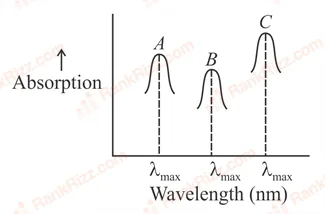
Simplified absorption spectra of three complexes ((i) and (ii) and (iii)) of M+nM^{+n} ion are provided below; their λmax\lambda_{max} values are marked as A, B and C respectively. The correct match between the complexes and their λmax\lambda_{max} values is:
Figure for JEE Main 2020 Chemistry question on Colour and magnetic behaviour of complexes from CFT
(i) [M(NCS)6](−6+n)[M(NCS)_6]^{(-6+n)}
(ii) [MF6](−6+n)[MF_6]^{(-6+n)}
(iii) [M(NH3)6]n+[M(NH_3)_6]^{n+}

  1. A

    A-(iii), (B)-(i), C-(ii)

  2. B

    A-(ii), (B)-(i), C-(iii)

  3. C

    A-(ii), (B)-(iii), C-(i)

  4. D

    A-(i), (B)-(ii), C-(iii)

JEE MAIN 2020 · 09 JAN S1Colour and magnetic behaviour of complexes from CFT

[Pd(F)(Cl)(Br)(I)]2−[Pd(F)(Cl)(Br)(I)]^{2-} has nn number of geometrical isomers. Then, the spin-only magnetic moment and crystal field stabilization energy [CFSE] of [Fe(CN)6]n−6[Fe(CN)_6]^{n-6}, respectively, are:
[Note: Ignore the pairing energy]

  1. A

    2.84 BM and −16Δ0-16\Delta_0

  2. B

    5.92 BM and 0

  3. C

    1.73 BM and −2.0Δ0-2.0\Delta_0

  4. D

    0 BM and −2.4Δ0-2.4\Delta_0

JEE MAIN 2020 · 09 JAN S2Colour and magnetic behaviour of complexes from CFT

The correct order of the spin-only magnetic moments of the following complexes is:
(I) [Cr(H2O)6]Br2[Cr(H_2O)_6]Br_2
(II) Na4[Fe(CN)6]Na_4[Fe(CN)_6]
(III) Na3[Fe(C2O4)3]Na_3[Fe(C_2O_4)_3] (Δ0>P)(\Delta_0 \gt P)
(IV) (Et4N)2[CoCl4](Et_4N)_2[CoCl_4]

  1. A

    (III)>(I)>(IV)>(II)(III) \gt (I) \gt (IV) \gt (II)

  2. B

    (III)>(I)>(II)>(IV)(III) \gt (I) \gt (II) \gt (IV)

  3. C

    (I)>(IV)>(III)>(II)(I) \gt (IV) \gt (III) \gt (II)

  4. D

    (II)≈(I)>(IV)>(III)(II) \approx (I) \gt (IV) \gt (III)

JEE MAIN 2020 · 07 JAN S1Colour and magnetic behaviour of complexes from CFT

The theory that can completely/properly explain the nature of bonding in [Ni(CO)4_4] is:

  1. A

    Werner's theory

  2. B

    Molecular orbital theory

  3. C

    Crystal field theory

  4. D

    Valence bond theory