RankRizz

Colour and magnetic behaviour of complexes from CFT — JEE Main Previous Year Questions

Colour and magnetic behaviour of complexes from CFT has been asked 145 times in JEE Main, in 17 different years between 2004 and 2026, and in all of the last five exam years (2022–2026), 102 questions in all. That is 39% of Coordination Compounds, its most-asked topic. Last asked in JEE Main 08 Apr 2026, Shift 2. 112 are multiple choice and 33 numerical-value; 13 easy, 117 medium and 8 hard by our difficulty labels. All of them are below, newest first, free to read.

Questions

145

Years asked

17

Since

2004

Of the chapter

39%

Every Colour and magnetic behaviour of complexes from CFT question

21–40 OF 145 · NEWEST FIRST

JEE MAIN 2026 · 21 JAN S2Colour and magnetic behaviour of complexes from CFT

Given below are two statements:
Statement I : Crystal Field Stabilization Energy (CFSE) of [Cr(H2O)6]2+\left[Cr\left( H_{2}O \right)_{6} \right]^{2+} is greater than that of [Mn(H2O)6]2+\left[Mn\left( H_{2}O \right)_{6} \right]^{2+}.
Statement II: Potassium ferricyanide has a greater spin-only magnetic moment than sodium ferrocyanide.
In the light of the above statements, choose the correct answer from the options given below :

  1. A

    Statement I is false but Statement II is true

  2. B

    Both Statement I and Statement II are false

  3. C

    Both Statement I and Statement II are true

  4. D

    Statement I is true but Statement II is false
JEE MAIN 2026 · 21 JAN S2Colour and magnetic behaviour of complexes from CFT

Identify the metal ions among Co2+,Ni2+,Fe2+,V3+ and Ti2+Co^{2+}, Ni^{2+}, Fe^{2+}, V^{3+} \text{ and } Ti^{2+} having a spin-only magnetic moment value more than 3.0 BM. The sum of unpaired electrons present in the high spin octahedral complexes formed by those metal ions is __________.

JEE MAIN 2026Colour and magnetic behaviour of complexes from CFT

How many of the following compounds are diamagnetic?
Ni(CO)4, [Cu(CN)4]3−, [Zn(NH3)4]2+, [Co(H2O)6]3+, K2MnO4, [Pt(en)2Cl2]+2, [Fe(EDTA)]−\mathrm{Ni(CO)_4,\ [Cu(CN)_4]^{3-},\ [Zn(NH_3)_4]^{2+},\ [Co(H_2O)_6]^{3+},\ K_2MnO_4,\ [Pt(en)_2Cl_2]^{+2},\ [Fe(EDTA)]^-}

JEE MAIN 2025 · 08 APR S2Colour and magnetic behaviour of complexes from CFT

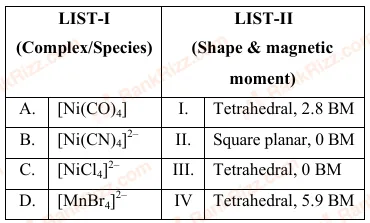
Match the LIST-I with LIST-II

Figure for JEE Main 2025 Chemistry question on Colour and magnetic behaviour of complexes from CFT

Choose the correct answer from the options given below :

  1. A

    A-III, B-IV, C-II, D-I

  2. B

    A-I, B-III, C-I, D-IV

  3. C

    A-III, B-II, C-I, D-IV

  4. D

    A-IV, B-I, C-III, D-II

JEE MAIN 2025 · 07 APR S2Colour and magnetic behaviour of complexes from CFT

The number of unpaired electrons responsible for the paramagnetic nature of the following species are respectively : [Fe(CN)6]3−[Fe(CN)_6]^{3-}, [FeF6]3−[FeF_6]^{3-}, [CoF6]3−[CoF_6]^{3-}, [Mn(CN)6]3−[Mn(CN)_6]^{3-}

  1. A

    1, 5, 4, 2

  2. B

    1, 5, 5, 2

  3. C

    1, 1, 4, 2

  4. D

    1, 4, 4, 2

JEE MAIN 2025 · 04 APR S1Colour and magnetic behaviour of complexes from CFT

Which one of the following complexes will have Δ0=0\Delta_0 = 0 and μ=5.96\mu = 5.96 B.M.?

  1. A

    [Fe(CN)6]4−[Fe(CN)_6]^{4-}

  2. B

    [CO(NH3)6]3+[CO(NH_3)_6]^{3+}

  3. C

    [FeF6]4−[FeF_6]^{4-}

  4. D

    [Mn(SCN)6]4−[Mn(SCN)_6]^{4-}

JEE MAIN 2025 · 04 APR S2Colour and magnetic behaviour of complexes from CFT

The correct order of [FeF6]3−[FeF_6]^{3-}, [CoF6]3−[CoF_6]^{3-}, [Ni(CO)4][Ni(CO)_4] and [Ni(CN)4]2−[Ni(CN)_4]^{2-} complex species based on the number of unpaired electrons present is :

  1. A

    [FeF6]3−>[CoF6]3−>[Ni(CN)4]2−>[Ni(CO)4][FeF_6]^{3-} > [CoF_6]^{3-} > [Ni(CN)_4]^{2-} > [Ni(CO)_4]

  2. B

    [Ni(CN)4]2−>[FeF6]3−>[CoF6]3−>[Ni(CO)4][Ni(CN)_4]^{2-} > [FeF_6]^{3-} > [CoF_6]^{3-} > [Ni(CO)_4]

  3. C

    [CoF6]3−>[FeF6]3−>[Ni(CO)4]>[Ni(CN)4]2−[CoF_6]^{3-} > [FeF_6]^{3-} > [Ni(CO)_4] > [Ni(CN)_4]^{2-}

  4. D

    [FeF6]3−>[CoF6]3−>[Ni(CN)4]2−=[Ni(CO)4][FeF_6]^{3-} > [CoF_6]^{3-} > [Ni(CN)_4]^{2-} = [Ni(CO)_4]

JEE MAIN 2025 · 04 APR S2Colour and magnetic behaviour of complexes from CFT

'X' is the number of electrons in t2gt_{2g} orbitals of the most stable complex ion among [Fe(NH3)6]3+[Fe(NH_3)_6]^{3+}, [Fe(Cl)6]3−[Fe(Cl)_6]^{3-}, [Fe(C2O4)3]3−[Fe(C_2O_4)_3]^{3-} and [Fe(H2O)6]3+[Fe(H_2O)_6]^{3+}. The nature of oxide of vanadium of the type V2OxV_2O_x is:

  1. A

    Acidic

  2. B

    Neutral

  3. C

    Basic

  4. D

    Amphoteric

JEE MAIN 2025 · 03 APR S1Colour and magnetic behaviour of complexes from CFT

The correct order of the complexes [Co(NH3)4(H2O)]3+[Co(NH_3)_4(H_2O)]^{3+} (A), [Co(NH3)6]3+[Co(NH_3)_6]^{3+} (B), [Co(CN)6]3−[Co(CN)_6]^{3-} (C) and [CoCl(NH3)5]2+[CoCl(NH_3)_5]^{2+} (D) in terms of wavelength of light absorbed is :

  1. A

    D>A>B>CD \gt A \gt B \gt C

  2. B

    C>B>D>AC \gt B \gt D \gt A

  3. C

    D>C>B>AD \gt C \gt B \gt A

  4. D

    C>B>A>DC \gt B \gt A \gt D

JEE MAIN 2025 · 03 APR S2Colour and magnetic behaviour of complexes from CFT

Identify the diamagnetic octahedral complex ions from below:
A. [Mn(CN)6]3−[Mn(CN)_6]^{3-}
B. [Co(NH3)6]3+[Co(NH_3)_6]^{3+}
C. [Fe(CN)6]4−[Fe(CN)_6]^{4-}
D. [Co(H2O)3F3][Co(H_2O)_3F_3]
Choose the correct answer from the options given below: 

  1. A

    B and D Only

  2. B

    A and D Only

  3. C

    A and C Only

  4. D

    B and C Only

JEE MAIN 2025 · 02 APR S1Colour and magnetic behaviour of complexes from CFT

Given below are two statements:

Statement (I): In octahedral complexes, when Δo<P\Delta_o \lt P high spin complexes are formed. When Δo>P\Delta_o \gt P low spin complexes are formed.

Statement (II): In tetrahedral complexes because of Δt<P\Delta_t \lt P, low spin complexes are rarely formed.

In the light of the above statements, choose the most appropriate answer from the options given below:

  1. A

    Statement I is correct but Statement II is incorrect.

  2. B

    Both Statement I and Statement II are incorrect

  3. C

    Statement I is incorrect but Statement II is correct

  4. D

    Both Statement I and Statement II are correct

JEE MAIN 2025 · 02 APR S1Colour and magnetic behaviour of complexes from CFT

A transition metal (M)(M) among Mn,Cr,CoMn, Cr, Co and FeFe has the highest standard electrode potential (M3+/M2+M^{3+}/M^{2+}). It forms a metal complex of the type [M(CN)6]4−[M(CN)_6]^{4-}. The number of electrons present in the ege_g orbital of the complex is ______.

JEE MAIN 2025 · 02 APR S2Colour and magnetic behaviour of complexes from CFT

The d-orbital electronic configuration of the complex among [Co(en)3]3+[Co(en)_3]^{3+}, [CoF6]3−[CoF_6]^{3-}, [Mn(H2O)6]2+[Mn(H_2O)_6]^{2+} and [Zn(H2O)6]2+[Zn(H_2O)_6]^{2+} that has the highest CFSE is :

  1. A

    t2g6eg0t_{2g}^{6}e_g^{0}

  2. B

    t2g6eg4t_{2g}^{6}e_g^{4}

  3. C

    t2g3eg2t_{2g}^{3}e_g^{2}

  4. D

    t2g4eg2t_{2g}^{4}e_g^{2}

JEE MAIN 2025 · 02 APR S2Colour and magnetic behaviour of complexes from CFT

The spin-only magnetic moment value of Mn+M^{n+} ion formed among Ni, Zn, Mn and Cu that has the least enthalpy of atomisation is _________. (in nearest integer)

Here n is equal to the number of diamagnetic complexes among K2[NiCl4]K_2[NiCl_4], [Zn(H2O)6]Cl2[Zn(H_2O)_6]Cl_2, K3[Mn(CN)6]K_3[Mn(CN)_6] and [Cu(PPh3)3I][Cu(PPh_3)_3I]

JEE MAIN 2025 · 29 JAN S1Colour and magnetic behaviour of complexes from CFT

The correct increasing order of stability of the complexes based on Δ∘\Delta_{\circ} value is: I.[Mn(CN)6]3[Mn(CN)_{6}]^{3} II.[Co(CN)6]4−[Co(CN)_{6}]^{4-} III.[Fe(CN)6]4−[Fe(CN)_{6}]^{4-} IV.[Fe(CN)6]3−[Fe(CN)_{6}]^{3-}

  1. A

    IV < III < II < I

  2. B

    I < II < IV < III

  3. C

    III < II < IV < I

  4. D

    II < III < I < IV

JEE MAIN 2025 · 29 JAN S2Colour and magnetic behaviour of complexes from CFT

Identify the homoleptic complexes with odd number of d electrons in the central metal : (A) [FeO4]2−[FeO_4]^{2-} (B) [Fe(CN)6]3−[Fe(CN)_6]^{3-} (C) [Fe(CN)5NO]2−[Fe(CN)_5NO]^{2-} (D) [CoCl4]2−[CoCl_4]^{2-} (E) [Co(H2O)3F3][Co(H_2O)_3F_3] Choose the correct answer from the options given below :

  1. A

    (A), (B) and (D) only

  2. B

    (C) and (E) only

  3. C

    (B) and (D) only

  4. D

    (A), (C) and (E) only

JEE MAIN 2025 · 29 JAN S2Colour and magnetic behaviour of complexes from CFT

The calculated spin-only magnetic moments of K3[Fe(OH)6]K_3[Fe(OH)_6] and K4[Fe(OH)6]K_4[Fe(OH)_6] respectively are :

  1. A

    3.87 and 4.90 B.M.

  2. B

    4.90 and 5.92 B.M.

  3. C

    4.90 and 4.90 B.M.

  4. D

    5.92 and 4.90 B.M.

JEE MAIN 2025 · 29 JAN S2Colour and magnetic behaviour of complexes from CFT

Consider the following low-spin complexes K3[Co(NO2)6]K_3[Co(NO_2)_6],   K4[Fe(CN)6]\; K_4[Fe(CN)_6],   K3[Fe(CN)6]\; K_3[Fe(CN)_6],   Cu2[Fe(CN)6]andZn2[Fe(CN)6]\; Cu_2[Fe(CN)_6] and Zn_2[Fe(CN)_6] The sum of the spin-only magnetic moment values of
complexes having yellow colour is. _____ B.M. (answer in nearest integer)

JEE MAIN 2025 · 24 JAN S2Colour and magnetic behaviour of complexes from CFT

When Ethane-1,2-diamine is added progressively to an aqueous solution of Nickel (II) chloride, the sequence of colour change observed will be :

  1. A

    Violet→Blue→Pale Blue→Green\text{Violet} \rightarrow \text{Blue} \rightarrow \text{Pale Blue} \rightarrow \text{Green}

  2. B

    Pale Blue→Blue→Green→Violet\text{Pale Blue} \rightarrow \text{Blue} \rightarrow \text{Green} \rightarrow \text{Violet}

  3. C

    Green→Pale Blue→Blue→Violet\text{Green} \rightarrow \text{Pale Blue} \rightarrow \text{Blue} \rightarrow \text{Violet}

  4. D

    Pale Blue→Blue→Violet→Green\text{Pale Blue} \rightarrow \text{Blue} \rightarrow \text{Violet} \rightarrow \text{Green}

JEE MAIN 2025 · 24 JAN S2Colour and magnetic behaviour of complexes from CFT

{The conditions and consequence that favours the  t2ggeg1t_{2gg} e_g^1  configuration in a metal complex are:

  1. A

    weak field ligand, low spin complex

  2. B

    weak field ligand, high spin complex

  3. C

    strong field ligand, high spin complex

  4. D

    strong field ligand, low spin complex