RankRizz

Gibbs energy and spontaneity — JEE Main Previous Year Questions

Gibbs energy and spontaneity has been asked 54 times in JEE Main, in 16 different years between 2007 and 2026, and in all of the last five exam years (2022–2026), 27 questions in all. That is 24% of Chemical Thermodynamics, one of its three most-asked topics. Last asked in JEE Main 06 Apr 2026, Shift 1. 31 are multiple choice and 23 numerical-value; 25 easy, 23 medium and 2 hard by our difficulty labels. All of them are below, newest first, free to read.

Questions

54

Years asked

16

Since

2007

Of the chapter

24%

Every Gibbs energy and spontaneity question

41–54 OF 54 · NEWEST FIRST

JEE MAIN 2019 · 10 JAN S1Gibbs energy and spontaneity

A process has ΔH=200\Delta H = 200 J mol−1^{-1} and ΔS=40\Delta S = 40 J K−1^{-1} mol−1^{-1}. Out of the values given below choose the minimum temperature above which the process will be spontaneous:

  1. A

    20 K

  2. B

    5 K

  3. C

    12 K

  4. D

    4 K

JEE MAIN 2018 · 16 APR ONLINEGibbs energy and spontaneity

For which of the following processes, ΔS\Delta S is negative?

  1. A

    C (diamond) →\rightarrow C (graphite)

  2. B

    N2_2(g, 1 atm) →\rightarrow N2_2(g, 5 atm)

  3. C

    N2_2(g, 273K) →\rightarrow N2_2(g, 300K)

  4. D

    H2_2(g) →\rightarrow 2H(g)

JEE MAIN 2018 · 15 APR S2Gibbs energy and spontaneity

ΔrG∘\Delta_r G^\circ at 500 K for substance 'S' in liquid state and gaseous state are +100.7 kcal mol−1^{-1} and +103 kcal mol−1^{-1}, respectively. Vapour pressure of liquid 'S' at 500 K is approximately equal to: (R = 2 cal K−1^{-1} mol−1^{-1})

  1. A

    100 atm

  2. B

    1 atm

  3. C

    10 atm

  4. D

    0.1 atm

JEE MAIN 2018 · 15 APR S2Gibbs energy and spontaneity

Given (i) 2Fe2_2O3_3(s) →\rightarrow 4Fe(s) + 3O2_2(g); ΔrG∘\Delta_r G^\circ = +1487.0 kJ mol−1^{-1}
(ii) 2CO(g) + O2_2(g) →\rightarrow 2CO2_2(g); ΔrG∘\Delta_r G^\circ = -514.4 kJ mol−1^{-1}
Free energy change, ΔrG∘\Delta_r G^\circ for the reaction 2Fe2_2O3_3(s) + 6CO(g) →\rightarrow 4Fe(s) + 6CO2_2(g) will be:

  1. A

    -112.4 kJ mol−1^{-1}

  2. B

    -56.2 kJ mol−1^{-1}

  3. C

    -208.0 kJ mol−1^{-1}

  4. D

    -168.2 kJ mol−1^{-1}

JEE MAIN 2016 · 09 APR ONLINEGibbs energy and spontaneity

For the reaction,
A(g)+B(g)→C(g)+D(g)A(g) + B(g) \to C(g) + D(g), ΔH°\Delta H° and ΔS°\Delta S° are, respectively, −29.8-29.8 kJ mol−1^{-1} and −0.100-0.100 kJ K−1^{-1} mol−1^{-1} at 298 K. The equilibrium constant for the reaction at 298 K is:

  1. A

    1.0×10−101.0 \times 10^{-10}

  2. B

    10

  3. C

    1

  4. D

    1.0×10101.0 \times 10^{10}

JEE MAIN 2016 · 09 APR ONLINEGibbs energy and spontaneity

A reaction at 1 bar is non-spontaneous at low temperature but becomes spontaneous at high temperature. Identify the correct statement about the reaction among the following:

  1. A

    ΔH\Delta H is negative while ΔS\Delta S is positive

  2. B

    Both ΔH\Delta H and ΔS\Delta S are negative

  3. C

    ΔH\Delta H is positive while ΔS\Delta S is negative

  4. D

    Both ΔH\Delta H and ΔS\Delta S are positive

JEE MAIN 2016 · 09 APR ONLINEGibbs energy and spontaneity

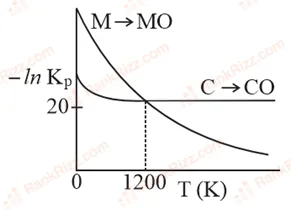
The plot shows the variation of −ln⁡KP-\ln K_P versus temperature for the two reactions.
M(s)+12O2(g)→MO(s)M(s) + \frac{1}{2}O_2(g) \to MO(s) and
C(s)+12O2(g)→CO(s)C(s) + \frac{1}{2}O_2(g) \to CO(s)

Figure for JEE Main 2016 Chemistry question on Gibbs energy and spontaneity


Identify the correct statement:

  1. A

    At T < 1200 K, oxidation of carbon is unfavourable

  2. B

    Oxidation of carbon is favourable at all temperatures

  3. C

    At T < 1200 K, the reaction MO(s)+C(s)→M(s)+CO(g)MO(s) + C(s) \to M(s) + CO(g) is spontaneous

  4. D

    At T > 1200 K, carbon will reduce MO(s)MO_{(s)} to M(s)M_{(s)}.

JEE MAIN 2015 · 04 APR OFFLINEGibbs energy and spontaneity

The following reaction is performed at 298 K.
2NO(g)+O2(g)⇌2NO2(g)2NO(g) + O_2(g) \rightleftharpoons 2NO_2(g)
The standard free energy of the formation of NO(g)NO(g) is 86.6 kJ mol−1^{-1} at 298 K. What is the standard free energy of the formation of NO2(g)NO_2(g) at 298 K? (KP=1.6×10¹²)(K_P = 1.6 \times 10^{12})

  1. A

    0.5[2×86,600−R(298)ln⁡(1.6×10¹²)]0.5[2 \times 86,600 - R(298)\ln(1.6 \times 10^{12})]

  2. B

    R(298)ln⁡(1.6×10¹²)−86,600R(298)\ln(1.6 \times 10^{12}) - 86,600

  3. C

    86,600+R(298)ln⁡(1.6×10¹²)86,600 + R(298)\ln(1.6 \times 10^{12})

  4. D

    86,600−ln⁡(1.6×10¹²)R(298)86,600 - \frac{\ln(1.6 \times 10^{12})}{R(298)}

JEE MAIN 2014 · 12 APR ONLINEGibbs energy and spontaneity

The (S°) of the following substances are: CH4_4(g) 186.2 JK−1^{-1} mol−1^{-1}, O2_2(g) 205.2 JK−1^{-1} mol−1^{-1}, CO2_2(g) 213.6 JK−1^{-1} mol−1^{-1}, H2_2O(g) 69.9 JK−1^{-1} mol−1^{-1}. The entropy change (ΔS∘\Delta S^\circ) for the reaction CH4_4(g) + 2O2_2(g) →\rightarrow CO2_2(g) + 2H2_2O(l) is:

  1. A

    −312.5-312.5 J K−1^{-1} mol−1^{-1}

  2. B

    −242.8-242.8 JK−1^{-1} mol−1^{-1}

  3. C

    −108.1-108.1 JK−1^{-1} mol−1^{-1}

  4. D

    −37.6-37.6 J K−1^{-1} mol−1^{-1}

JEE MAIN 2014 · 11 APR ONLINEGibbs energy and spontaneity

The molar heat capacity (Cp_p) of CD2_2O is 10 cals at 1000 K. The change of entropy associated with cooling of 32 g of CD2_2O vapour from 1000 K to 100 K at constant pressure will be: (D = deuterium, atomic mass = 2u)

  1. A

    23.03 cal deg−1^{-1}

  2. B

    −23.03-23.03 cal deg−1^{-1}

  3. C

    2.303 cal deg−1^{-1}

  4. D

    −2.303-2.303 cal deg−1^{-1}

JEE MAIN 2012Gibbs energy and spontaneity

The incorrect expression among the following is :

  1. A

    ΔGsystemΔStotal=−T\frac{\Delta G_{system}}{\Delta S_{total}} = -T

  2. B

    In isothermal process wreversible=−nRTln⁡VfViw_{reversible} = -nRT \ln \frac{V_f}{V_i}

  3. C

    ln⁡K=ΔH0−TΔS0RT\ln K = \frac{\Delta H^0 - T\Delta S^0}{RT}

  4. D

    K=e−ΔG0/RTK = e^{-\Delta G^0/RT}

JEE MAIN 2010Gibbs energy and spontaneity

For a particular reversible reaction at temperature TT, ΔH\Delta H and ΔS\Delta S were found to be both +ve+ve. If TeT_e is the temperature at equilibrium, the reaction would be spontaneous when

  1. A

    Te>TT_e > T

  2. B

    T>TeT > T_e

  3. C

    TeT_e is 5 times TT

  4. D

    T=TeT = T_e

JEE MAIN 2008Gibbs energy and spontaneity

Standard entropy of X2,Y2X_2, Y_2 and XY3XY_3 are 60, 40 and 50 JK−1 mol−1JK^{-1}\ mol^{-1}, respectively. For the reaction, 12X2+32Y2→XY3, ΔH=−30 kJ\frac{1}{2}X_2 + \frac{3}{2}Y_2 \to XY_3,\ \Delta H = -30\ kJ, to be at equilibrium, the temperature will be

  1. A

    1250 K

  2. B

    500 K

  3. C

    750 K

  4. D

    1000 K

JEE MAIN 2007Gibbs energy and spontaneity

In conversion of lime-stone to lime, CaCO3(s)⟶CaO(s)+CO2(g)CaCO_3(s) \longrightarrow CaO(s) + CO_2(g) the values of ΔH∘\Delta H^\circ and ΔS∘\Delta S^\circ are +179.1+179.1 kJ mol−1mol^{-1} and 160.2 J/K respectively at 298 K and 1 bar. Assuming that ΔH∘\Delta H^\circ do not change with temperature, temperature above which conversion of limestone to lime will be spontaneous is

  1. A

    1008 K

  2. B

    1200

  3. C

    845 K

  4. D

    1118 K