For complete combustion of ethene,
the amount of heat produced as measured in bomb calorimeter is 1406 kJ mol at 300 K. The minimum value of TS needed to reach equilibrium is () kJ. (Nearest integer)
Given: R = 8.3 J K mol
Gibbs energy and spontaneity has been asked 54 times in JEE Main, in 16 different years between 2007 and 2026, and in all of the last five exam years (2022–2026), 27 questions in all. That is 24% of Chemical Thermodynamics, one of its three most-asked topics. Last asked in JEE Main 06 Apr 2026, Shift 1. 31 are multiple choice and 23 numerical-value; 25 easy, 23 medium and 2 hard by our difficulty labels. All of them are below, newest first, free to read.
Questions
54
Years asked
16
Since
2007
Of the chapter
24%
21–40 OF 54 · NEWEST FIRST
For complete combustion of ethene,
the amount of heat produced as measured in bomb calorimeter is 1406 kJ mol at 300 K. The minimum value of TS needed to reach equilibrium is () kJ. (Nearest integer)
Given: R = 8.3 J K mol
The value of log K for the reaction A B at 298 K is ______. (Nearest integer)
Given: kJ mol, J K mol
(Taken )
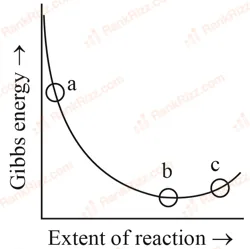
Consider the graph of Gibbs free energy G vs extent of reaction. The number of statement/s from the following which are true with respect to points (a), (b) and (c) is ______
A. Reaction is spontaneous at (a) and (b)
B. Reaction is at equilibrium at point (b) and non-spontaneous at point (c)
C. Reaction is spontaneous at (a) and non-spontaneous at (c)
D. Reaction is non-spontaneous at (a) and (b)
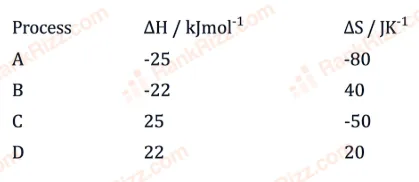
For independent process at 300 K.
The number of non-spontaneous process from the following is _____.
For independent process at 300 K.
| Process | / kJmol | / JK |
|---|---|---|
| A | -25 | -80 |
| B | -22 | 40 |
| C | 25 | -50 |
| D | 22 | 20 |
Given below are two statements: One is labelled as Assertion A and the other is labelled as Reason R
Assertion A: The reduction of a metal oxide is easier if the metal formed is in liquid state than solid state.
Reason R: The value of becomes more on negative side as entropy is higher in liquid state than solid state.
In the light of the above statements, choose the most appropriate answer from the options given below
Both A and R are correct and R is the correct explanation of A
Both A and R are correct but R is NOT the correct explanation of A
A is correct but R is not correct
A is not correct but R is correct
The standard entropy change for the reaction
is J K at K
[Given : The standard enthalpy change for the reaction is kJ mol]. The temperature in K at which the reaction attains equilibrium is (Nearest Integer) ______
For the reaction 2NO(g) NO(g), when J K and kJ mol the magnitude of at 298 K for the reaction is _________ kJ mol. (Nearest integer)
The incorrect expression among the following is:
For isothermal process
(at constant P)
Data given for the following reaction is as follows:
FeO + C Fe + CO
Substance (kJ mol) (J mol K)
FeO -266.3 57.49
C 0 5.74
Fe 0 27.28
CO -110.5 197.6
The minimum temperature in K at which the reaction becomes spontaneous is _________. (Integer answer)
For a given chemical reaction A B at 300 K the free energy change is -49.4 kJ mol and the enthalpy of reaction is 51.4 kJ mol. The entropy change of the reaction is ___ JK mol.
During which of the following processes, does entropy decrease?
(A) Freezing of water to ice at 0°C
(B) Freezing of water to ice at -10°C
(C) N(g) + 3H(g) 2NH(g)
(D) Adsorption of CO(g) and lead surface
(E) Dissolution of NaCl in water
(A), (B), (C) and (D) only
(B) and (C) only
(A) and (E) only
(A), (C) and (E) only
Assuming ideal behaviour, the magnitude of log K for the following reaction at 25°C is . The value of x is ______. (Integer answer)
[Given: J mol; J mol; R = 8.314 J K mol]
For a dimerization reaction,
at 298K, , , then the will be .....J.
For the reaction:
A(l) 2B(g)
kcal, cal K at 300K.
Hence in kcal is
A process will be spontaneous at all temperatures if:
and
and
and
and
For the chemical reaction , the standard reaction Gibbs energy depends on temperature T (in K) as (in kJ mol) . The major component of the reaction mixture at T is:
Y if T = 300 K
Y if T = 280 K
X if T = 350 K
X if T = 315 K
The reaction , for which kJ mol and JK mol is not feasible at 298 K. Temperature above which reaction will be feasible is
2040.5 K
1890.0 K
2480.3 K
2380.5 K
The standard reaction Gibbs energy for a chemical reaction at an absolute temperature T is given by where A and B are non-zero constants. Which of the following is true about this reaction?
Exothermic if
Endothermic if
Endothermic if and
Exothermic if and
For the equilibrium ; the value of at 298 K is approximately:
100 kJ mol
kJ mol
80 kJ mol
kJ mol