JEE MAIN 2024 · 04 APR S2First law: work, heat and internal energy
Three moles of an ideal gas are compressed isothermally from L to L using constant pressure of atm. Heat exchange for the compression is ______ Lit. atm.
First law: work, heat and internal energy has been asked 55 times in JEE Main, in 14 different years between 2004 and 2026, and in all of the last five exam years (2022–2026), 34 questions in all. That is 24% of Chemical Thermodynamics, one of its three most-asked topics. Last asked in JEE Main 06 Apr 2026, Shift 2. 31 are multiple choice and 24 numerical-value; 31 easy and 19 medium by our difficulty labels. All of them are below, newest first, free to read.
Questions
55
Years asked
14
Since
2004
Of the chapter
24%
21–40 OF 55 · NEWEST FIRST
Three moles of an ideal gas are compressed isothermally from L to L using constant pressure of atm. Heat exchange for the compression is ______ Lit. atm.
Choose the correct option for free expansion of an ideal gas under adiabatic condition from the following :
If 5 moles of an ideal gas expands from 10 L to a volume of 100 L at 300 K under isothermal and reversible condition then work, , is J. The value of is (Given J K mol)
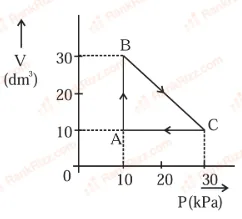
An ideal gas undergoes a cyclic transformation starting from the point and coming back to the same point by tracing the path as shown in the diagram. The total work done in the process is _____ J.
If three moles of an ideal gas at K expand isothermally from to against a constant opposing pressure of kPa, then the amount of heat transferred is _________ J.
When a 60 W electric heater is immersed in a gas for 100 s in a constant volume container with adiabatic walls, the temperature of the gas rises by 5°C. The heat capacity of the given gas is JK (Nearest integer)
When 2 litre of ideal gas expands isothermally into vacuum to a total volume of 6 litre, the change in internal energy is ______ J. (Nearest integer)
1 mole of ideal gas is allowed to expand reversibly and adiabatically from a temperature of C. The work done is kJ mol. The final temperature of the gas is ______ K (Nearest integer). Given J mol K
One mole of an ideal monoatomic gas is subjected to changes as shown in the graph. The magnitude of the work done (by the system or on the system) is _____ J (nearest integer)
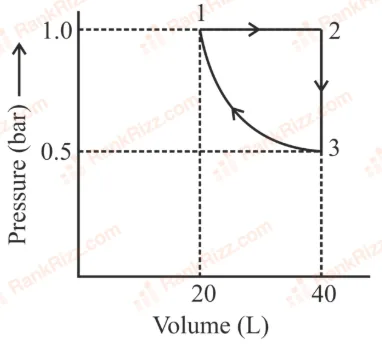
Given: log 2 = 0.3, ln 10 = 2.3
The molar heat capacity for an ideal gas at constant pressure is . The change in internal energy is upon heating it from to . The number of moles of the gas at constant volume is ______ (Given: )
A gas (Molar mass = 280 g mol) was burnt in excess in a constant volume calorimeter and during combustion the temperature of calorimeter increased from 298.0 K to 298.45 K. If the heat capacity of calorimeter is 2.5 kJ K and enthalpy of combustion of gas is 9 kJ mol then amount of gas burnt is _____ g.
2.2 g of nitrous oxide (NO) gas is cooled at a constant pressure of 1 atm from 310 K to 270 K causing the compression of the gas from 217.1 mL to 167.75 mL. The change in internal energy of the process, U is '-x'J. The value of 'x' is ______.
[nearest integer]
(Given: atomic mass of N = 14 g mol and of O = 16 g mol. Molar heat capacity of NO is 100 JK mol)
L of an ideal gas is allowed to expand isothermally into vacuum until the total volume is L. The amount of heat absorbed in this expansion is ______ L atm.
A fish swimming in water body when taken out from the water body is covered with a film of water of weight g. When it is subjected to cooking at C, then the internal energy for vaporization in kJ mol is ______ [integer]
[Assume steam to be an ideal gas. Given for water at K and bar is kJ mol : J K mol]
A system does 200 J of work and at the same time absorbs 150 J of heat. The magnitude of the change in internal energy is _________J. (Nearest integer)
At 25°C, 50 g of iron reacts with HCl to form . The evolved hydrogen gas expands against a constant pressure of 1 bar. The work done by the gas during this expansion is ________ J. (Round off to the Nearest Integer)
[Given: J mol K. Assume, hydrogen is an ideal gas]
[Atomic mass of Fe is 55.85 u]
The reaction of cyanamide, with oxygen was run in a bomb calorimeter and was found to be kJ mol. The magnitude of for the reaction
is ______ kJ. (Rounded off to the nearest integer) [Assume ideal gases and R = 8.314 J mol K]
Five moles of an ideal gas at 293 K is expanded isothermally from an initial pressure of 2.1 MPa to 1.3 MPa against at constant external pressure 4.3 MPa. The heat transferred in this process is ______ kJ mol.
(Rounded-off to the nearest integer)
[Use J mol K]
Five moles of an ideal gas at 1 bar and 298 K is expanded into vacuum to double the volume. The work done is:
Zero
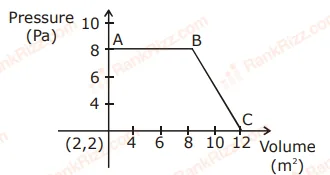
The magnitude of work done by a gas that undergoes a reversible expansion along the path ABC shown in the figure is __________.