Moving Charges & Magnetism JEE Advanced PYQs with answer key
PHYSICS · 38 PAST QUESTIONS · 7 TOPICS · 2007–2026
HOW TO USE THIS SHEET
Every JEE Advanced Moving Charges & Magnetism question we hold, grouped by topic, most-asked topic first and newest first inside each. The answer key is at the end (35 of 38 questions have a checked key); the worked solution is on each question’s page, printed beside it.
Motion of charged particles in a magnetic field 15
In a vacuum chamber, a particle of charge and mass is projected with a velocity from the plane at time in an electric field of . At , the electric field is switched off and a magnetic field of is switched on. The acceleration due to gravity is . Correct option(s) is/are:
- (A)
The vertical distance of the particle from the plane at is .
- (B)
The vertical distance of the particle from the plane at is .
- (C)
The radius of the trajectory of the particle for is .
- (D)
The particle will be in the plane at .
rr2.rankrizz.com/jee-advanced/physics/moving-charges-and-magnetism/q/2026-paper-2-q6
- (A)
A positive, singly ionized atom of mass number is accelerated from rest by the voltage 192 V. Thereafter, it enters a rectangular region of width with magnetic field Tesla, as shown in the figure. The ion finally hits a detector at the distance below its starting trajectory.
[Given: Mass of neutron/proton kg, charge of the electron C.]
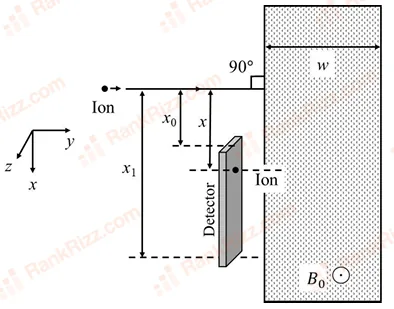
Which of the following option(s) is(are) correct?
- (A)
The value of for ion is 4 cm.
- (B)
The value of for an ion with is 48 cm.
- (C)
For detecting ions with , the minimum height of the detector is 55 cm.
- (D)
The minimum width of the region of the magnetic field for detecting ions with is 56 cm.
rr2.rankrizz.com/jee-advanced/physics/moving-charges-and-magnetism/q/2024-paper-2-q24
- (A)
An -particle (mass 4 amu) and a singly charged sulfur ion (mass 32 amu) are initially at rest. They are accelerated through a potential V and then allowed to pass into a region of uniform magnetic field which is normal to the velocities of the particles. Within this region, the -particle and the sulfur ion move in circular orbits of radii and , respectively. The ratio is ___.
Answer: ____________
rr2.rankrizz.com/jee-advanced/physics/moving-charges-and-magnetism/q/2021-paper-1-q36
The relation between and is
- (A)
- (B)
- (C)
- (D)
rr2.rankrizz.com/jee-advanced/physics/moving-charges-and-magnetism/q/2018-paper-1-q16
- (A)
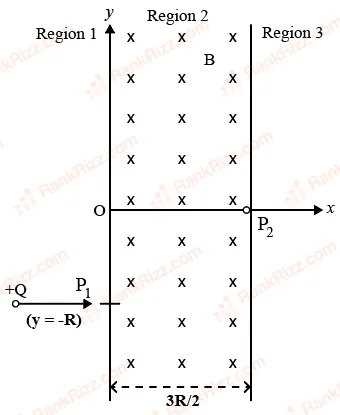
A uniform magnetic field B exists in the region between and (region 2 in the figure) pointing normally into the plane of the paper. A particle with charge and momentum directed along x-axis enters region 2 from region 1 at point .Which of the following option(s) is/are correct?
- (A)
For , the particle will re-enter region 1
- (B)
For , the particle will enter region 3 through the point on x-axis
- (C)
When the particle re-enters region 1 through the longest possible path in region 2,the magnitude of the change in its linear momentum between point and the farthest point from axis is
- (D)
For a fixed B, particles of same charge Q and same velocity V, the distance between the point and the point of re-entry into region 1 is inversely proportional to the mass of the particle
rr2.rankrizz.com/jee-advanced/physics/moving-charges-and-magnetism/q/2017-paper-2-q8
- (A)
In which case will the particle move in a straight line with constant velocity?
- (A)
(III) (ii) (R)
- (B)
(IV) (i) (S)
- (C)
(III) (iii) (P)
- (D)
(II) (iii) (S)
rr2.rankrizz.com/jee-advanced/physics/moving-charges-and-magnetism/q/2017-paper-1-q13
- (A)
In which case will the particle describe a helical path with axis along the positive z direction?
- (A)
(IV) (i) (S)
- (B)
(II) (ii) (R)
- (C)
(III) (iii) (P)
- (D)
(IV) (ii) (R)
rr2.rankrizz.com/jee-advanced/physics/moving-charges-and-magnetism/q/2017-paper-1-q14
- (A)
In which case would the particle move in a straight line along the negative direction of y-axis (i.e., move along )?
- (A)
(II) (iii) (Q)
- (B)
(III) (ii) (R)
- (C)
(IV) (ii) (S)
- (D)
(III) (ii) (P)
rr2.rankrizz.com/jee-advanced/physics/moving-charges-and-magnetism/q/2017-paper-1-q15
- (A)
Consider two different metallic strips (1 and 2) of the same material. Their lengths are the same, widths are and and thicknesses are and , respectively. Two points K and M are symmetrically located on the opposite faces parallel to the x-y plane (see figure). and are the potential differences between K and M instrips 1 and 2, respectively. Then,for a given current I flowing through them in a given magnetic field strength B, the correct statement(s) is(are)
- (A)
If and , then
- (B)
If and , then
- (C)
If and , then
- (D)
If and , then
rr2.rankrizz.com/jee-advanced/physics/moving-charges-and-magnetism/q/2015-paper-2-q17
- (A)
Consider two different metallic strips (1 and 2) of same dimensions (length l, width w and thickness d) with carrier densities and , respectively. Strip 1 is placed in magnetic field and strip 2 is placed in magnetic field both along positive y-directions. Then and are the potential differences developed between K and M in strips 1 and 2, respectively. Assuming that the current I is the same for both the strips, the correct option(s) is(are)
- (A)
If and , then
- (B)
If and , then
- (C)
If and , then
- (D)
If and , then
rr2.rankrizz.com/jee-advanced/physics/moving-charges-and-magnetism/q/2015-paper-2-q18
- (A)
Two parallel wires in the plane of the paper are distance apart. A point charge is moving with speed u between the wires in the same plane at a distance from one of the wires. When the wires carry current of magnitude I in the same direction, the radius of curvature of the path of the point charge is . In contrast, if the currents I in the two wires have directions opposite to each other, the radius of curvature of the path is . If the value of is
Answer: ____________
rr2.rankrizz.com/jee-advanced/physics/moving-charges-and-magnetism/q/2014-paper-1-q14
A particle of mass M and positive charge Q, moving with a constant velocity , enters a region of uniform static magnetic field normal to the x-y plane. The region of the magnetic field extends from x = 0 to x = L for all values of y. After passing through this region, the particle emerges on the other side after 10 milliseconds with a velocity . The correct statement(s) is (are)
- (A)
The direction of the magnetic field is —z direction.
- (B)
The direction of the magnetic field is +z direction.
- (C)
The magnitude of the magnetic field units.
- (D)
The magnitude of the magnetic field is units.
rr2.rankrizz.com/jee-advanced/physics/moving-charges-and-magnetism/q/2013-paper-1-q13
- (A)
Consider the motion of a positive point charge in a region where there are simultaneous uniform electric and magnetic fields and . At time t = 0, this charge has velocity in the x-y plane, making an angle with the x-axis. Which of the following option(s) is (are) correct for time t > 0?
- (A)
if , the charge moves in circular path in the x-z plane.
- (B)
If , the charge undergoes helical motion with constant pitch along the y-axis.
- (C)
If , the charge undergoes helical motion with its pitch increasing with time, along the y-axis.
- (D)
If , the charge undergoes linear but accelerated motion along the y-axis.
rr2.rankrizz.com/jee-advanced/physics/moving-charges-and-magnetism/q/2012-paper-1-q14
- (A)
An electron and a proton are moving on straight parallel paths with same velocity. They enter a semi-infinite region of uniform magnetic field perpendicular to the velocity. Which of the following statement(s) is/are true ?
- (A)
They will never come out of the magnetic field region
- (B)
They will come out traveling along parallel paths
- (C)
They will come out at the same time
- (D)
They will come out at different times
rr2.rankrizz.com/jee-advanced/physics/moving-charges-and-magnetism/q/2011-paper-1-q33
- (A)
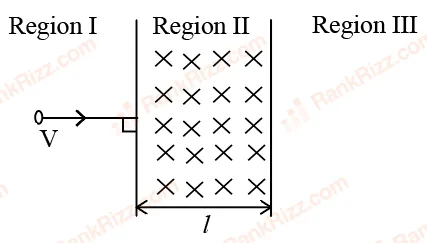
A particle of mass m and charge q, moving with velocity V enters Region II normal to the boundary as shown in the figure. Region II has a uniform magnetic field B perpendicular to the plane of the paper. The length of the Region II is l. Choose the correct choice(s).
- (A)
The particle enters Region III only if its velocity
- (B)
The particle enters Region III only if its velocity
- (C)
Path length of the particle in Region IJ is maximum when velocity
- (D)
Time spent in Region II is same for any velocity V as long as the particle returns to Region I
rr2.rankrizz.com/jee-advanced/physics/moving-charges-and-magnetism/q/2008-paper-1-q32
- (A)
Magnetic field of circular loops, arcs and coils 7
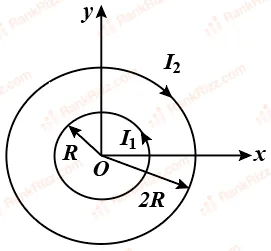
Two concentric circular loops, one of radius R and the other of radius 2R, lie in the xy-plane with the origin as their common center, as shown in the figure. The smaller loop carries current in the anti-clockwise direction and the larger loop carries current in the clockwise direction, with denotes the magnetic field at a point (x, y) in the xy-plane. Which of the following statement(s) is(are) correct?
- (A)
is perpendicular to the xy-plane at any point in the plane
- (B)
depends on x and y only through the radial distance
- (C)
is non-zero at all points for r < R
- (D)
points normally outward from the xy-plane for all the points between the two loops
rr2.rankrizz.com/jee-advanced/physics/moving-charges-and-magnetism/q/2021-paper-2-q25
- (A)
Two infinitely long straight wires lie in the 𝑥𝑦-plane along the lines 𝑥 =𝑅. The wire located at 𝑥 = 𝑅 carries a constant current and the wire located at 𝑥 = −𝑅 carries a constant current . A circular loop of radius 𝑅 is suspended with its centre at (0, 0, ) and in a plane parallel to the 𝑥𝑦-plane. This loop carries a constant current 𝐼 in the clockwise direction as seen from above the loop. The current in the wire is taken to be positive if it is in the + direction. Which of the following statements regarding the magnetic field is (are) true?
- (A)
If , then cannot be equal to zero at the origin (0, 0, 0)
- (B)
If , then can be equal to zero at the origin (0, 0, 0)
- (C)
If , then can be equal to zero at the origin (0, 0, 0)
- (D)
If , then the z-component of the magnetic field at the centre of the loop is
rr2.rankrizz.com/jee-advanced/physics/moving-charges-and-magnetism/q/2018-paper-1-q5
- (A)
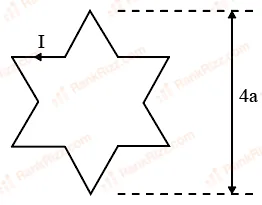
A symmetric star shaped conducting wire loop is carrying a steady state current I as shown in the figure. The distance between the diametrically opposite vertices of the star is . The magnitude of the magnetic field at the center of the loop is
- (A)
- (B)
- (C)
- (D)
rr2.rankrizz.com/jee-advanced/physics/moving-charges-and-magnetism/q/2017-paper-2-q4
- (A)
When but wires are not touching the loop, it is found that the net magnetic field on the axis of the loop is zero at a height h above the loop. In that case
- (A)
current in wire 1 and wire 2 is the direction PQ and RS, respectively and
- (B)
current in wire 1 and wire 2 is the direction PQ and SR, respectively and
- (C)
current in wire 1 and wire 2 is the direction PQ and SR, respectively and
- (D)
current in wire 1 and wire 2 is the direction PQ and RS, respectively and
rr2.rankrizz.com/jee-advanced/physics/moving-charges-and-magnetism/q/2014-paper-2-q15
- (A)
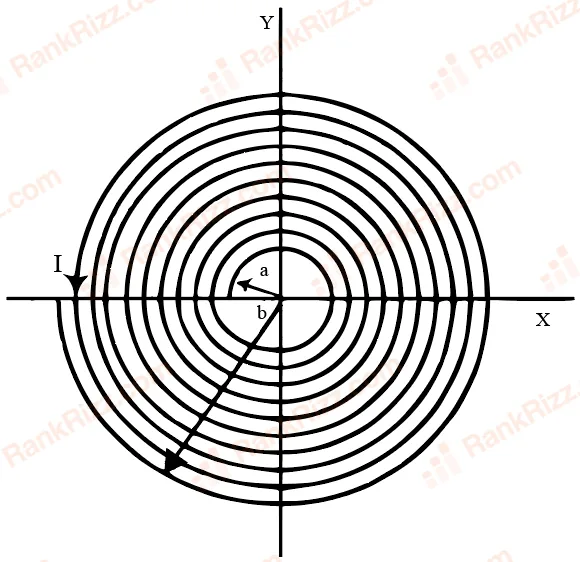
A long insulated copper wire is closely wound asa spiral of ‘N’ turns. The spiral has inner radius ‘a’ and outer radius ‘b’. The spiral lies in the X-Y plane and a steady current ‘I’ flows through the wire. The Z-component of the magnetic field at the center of the spiral is
- (A)
- (B)
- (C)
- (D)
rr2.rankrizz.com/jee-advanced/physics/moving-charges-and-magnetism/q/2011-paper-2-q23
- (A)
A steady current I goes through a wire loop PQR having shape of a right angle triangle with PQ = 3x, PR = 4x and QR = 5x. If the magnitude of the magnetic field at P due to this loop is , find the value of k.
Answer: ____________
rr2.rankrizz.com/jee-advanced/physics/moving-charges-and-magnetism/q/2009-paper-2-q54
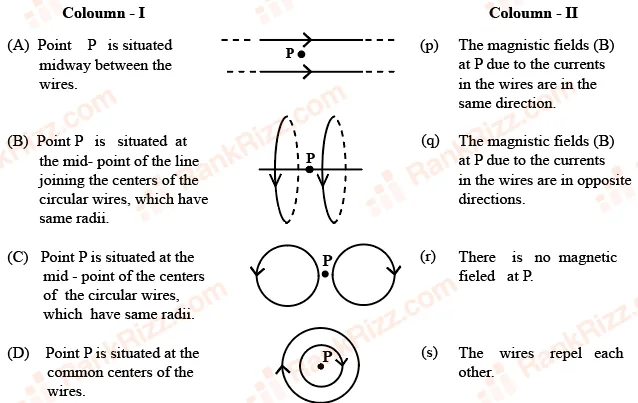
Two wires each carrying a steady current J are shown in four configurations in Column I. Some of the resulting effects are described in Column II. Match the statements in Column I with the statements in Column II and indicate your answer by darkening appropriate bubbles in the matrix given in the ORS.
rr2.rankrizz.com/jee-advanced/physics/moving-charges-and-magnetism/q/2007-paper-2-q21
Force on current-carrying conductors and between parallel wires 5
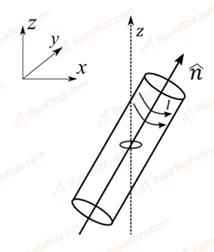
A small circular loop of area and resistance is fixed on a horizontal -plane with the center of the loop always on the axis of a long solenoid. The solenoid has turns per unit length and carries current counterclockwise as shown in the figure. The magnetic field due to the solenoid is in direction. List-I gives time dependences of in terms of a constant angular frequency .
List-II gives the torques experienced by the circular loop at time . Let .
List-I List-II (I) (P) 0 (II) (Q) (III) (R) (IV) (S) Which one of the following options is correct? (T) - (A)
I Q, II P, III S, IV T
- (B)
I S, II T, III Q, IV P
- (C)
I Q, II P, III S, IV R
- (D)
I T, II Q, III P, IV R
rr2.rankrizz.com/jee-advanced/physics/moving-charges-and-magnetism/q/2022-paper-1-q33
- (A)
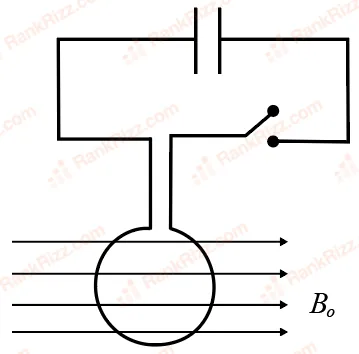
A circular coil of radius R and N turns has negligible resistance. As shown in the schematic figure, its two ends are connected to two wires and it is hanging by those wires with its plane being vertical. The wires are connected to a capacitor with charge Q through a switch. The coil is in a horizontal uniform magnetic field parallel to the plane of the coil. When the switch is closed, the capacitor gets discharged through the coil in a very short time. By the time the capacitor is discharged fully, magnitude of the angular momentum gained by the coil will be (assume that the discharge time is so short that the coil has hardly rotated during this time)
- (A)
- (B)
- (C)
- (D)
rr2.rankrizz.com/jee-advanced/physics/moving-charges-and-magnetism/q/2020-paper-1-q4
- (A)
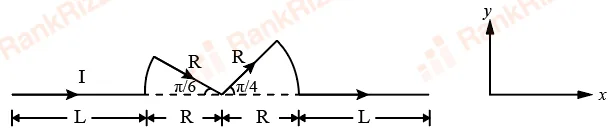
A conductor (shown in the figure) carrying constant current I is kept in the x-y plane in a uniform magnetic field . If F is the magnitude of the total magnetic force acting on the conductor, then the correct statement(s) is(are)
- (A)
If is along
- (B)
If is along
- (C)
If is along
- (D)
If is along
rr2.rankrizz.com/jee-advanced/physics/moving-charges-and-magnetism/q/2015-paper-1-q15
- (A)
Consider , and the loop is rotated about its diameter parallel to the wires by from the position shown in the figure. If the currents in the wires are in the opposite directions, the torque on the loop at its new position will be (assume that the net field due to the wires is constant over the loop)
- (A)
- (B)
- (C)
- (D)
rr2.rankrizz.com/jee-advanced/physics/moving-charges-and-magnetism/q/2014-paper-2-q16
- (A)
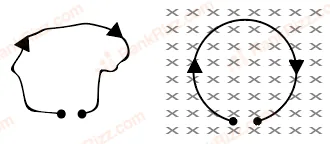
A thin flexible wire of length L is connected to two adjacent fixed points and carries a current I in the clockwise direction, as shown in the figure. When the system is put in a uniform magnetic field of strength B going into the plane of the paper, the wire takes the shape of a circle. The tension in the wire is
- (A)
- (B)
- (C)
- (D)
rr2.rankrizz.com/jee-advanced/physics/moving-charges-and-magnetism/q/2010-paper-1-q62
- (A)
Magnetic dipole moment of current loops and torque on loops 5
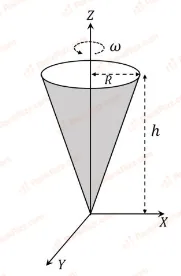
A hollow, right circular cone of base radius and height , with its tip at the origin is rotating about the -axis with an angular velocity , as shown in the figure. The cone carries a total charge uniformly distributed on its curved surface. The magnitude of magnetic field at a point , where and , is . The value of is:
Answer: ____________
rr2.rankrizz.com/jee-advanced/physics/moving-charges-and-magnetism/q/2026-paper-1-q12
A conducting solid sphere of radius and mass carries a charge . The sphere is rotating about an axis passing through its center with a uniform angular speed . The ratio of the magnitudes of the magnetic dipole moment to the angular momentum about the same axis is given as . The value of is ______.
Answer: ____________
rr2.rankrizz.com/jee-advanced/physics/moving-charges-and-magnetism/q/2025-paper-2-q25
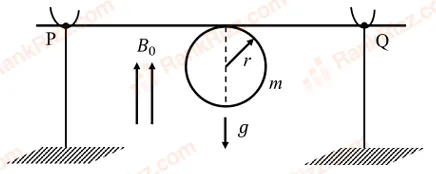
A thin stiff insulated metal wire is bent into a circular loop with its two ends extending tangentially from the same point of the loop. The wire loop has mass and radius and it is in a uniform vertical magnetic field , as shown in the figure. Initially, it hangs vertically downwards, because of acceleration due to gravity , on two conducting supports at and . When a current is passed through the loop, the loop turns about the line by an angle given by: ( equilibrium position)
- (A)
- (B)
- (C)
- (D)
rr2.rankrizz.com/jee-advanced/physics/moving-charges-and-magnetism/q/2024-paper-2-q21
- (A)
The change in the magnetic dipole moment associated with the orbit, at the end of the time interval of the magnetic field change, is
- (A)
- (B)
- (C)
- (D)
rr2.rankrizz.com/jee-advanced/physics/moving-charges-and-magnetism/q/2013-paper-2-q10
- (A)
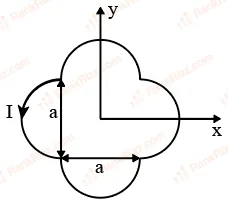
A loop carrying current I lies in the x-y plane as shown in the figure. the unit vector is coming out of the plane of the paper. the magnetic moment of the current loop is :
- (A)
- (B)
- (C)
- (D)
rr2.rankrizz.com/jee-advanced/physics/moving-charges-and-magnetism/q/2012-paper-2-q1
- (A)
Ampere's circuital law: cylinders, solenoids and toroids 4
An infinitely long wire, located on the z-axis, carries a current along the -direction and produces the magnetic field . The magnitude of the line integral along a straight line from the point to is given by
[ is the magnetic permeability of free space.]
- (A)
- (B)
- (C)
- (D)
rr2.rankrizz.com/jee-advanced/physics/moving-charges-and-magnetism/q/2024-paper-1-q19
- (A)
A steady current I flows along an infinitely long hollow cylindrical conductor of radius R. This cylinder is placed coaxially inside an infinite solenoid of radius 2R. The solenoid has n turns per unit length and carries a steady current I. Consider a point P at a distance r from the common axis. The correct statement(s) is (are)
- (A)
In the region 0 < r < R, the magnetic field is non-zero.
- (B)
In the region R < r < 2R, the magneticfield is along the common axis.
- (C)
In the region R < r < 2R, the magnetic field is tangential to the circle of radiusr, centered on the axis.
- (D)
In the region r > 2R, the magnetic field is non-zero.
rr2.rankrizz.com/jee-advanced/physics/moving-charges-and-magnetism/q/2013-paper-2-q7
- (A)
An infinitely long hollow conducting cylinder with inner radius R/2 and outer radius R carries a uniform current density along is length. Themagnitude of themagnetic field, as a function of the radial distance r from the axis is best represented by :
- (A)
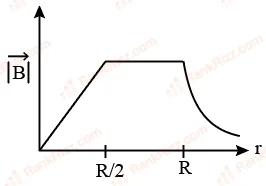
- (B)
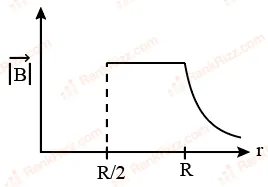
- (C)
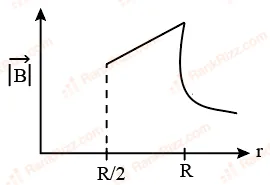
- (D)
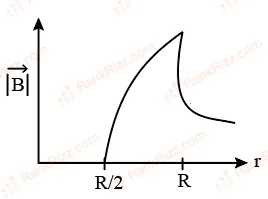
rr2.rankrizz.com/jee-advanced/physics/moving-charges-and-magnetism/q/2012-paper-2-q3
- (A)
A cylindrical cavity of diameter a exists inside a cylinder of diameter 2a as shown in the figure. Both the cylinder and the cavity are infinitely long. A uniform current density/ flows along the length. If the magnitude of the magnetic field at the point P is given by , then the value of N is
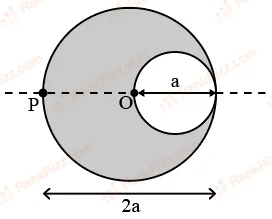
Answer: ____________
rr2.rankrizz.com/jee-advanced/physics/moving-charges-and-magnetism/q/2012-paper-1-q17
Biot-Savart law: straight wires and moving charges 1
Which one of the following options represents the magnetic field at O due to the current flowing in the given wire segments lying on the plane?
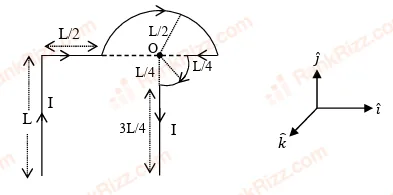
- (A)
- (B)
- (C)
- (D)
rr2.rankrizz.com/jee-advanced/physics/moving-charges-and-magnetism/q/2022-paper-2-q36
- (A)
Moving coil galvanometer 1
STATEMENT-1
The sensitivity of a moving coil galvanometer is increased by placing a suitable magnetic material as a core inside the coil.
and
STATEMENT-2
Soft iron has a high magnetic permeability and cannot be easily magnetized or demagnetized.- (A)
STATEMENT-1 is True, STATEMENT-2 is True; STATEMENT-2 is a correct explanation for STATEMENT-1
- (B)
STATEMENT-1 is True, STATEMENT-2 is True; STATEMENT-2 is NOT a correct explanation for STATEMENT-1
- (C)
STATEMENT-1 is True, STATEMENT-2 is False
- (D)
STATEMENT-1 is False, STATEMENT-2 is True
rr2.rankrizz.com/jee-advanced/physics/moving-charges-and-magnetism/q/2008-paper-2-q35
- (A)
Answer key
- 01 A, C
- 02 A, B
- 03 4
- 04 —
- 05 A, B
- 06 D
- 07 A
- 08 B
- 09 A, D
- 10 A, C
- 11 3
- 12 A, C
- 13 C, D
- 14 B, C
- 15 A
- 16 A
- 17 A, B, D
- 18 A
- 19 C
- 20 A
- 21 —
- 22 A-QR, B-P, C-QR, D-Q
- 23 C
- 24 B
- 25 A, B, C
- 26 B
- 27 C
- 28 0.50
- 29 —
- 30 A
- 31 B
- 32 B
- 33 A
- 34 A, D
- 35 D
- 36 5
- 37 C
- 38 C
“—” marks a question whose key we have not checked yet; its page shows the latest on it.
Past questions are reproduced with their sitting. Not affiliated with NTA or the IITs. Every question, online and free: rr2.rankrizz.com/jee-advanced/physics/moving-charges-and-magnetism