In the following nuclear reaction,
Mass number of is 182 and atomic number is 74. Mass number and atomic number of respectively will be
- A
174 and 71
- B
174 and 69
- C
172 and 69
- D
172 and 71
Radioactivity: decay law, half-life and decay modes has been asked 104 times in JEE Main, in 20 different years between 2005 and 2026, and in all of the last five exam years (2022–2026), 47 questions in all. That is 34% of Atoms & Nuclei, one of its three most-asked topics. Last asked in JEE Main 08 Apr 2026, Shift 2. 89 are multiple choice and 15 numerical-value; 50 easy, 38 medium and 1 hard by our difficulty labels. All of them are below, newest first, free to read.
Questions
104
Years asked
20
Since
2005
Of the chapter
34%
41–60 OF 104 · NEWEST FIRST
In the following nuclear reaction,
Mass number of is 182 and atomic number is 74. Mass number and atomic number of respectively will be
174 and 71
174 and 69
172 and 69
172 and 71
The half life of a radioactive substance is 5 years. After years a given sample of the radioactive substance gets reduced to 6.25% of its initial value. The value of is ______.
Following statements related to radioactivity are given below:
(A) Radioactivity is a random and spontaneous process and is dependent on physical and chemical conditions.
(B) The number of undecayed nuclei in the radioactive sample decays exponentially with time.
(C) Slope of the graph of (no. of undecayed nuclei) vs. time represents the reciprocal of mean life time ().
(D) Product of decay constant () and half-life time is not constant.
Choose the most appropriate answer from the options given below:
(A) and (B) only
(B) and (D) only
(B) and (C) only
(C) and (D) only
How many alpha and beta particles are emitted when Uranium decays to lead ?
3 alpha particles and 5 beta particles
6 alpha particles and 4 beta particles
4 alpha particles and 5 beta particles
8 alpha particles and 6 beta particles
A radioactive nucleus can decay by two different processes. Half-life for the first process is hours while it is hours for the second process. The effective halflife of the nucleus will be
hours
hours
hours
hours
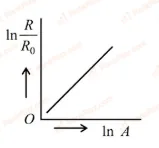
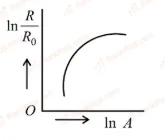
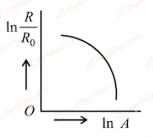
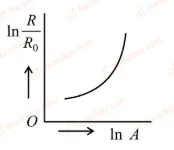
Which of the following figure represents the variation of with (if = radius of a nucleus and = its mass number)?


A sample contains kg each of two substances and with half lives s and s respectively. The ratio of their atomic weights is . The ratio of the amounts of and after s is . The value of is ______.
The half life period of a radioactive element is same as the mean life time of another radioactive element . Initially they have the same number of atoms. Then:
and decay at the same rate always.
-will decay faster than .
and have same decay rate initially and later on different decay rate.
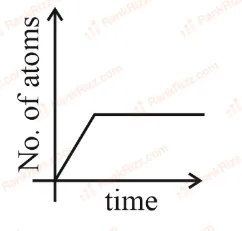
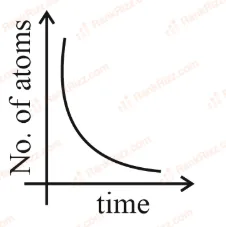
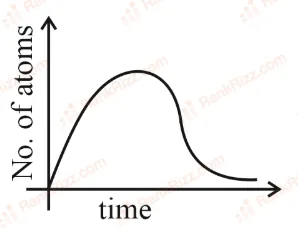
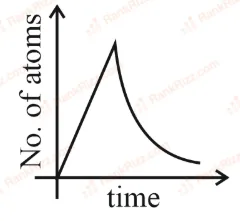
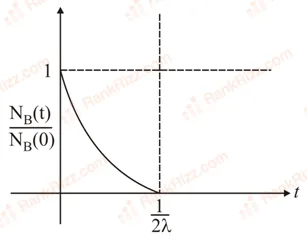
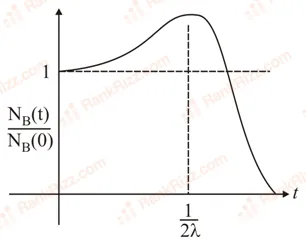
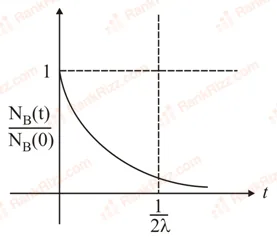
A sample of a radioactive nucleus disintegrates to another radioactive nucleus , which in turn disintegrates to some other stable nucleus . Plot of a graph showing the variation of number of atoms of nucleus versus time is: (Assume that at , there are no atoms in the sample)


There are radioactive nuclei in a given radioactive element. Its half-life time is 1 min. How many nuclei will remain after 30 s?
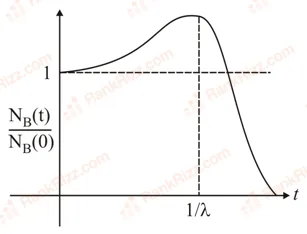
At time , a material is composed of two radioactive atoms and , where . The decay constant of both kind of radioactive atoms is . However, disintegrates to and disintegrates to . Which of the following figures represents the evolution of with respect to time ?


If denotes the ratio of the number of nuclei decayed to the number of nuclei at , then for a collection of radioactive nuclei, the rate of change of with respect to time is given as: [ is the radioactive decay constant]
A radioactive sample has an average life of 30 ms and is decaying. A capacitor of capacitance 200 F is first charged and later connected with resistor . If the ratio of the charge on the capacitor to the activity of the radioactive sample is fixed with respect to time then the value of should be _________ .
Consider the following statements:
A. Atoms of each element emit characteristics spectrum.
B. According to Bohr's Postulate, an electron in a hydrogen atom revolves in a certain stationary orbit.
C. The density of nuclear matter depends on the size of the nucleus.
D. A free neutron is stable but a free proton decay is possible.
E. Radioactivity is an indication of the instability of nuclei. Choose the correct answer from the options given below.
and
and only.
and only
and only
Some nuclei of a radioactive material are undergoing radioactive decay. The time gap between the instances when a quarter of the nuclei have decayed and when half of the nuclei have decayed is given as: (where is the decay constant)
The half-life of Au is 3 days. If atomic weight of Au is 198 g mol, then the activity of 2 mg of Au is [in disintegration second]:
The nuclear activity of a radioactive element becomes of its initial value in 30 years. The half-life of radioactive element is _________ years.
A radioactive material decays by simultaneous emissions of two particles with half lives of 1400 years and 700 years, respectively. What will be the time after the which one third of the material remains? (Take ln 3 = 1.1)
1110 years
700 years
340 years
740 years
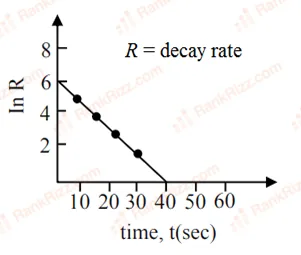
For a certain radioactive process, the graph between ln R and (sec) is obtained as shown in the figure. Then the value of half life for the unknown radioactive material is approximately:

9.15 sec
6.93 sec
2.62 sec
4.62 sec
A radioactive substance decays to of its initial activity in 80 days. The half life of the radioactive substance expressed in days is ___.