JEE MAIN 2018 · 16 APR ONLINERadioactivity: decay law, half-life and decay modes
At some instant, a radioactive sample S1 having an activity 5μCi has twice the number of nuclei as another sample S2 which has an activity of 10μCi. The half lives of S1 and S2 are:
- A
- B
- C
- D
JEE MAIN 2018 · 15 APR S1Radioactivity: decay law, half-life and decay modes
A solution containing active cobalt 2760Co having activity of 0.8 μCi and decay constant λ is injected in an animal's body. If 1 cm3 of blood is drawn from the animal's body after 10 hrs of injection, the activity found was 300 decays per minute. What is the volume of blood that is flowing in the body? (1 Ci = 3.7×10¹⁰ decay per second and at t = 10 hrs the value of e−λt = 0.84)
- A
- B
- C
- D
JEE MAIN 2018 · 15 APR S2Radioactivity: decay law, half-life and decay modes
An unstable heavy nucleus at rest breaks into two nuclei which move away with velocities in the ratio of 8 : 27. The ratio of the radii of the nuclei (assumed to be spherical) is:
- A
- B
- C
- D
JEE MAIN 2017 · 02 APR OFFLINERadioactivity: decay law, half-life and decay modes
A radioactive nucleus A with a half-life T, decays into a nucleus B. At t=0, there is no nucleus B. At some time t, the ratio of the number of B to that of A is 0.3. Then, t is given by: (Consider logex=logx)
- A
t=log1.3T
- B
t=2log1.3Tlog2
- C
t=Tlog2log1.3
- D
t=Tlog1.3
JEE MAIN 2016 · 03 APR OFFLINERadioactivity: decay law, half-life and decay modes
Half-lives of two radioactive elements A and B are 20 minutes and 40 minutes, respectively. Initially, the samples have an equal number of nuclei. After 80 minutes, the ratio of decayed numbers of A and B nuclei will be:
- A
- B
- C
- D
JEE MAIN 2015 · 11 APR ONLINERadioactivity: decay law, half-life and decay modes
Let Nβ be the number of β particle emitted by 1 gram of Na24 radioactive nuclei having a half life of 15 h. In 7.5 h, the number Nβ is close to [NA=6.023×10²³ mole−1]
- A
1.75×10²²
- B
6.2×10²¹
- C
7.5×10²¹
- D
1.25×10²²
JEE MAIN 2014 · 19 APR ONLINERadioactivity: decay law, half-life and decay modes
A piece of wood from a recently cut tree shows 20 decays per minute. A wooden piece of the same size placed in a museum (obtained from a tree cut many years back) shows 2 decays per minute. If the half-life of C14 is 5730 years, then the age of the wooden piece placed in the museum is approximately: [This question was awarded a bonus and proper correction was made to avoid that]
- A
- B
- C
- D
JEE MAIN 2014 · 12 APR ONLINERadioactivity: decay law, half-life and decay modes
A piece of bone of an animal from a ruin is found to have 14C activity of 12 disintegrations per minute per gm of its carbon content. The 14C activity of a living animal is 16 disintegrations per minute per gm. How long ago nearly did the animal die? (Given half life of 14C is t1/2 = 5760 years)
- A
- B
- C
- D
JEE MAIN 2014 · 11 APR ONLINERadioactivity: decay law, half-life and decay modes
A radioactive nuclei with decay constant 0.5/s is being produced at a constant rate of 100 nuclei/s. If at t = 0 there were no nuclei, the time when there are 50 nuclei is:
- A
- B
2ln(34) s
- C
- D
ln(34) s
JEE MAIN 2013 · 22 APR ONLINERadioactivity: decay law, half-life and decay modes
The half-life of a radioactive element A is the same as the mean-life of another radioactive element B. Initially both substances have the same number of atoms, then :
- A
A and B decay at the same rate always.
- B
A and B decay at the same rate initially.
- C
A will decay at a faster rate than B.
- D
B will decay at a faster rate than A.
JEE MAIN 2012Radioactivity: decay law, half-life and decay modes
A sample originally contained 1020 radioactive atoms, which emit α-particles. The ratio of α particles emitted in the third year to that emitted during the second year is 0.3. How many α particles were emitted in the first year?
- A
3×10¹⁸
- B
3×10¹⁹
- C
5×10¹⁸
- D
7×10¹⁹
JEE MAIN 2012Radioactivity: decay law, half-life and decay modes
The counting rate observed from a radioactive source at t=0 was 1600 counts s−1, and t=8 s, it was 100 counts s−1. The counting rate observed as counts s−1 at t=6 s will be
- A
- B
- C
- D
JEE MAIN 2012Radioactivity: decay law, half-life and decay modes
The decay constants of a radioactive substance for α and β emission are λα and λβ respectively. If the substance emits α and β simultaneously, then the average half life of the material will be
- A
Tα+Tβ2TαTβ
- B
Tα+Tβ
- C
Tα+TβTαTβ
- D
21(Tα+Tβ)
JEE MAIN 2012Radioactivity: decay law, half-life and decay modes
Which of the following Statements is correct?
- A
The rate of radioactive decay cannot be controlled but that of nuclear fission can be controlled.
- B
Nuclear forces are short range, attractive and charge dependent.
- C
Nuclei of atoms having same number of neutrons are known as isobars.
- D
Wavelength of matter waves is given by de Broglie formula but that of photons is not given by the same formula.
JEE MAIN 2011Radioactivity: decay law, half-life and decay modes
The half life of a radioactive substance is 20 minutes. The approximate time interval (t2−t1) between the time t2 when 32 of it has decayed and time t1 and 31 of it had decayed is:
- A
14min
- B
20min
- C
28min
- D
JEE MAIN 2010Radioactivity: decay law, half-life and decay modes
A radioactive nucleus (initial mass number A and atomic number Z) emits 3 α-particles and 2 positrons. The ratio of number of neutrons to that of protons in the final nucleus will be
- A
Z−4A−Z−8
- B
Z−8A−Z−4
- C
Z−4A−Z−12
- D
Z−2A−Z−4
JEE MAIN 2007Radioactivity: decay law, half-life and decay modes
In gamma ray emission from a nucleus
- A
both the neutron number and the proton number change
- B
there is no change in the proton number and the neutron number.
- C
only the neutron number changes
- D
only the proton number changes
JEE MAIN 2007Radioactivity: decay law, half-life and decay modes
The half-life period of a radio-active element X is same as the mean life time of another radioactive element Y. Initially they have the same number of atoms. Then
- A
X will decay faster than Y
- B
Y will decay faster than X
- C
X and Y have same decay rate initially
- D
X and Y decay at same rate always.
JEE MAIN 2006Radioactivity: decay law, half-life and decay modes
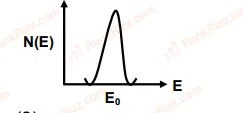
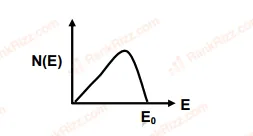
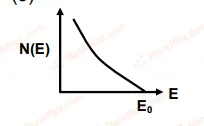
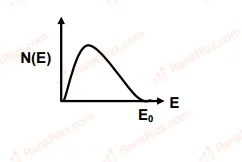
The energy spectrum of β-particles [number N(E) as a function of β-energy E] emitted from a radioactive source is
- A
- B
- C
- D
JEE MAIN 2006Radioactivity: decay law, half-life and decay modes
When 3Li7 nuclei are bombarded by protons, and the resultant nuclei are 4Be8, the emitted particles will be
- A
- B
- C
- D