The decay of a proton to neutron is :
- A
not possible as proton mass is less than the neutron mass
- B
possible only inside the nucleus
- C
not possible but neutron to proton conversion is possible
- D
always possible as it is associated only with decay
Radioactivity: decay law, half-life and decay modes has been asked 104 times in JEE Main, in 20 different years between 2005 and 2026, and in all of the last five exam years (2022–2026), 47 questions in all. That is 34% of Atoms & Nuclei, one of its three most-asked topics. Last asked in JEE Main 08 Apr 2026, Shift 2. 89 are multiple choice and 15 numerical-value; 50 easy, 38 medium and 1 hard by our difficulty labels. All of them are below, newest first, free to read.
Questions
104
Years asked
20
Since
2005
Of the chapter
34%
61–80 OF 104 · NEWEST FIRST
The decay of a proton to neutron is :
not possible as proton mass is less than the neutron mass
possible only inside the nucleus
not possible but neutron to proton conversion is possible
always possible as it is associated only with decay
The half-life of is 2.7 days. The activity of 1.50 mg of , if its atomic weight is 198 g mol is, ( mol)
240 Ci
357 Ci
535 Ci
252 Ci
Calculate the time interval between 33% decay and 67% decay if half-life of a substance is 20 min.
60 min
20 min
40 min
13 min
A radioactive sample is undergoing decay. At any time , its activity is and another time , the activity is . What is the average life time for the sample?
Two radioactive substances and originally have and nuclei respectively. Half life of is half of the half life of . After three half lives of , number of nuclei of both are equal. The ratio will be equal to:
Given the masses of various atomic particles , , , , , where p = proton, n = neutron, e = electron, = antineutrino and d = deuteron. Which of the following process is allowed by momentum and energy conservation:
deuterium atom (electron bound to the nucleus)
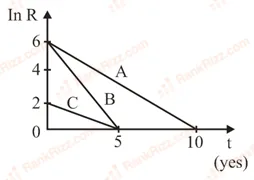
Activities of three radioactive substances , and are represented by the curves , and , in the figure. Then their half-lives are in the ratio:

A radioactive nucleus decays by two different processes. The half-life for the first process is and that for the second is . The effective half-life of the nucleus is close to:
9 s
6 s
55 s
12 s
In a radioactive material, a fraction of active material remaining after the time is . The fraction that was remaining after the time is:
The radius R of a nucleus of mass number A can be estimated by the formula m. It follows that the mass density of n nucleus is of the order of: kg)
kg m
kg m
kg m
kg m
The activity of a radioactive sample falls from 700 s to 500 s in 30 minutes. Its half life is close to:
72 min
62 min
66 min
52 min
Half lives of two radioactive nuclei A and B are 10 minutes and 20 minutes, respectively. If, initially a sample has equal number of nuclei, then after 60 minutes, the ratio of decayed numbers of nuclei A and B will be:
3 : 8
8 : 1
1 : 8
9 : 8
Two radioactive materials A and B have decay constants and , respectively. If initially they have the same number of nuclei, then the ratio of the number of nuclei of A to that of B will be 1/e after a time:
Two radioactive substances A and B have decay constants and respectively. At t = 0, a sample has the same number of the two nuclei. The time taken for the ratio of the number of nuclei to become will be
The ratio of mass densities of nuclei of Ca and O is close to:
1
0.1
2
5
In a radioactive decay chain, the initial nucleus is . At the end, there are 6 -particles and 4-particles which are emitted. If the end nucleus is , A and Z are given by:
A = 208; Z = 82
A = 208; Z = 80
A = 200; Z = 81
A = 202; Z = 80
Using a nuclear counter the count rate of emitted particles from a radioactive source is measured. At it was 1600 counts per second and seconds it was 100 counts per second. The count rate observed, as counts per second, at seconds is close to:
400
200
150
360
A Sample of radioactive material A, that has an activity of 10 mCi (1 Ci decays s), has twice the number of nuclei as another sample of a different radioactive material B which has an activity of 20 mCi. The correct choices for half-lives of A and B would then be, respectively:
5 days and 10 days
10 days and 40 days
20 days and 10 days
20 days and 5 days
At a given instant, say , two radioactive substance A and B have equal activities. The ratio of their activities after time itself decays with time as . If the half-life of A is , the half-life of B is:
Both the nucleus and the atom of some element are in their respective first excited states. They get de-excited by emitting photons of wavelengths , respectively. The ratio is closest to:
10