Compound (A), , gives a white precipitate when warmed with alcoholic AgNO. Oxidation of (A) gives an acid (B), . (B) easily forms anhydride on heating. Identify the compound (A).
- A
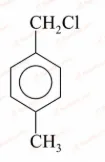
- B
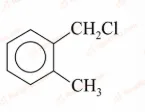
- C
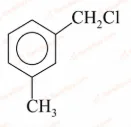
- D
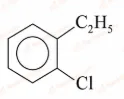
Nucleophilic substitution (SN1 and SN2) has been asked 128 times in JEE Main, in 20 different years between 2005 and 2026, and in all of the last five exam years (2022–2026), 64 questions in all. That is 68% of Haloalkanes and Haloarenes, its most-asked topic. Last asked in JEE Main 08 Apr 2026, Shift 2. 122 are multiple choice and 6 numerical-value; 22 easy, 91 medium and 4 hard by our difficulty labels. All of them are below, newest first, free to read.
Questions
128
Years asked
20
Since
2005
Of the chapter
68%
121–128 OF 128 · NEWEST FIRST
Compound (A), , gives a white precipitate when warmed with alcoholic AgNO. Oxidation of (A) gives an acid (B), . (B) easily forms anhydride on heating. Identify the compound (A).


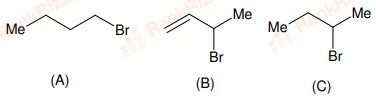
Consider the following bromides: 
The correct order of reactivity is
Which of the following on heating with aqueous KOH, produces acetaldehyde?
The organic chloro compound, which shows complete stereochemical inversion during a reaction, is
Which of the following is the correct order of decreasing reactivity?
( a halogen)
$
D > C > A > B
D > C > B > A
A > B > C > D
B > D > C > A
Question:
Consider the reaction of bromoethane with two different cyanide reagents in an aqueous ethanolic solution:
Reaction 1:
Reaction 2:
Identify the major products A and B, respectively.
Ethyl isocyanide and Propanenitrile (Ethyl cyanide)
Propanenitrile (Ethyl cyanide) and Ethyl isocyanide
Propanenitrile (Ethyl cyanide) in both reactions
Ethyl isocyanide in both reactions
Tertiary alkyl halides are practically inert to substitution by mechanism because of
insolubility
instability
inductive effect
steric hindrance
RELATED HALOALKANES AND HALOARENES TOPICS