JEE MAIN 2019 · 12 APR S1Electrode potentials, electrochemical series and cell EMF
Given:
Co3+ + e− → Co2+; E° = +1.81V
Pb3+ + 2e− → Pb2+; E° = +1.67V
Ce4+ + e− → Ce3+; E° = +1.61V
Bi3+ + 3e− → Bi; E° = +0.20V
Oxidizing power of the species will increase in the order:
- A
Co3+ < Ce4+ < Bi3+ < Pb4+
- B
Bi3+ < Ce4+ < Pb4+ < Co3+
- C
Co3+ < Pb4+ < Ce3+ < Bi4+
- D
Ce4+ < Pb4+ < Bi3+ < Co3+
JEE MAIN 2019 · 09 APR S1Electrode potentials, electrochemical series and cell EMF
The standard Gibbs energy for the given cell reaction in kJ mol−1 at 298 K is:
Zn(s) + Cu2+(aq) → Zn2+(aq) + Cu(s),
E0 = 2 V at 298 K
(Faraday's constant, F = 96000 C mol−1)
- A
- B
- C
- D
JEE MAIN 2019 · 08 APR S1Electrode potentials, electrochemical series and cell EMF
Given that,
EO2/H2O0=+1.23 V;
ES2O82−/SO42−0=2.05 V;
EBr2/Br−0=+1.09 V;
EAu3+/Au0=1.4 V
The strongest oxidizing agent is:
- A
- B
S2O82−
- C
- D
JEE MAIN 2019 · 08 APR S2Electrode potentials, electrochemical series and cell EMF
Calculate the standard cell potential (in V) of the cell in which the following reaction takes place:
Fe2+(aq) + Ag+(aq) → Fe3+(aq) + Ag(s)
Given that EAg+/Ag0=x V, EFe2+/Fe0=y V, EFe3+/Fe0=z V
- A
x+2y−3z
- B
- C
- D
JEE MAIN 2019 · 12 JAN S1Electrode potentials, electrochemical series and cell EMF
The standard electrode potential E° and its temperature coefficient (dTdE) for a cell are 2 V and −5×10⁻⁴ V K−1 at 300 K, respectively. The reaction is Zn(s) + Cu2+(aq) → Zn2+(aq) + Cu(s). The standard reaction enthalpy (ΔrH−) at 300 K in mol−1 is [Use R = 8 J K−1 mol−1 and F = 96,500 C mol−1]
- A
- B
- C
- D
JEE MAIN 2019 · 11 JAN S1Electrode potentials, electrochemical series and cell EMF
For the cell Zn(s)∣Zn2+(aq)∣∣Mx+(aq)∣M(s), different half cells and their standard electrode potentials are given below:
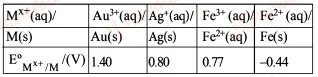
If E°Zn2+/Zn=−0.76 V, which cathode will give a maximum value of E°cell per electron transferred?
- A
- B
Fe3+/Fe2+
- C
- D
JEE MAIN 2019 · 11 JAN S2Electrode potentials, electrochemical series and cell EMF
Given the equilibrium constant: KC of the reaction: Cu(s)+2Ag+(aq)→Cu2+(aq)+2Ag(s) is 10×1015. Calculate the E°cell of this reaction at 298 K. [2.303FRT at 298 K = 0.059 V]
- A
- B
- C
- D
JEE MAIN 2019 · 10 JAN S1Electrode potentials, electrochemical series and cell EMF
Consider the following reduction processes:
Zn2++2e−→Zn(s);E∘=−0.76 V
Ca2++2e−→Ca(s);E∘=−2.87 V
Mg2++2e−→Mg(s);E∘=−2.36 V
Ni2++2e−→Ni(s);E∘=−0.25 V
The reducing power of the metals increases in the order:
- A
- B
- C
- D
JEE MAIN 2019 · 10 JAN S2Electrode potentials, electrochemical series and cell EMF
In the cell, Pt(s)|H2(g, 1 bar)|HCl(aq)|AgCl(s)|Ag(s)|Pt(s), the cell potential is 0.92 V when a 10−6 molar HCl solution is used. The standard electrode potential of Ag|AgCl|Cl− electrode is: (Given, F2.303RT=0.06 V at 298 K)
- A
- B
- C
- D
JEE MAIN 2019 · 09 JAN S2Electrode potentials, electrochemical series and cell EMF
If the standard electrode potential for a cell is 2 V at 300 K, the equilibrium constant (K) for the reaction.
Zn(s)+Cu2+(aq)⇌Zn2+(aq)+Cu(s)
at 300 K is approximately: (R=8 J K−1 mol−1, F=96000 C mol−1)
- A
- B
- C
- D
JEE MAIN 2017 · 09 APR ONLINEElectrode potentials, electrochemical series and cell EMF
To find the standard potential of M3+/M electrode, the following cell is constituted:
Pt | M/M3+ (0.001 mol L−1) / Ag+ (0.01 mol L−1) / Ag
The emf of the cell is found to be 0.421 volt at 298 K. The standard potential of half-reaction M3+ + 3e− → M at 298 K will be:
(Given: EAg+/Ag⊖ at 298 K = 0.80 volt)
- A
- B
- C
- D
JEE MAIN 2017 · 08 APR ONLINEElectrode potentials, electrochemical series and cell EMF
Consider the following standard electrode potentials (E° in volts) in aqueous solution:
| Element | M3+/M | M+/M |
|---|
| Al | −1.66 | +0.55 |
| Tl | +1.26 | −0.34 |
Based on these data, which of the following statements is correct?
- A
Tl+ is more stable than Al3+
- B
Al+ is more stable than Al3+
- C
Tl3+ is more stable than Al3+
- D
Tl+ is more stable than Al+
JEE MAIN 2017 · 08 APR ONLINEElectrode potentials, electrochemical series and cell EMF
What is the standard reduction potential (E°) for Fe3+→Fe?
Given that:
Fe2++2e−→Fe; E°Fe2+/Fe=−0.47 V
Fe3++e−→Fe2+; E°Fe3+/Fe2+=+0.77 V
- A
- B
- C
- D
JEE MAIN 2017 · 02 APR OFFLINEElectrode potentials, electrochemical series and cell EMF
Given
E°Cl2/Cl− = 1.36 V, E°Cr3+/Cr = -0.74 V
E°Cr2O72−/Cr3+ = 1.33 V, E°MnO4−/Mn2+ = 1.51 V
Among the following, the strongest reducing agent is:
- A
- B
- C
- D
JEE MAIN 2016 · 09 APR ONLINEElectrode potentials, electrochemical series and cell EMF
What will happen when a block of copper metal is dropped into a beaker containing a solution of 1 M ZnSO4?
- A
The copper metal will dissolve with evolution of oxygen gas.
- B
The copper metal will dissolve with evolution of hydrogen gas.
- C
- D
The copper metal will dissolve and zinc metal will be deposited.
JEE MAIN 2014 · 11 APR ONLINEElectrode potentials, electrochemical series and cell EMF
Given:
Fe3+(aq) + e− → Fe2+(aq); E0 = +0.77 V
Al3+(aq) + 3e− → Al(s); E0 = −1.66 V
Br2(aq) + 2e− → 2Br−; E0 = +1.09 V
Considering the electrode potentials, which of the following represents the correct order of reducing power?
- A
Fe2+ < Al < Br−
- B
Br− < Fe2+ < Al
- C
Al < Br− < Fe2+
- D
Al < Fe2+ < Br−
JEE MAIN 2014 · 09 APR ONLINEElectrode potentials, electrochemical series and cell EMF
The standard electrode potentials (EM+/M∘) of four metals A, B, C and D are −1.2 V, 0.6 V, 0.85 V and −0.76 V, respectively. The sequence of deposition of metals on applying potential is:
- A
- B
- C
- D
JEE MAIN 2014 · 06 APR OFFLINEElectrode potentials, electrochemical series and cell EMF
Given below are the half-cell reactions:
Mn2++2e−→Mn; E∘=−1.18 V
2(Mn3++e−→Mn2+); E∘=+1.51 V
The E∘ for 3Mn2+→Mn+2Mn3+ will be:
- A
−2.69 V; the reaction will not occur
- B
−2.69 V; the reaction will occur
- C
−0.33 V; the reaction will not occur
- D
−0.33 V; the reaction will occur
JEE MAIN 2013 · 25 APR ONLINEElectrode potentials, electrochemical series and cell EMF
The Gibbs energy for the decomposition of Al2O3 at 500°C is as follows :
32Al2O3→34Al+O2, ΔrG=+940 kJ mol−1
The potential difference needed for the electrolytic reduction of aluminium oxide at 500°C should be at least :
- A
- B
- C
- D
JEE MAIN 2013 · 23 APR ONLINEElectrode potentials, electrochemical series and cell EMF
Given :
E21Cl2/Cl−∘=1.36 V, ECr3+/Cr∘=−0.74 V
ECr2O72−/Cr3+∘=1.33 V, EMnO4−/Mn2+∘=1.51 V
The correct order of reducing power of the species (Cr, Cr3+, Mn2+ and Cl−) will be:
- A
Mn2+ < Cl− < Cr3+ < Cr
- B
Mn2+ < Cl3+ < Cl− < Cr
- C
Cr3+ < Cl− < Mn2+ < Cr
- D
Cr3+ < Cl− < Cr < Mn2+