JEE MAIN 2022 · 25 JUN S2Electrode potentials, electrochemical series and cell EMF
The correct order of reduction potentials of the following pairs is
A.
B.
C.
D.
E.
Choose the correct answer from the options given below.
- A
- B
- C
- D
Electrode potentials, electrochemical series and cell EMF has been asked 106 times in JEE Main, in 15 different years between 2004 and 2026, and in all of the last five exam years (2022–2026), 62 questions in all. That is 47% of Electrochemistry, its most-asked topic. Last asked in JEE Main 08 Apr 2026, Shift 2. 55 are multiple choice and 51 numerical-value; 25 easy, 72 medium and 5 hard by our difficulty labels. All of them are below, newest first, free to read.
Questions
106
Years asked
15
Since
2004
Of the chapter
47%
61–80 OF 106 · NEWEST FIRST
The correct order of reduction potentials of the following pairs is
A.
B.
C.
D.
E.
Choose the correct answer from the options given below.
The cell potential for the following cell is V at K. The pH of the solution is (Nearest integer) ______
(Given : V and V)
Consider the following cell reaction Cd + HgSO(s) + HO CdSO.HO + 2Hg.
The value of E is 4.315 V at 25°C. If = -825.2 kJ mol, the standard entropy change in J K is _________. (Nearest integer)
[Given : Faraday constant = 96487 C mol]
These are physical properties of an element:
(A) Sublimation enthalpy
(B) Ionisation enthalpy
(C) Hydration enthalpy
(D) Electron gain enthalpy
The total number of above properties that affect the reduction potential is _________ (Integer answer)
For the galvanic cell,
Zn(s) + Cu(0.02M) Zn(0.04M) + Cu(s)
E = _________ V (Nearest integer)
[Use: E Cu/Cu = V, E = +0.76 V, = 0.059 V]
For the cell Cu(s)|Cu(aq)(0.1M)||Ag(aq)(0.01M)|Ag(s) the cell potential E = 0.3095 V. For the cell Cu(s)|Cu(aq)(0.01M)||Ag(aq)(0.001M)|Ag(s) the cell potential = V. Find value of x.
(Round off to the Nearest Integer).
[Use: J]
Consider the cell at 25C
Zn|Zn aq, 1 M || Fe(aq), Feaq|Pt
The fraction of total iron present as Fe ion at the cell potential of 1.500 V is . The value of x is ___.
(Nearest integer)
Given: E = 0.77V, E = -0.76V
Assume a cell with the following reaction Cu + 2Ag(1 M) Cu(0.250M) + 2Ag
E = 2.97 V
E for the above reaction is ___ V.
(Nearest integer)
[Given : log 2.5 = 0.3979, T = 298 K]
Emf of the following cell at 298 K in V is
The value of is ______ (Rounded off to the nearest integer)
[Given: V; V; ]
Copper reduces into NO and depending upon the concentration of in solution. (Assuming fixed and ), the concentration at which the thermodynamic tendency for reduction of into NO and by copper is same is M. The value of is ______. (Rounded-off to the nearest integer)
[Given, V, V, V and at 298 K, ]
The magnitude of the change in oxidising power of the couple is V if the concentration is decreased from 1 M to M at 25°C. (Assume concentration of and to be same on change in concentration). The value of x is ______. (Rounded off to the nearest integer)
[Given: ]
For the given cell;
change in Gibbs energy is negative, it:
An oxidation-reduction reaction in which 3 electrons are transferred has a of at . The value of (in V) is __________ . ()
Identify the incorrect statement from the options below for the above cell:
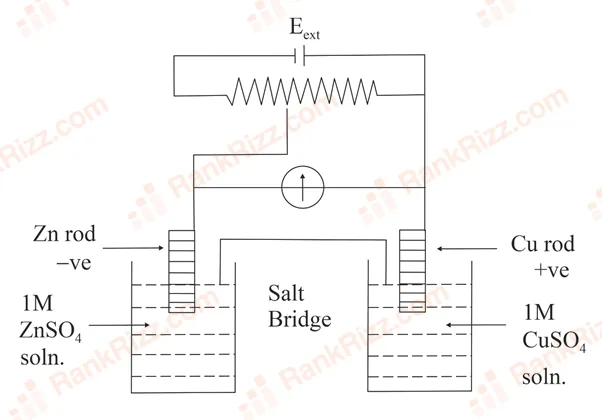
V,
V
If V, e flow from Cu to Zn
If V, Zn dissolves at Zn electrode and Cu deposits at Cu electrode
If V, Zn dissolves at anode and Cu deposits at cathode
If V, no flow of e or current occurs
The photoelectric current from Na (work function, eV) is stopped by the output voltage of the cell
Pt(s)|H(g, 1 bar)|HCl(aq, pH = 1)|AgCl(s)|Ag(s)
The pH of aq. HCl required to stop the photoelectric current from K( eV), all other conditions remaining the same, is ......... (to the nearest integer).
Given V; V
The Gibbs energy change (in J) for the given reaction at M and 298 K is:
;
For the disproportionation reaction at 298K, ln K (where K is the equilibrium constant) is ___________ .
Given:
What would be the electrode potential for the given half-cell reaction at pH = 5?
2HO O + 4H + 4e; E V
(R = 8.314 J mol K; Temp = 298K; oxygen under standard atm. pressure of 1 bar)
For an electrochemical cell Sn(s)|Sn(aq, 1M)||Pb(aq, 1M)|Pb(s) the ratio when this cell attains equilibrium is __________.
(Given: E V, E V, )
Given that the standard potentials (E) of Cu/Cu and Cu/Cu are 0.34V and 0.522V respectively, the E of Cu/Cu is:
0.182V
+0.158V
-0.182V
-0.158V