JEE MAIN 2022 · 25 JUL S2VSEPR theory and shapes of molecules and ions
The sum of number of lone pairs of electrons present on the central atoms of , and is ______.
VSEPR theory and shapes of molecules and ions has been asked 118 times in JEE Main, in 19 different years between 2004 and 2026, and in all of the last five exam years (2022–2026), 69 questions in all. That is 37% of Chemical Bonding and Molecular Structure, its most-asked topic. Last asked in JEE Main 08 Apr 2026, Shift 2. 92 are multiple choice and 26 numerical-value; 48 easy and 59 medium by our difficulty labels. All of them are below, newest first, free to read.
Questions
118
Years asked
19
Since
2004
Of the chapter
37%
61–80 OF 118 · NEWEST FIRST
The sum of number of lone pairs of electrons present on the central atoms of , and is ______.
Consider the species CH, NH and BH. Choose the correct option with respect to the three species:
They are isoelectronic and only two have tetrahedral structures
They are isoelectronic and all have tetrahedral structures
Only two are isoelectronic and all have tetrahedral structures
Only two are isoelectronic and only two have tetrahedral structures
Number of lone pair (s) of electrons on central atom and the shape of BrF molecule respectively, are:
0, triangular planar.
1, pyramidal.
2, bent T-shape.
1, bent T-shape
The hybridization of P exhibited in is . The value of is ______
In the structure of SF, the lone pair of electrons on S is in.
Equatorial position and there are two lone pair - bond pair repulsions at 90°.
equatorial position and there are three lone pair - bond pair repulsions at 90°.
axial position and there are three lone pair - bond pair repulsions at 90°.
axial position and there are two lone pair - bond pair repulsion at 90°.
Based upon VSEPR theory, match the shape (geometry) of the molecules in List-I with the molecules in List-II
| List-I (Shape) | List-II (Molecules) |
|---|---|
| A T-shaped | I. |
| B Trigonal planar | II. |
| C Square planar | III. |
| D See-saw | IV. |
A-(I), B-(II), C-(III), D-(IV)
A-(IV), B-(I), C-(II), D-(III)
A-(II), B-(I), C-(IV), D-(III)
A-(III), B-(IV), C-(I), D-(II)
Identify the incorrect statement for from the following.
In this molecule, orbitals of phosphorous are assumed to undergo hybridization.
The geometry of is trigonal bipyramidal.
has two axial bonds stronger than three equatorial bonds.
The three equatorial bonds of lie in a plane.
Amongst and , the number of species with two lone pairs of electrons is ______
Number of electron deficient molecules among the following and is
0
1
2
3
Match List - I with List - II:
List-I (Species) List-II (Number of lone pairs of electrons on the central atom)
(a) XeF (i) 0
(b) XeOF (ii) 1
(c) XeOF (iii) 2
(d) XeF (iv) 3
Choose the most appropriate answer from the options given below:
(a) - (iii), (b) - (iv), (c) - (ii), (d) - (i)
(a) - (iv), (b) - (i), (c) - (ii), (d) - (iii)
(a) - (iii), (b) - (ii), (c) - (iv), (d) - (i)
(a) - (iv), (b) - (ii), (c) - (i), (d) - (iii)
The number of species having non-pyramidal shape among the following is:
(A) SO
(B) NO
(C) PCl
(D) CO
AB is an interhalogen T-shaped molecule. The number of lone pairs of electrons on A is _________ (Integer answer)
In gaseous triethyl amine the C-N-C bond angle is _________ degree.
Match List-I with List-II
| (a) SF | (i) spd |
| (b) IF | (ii) dsp |
| (c) NO | (iii) spd |
| (d) NH | (iv) sp |
| (v) sp |
Choose the correct answer from the options given below:
(a)-(i), (b)-(ii), (c)-(v) and (d)-(iii)
(a)-(ii), (b)-(i), (c)-(iv) and (d)-(v)
(a)-(iii), (b)-(i), (c)-(v) and (d)-(iv)
(a)-(iv), (b)-(iii), (c)-(ii) and (d)-(v)
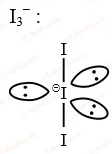
The number of lone pairs of electrons on the central I atom in I is ___.
The hybridisations of the atomic orbitals of nitrogen in NO, NO and NH respectively are:
sp, sp and sp
sp, sp and sp
sp, sp and sp
sp, sp and sp
In the following molecules,
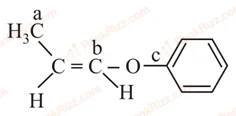
Hybridisation of carbon a, b and c respectively are :
sp, sp, sp
sp, sp, sp
sp, sp, sp
sp, sp, sp
The number of species below that have two lone pairs of electrons in their central atom is ___ (Round off to the Nearest integer)
SF, BF, ClF, AsF, PCl, BrF, XeF, SF
A central atom in a molecule has two lone pairs of electrons and forms three single bonds. The shape of this molecule is:
see-saw
planar triangular
T-shaped
trigonal pyramidal
Amongst the following, the linear species is:
NO
ClO
O
N
RELATED CHEMICAL BONDING AND MOLECULAR STRUCTURE TOPICS