A balloon filled with helium (32°C and 1.7 atm) bursts. Immediately afterwards the expansion of helium can be considered as:
- A
irreversible isothermal
- B
irreversible adiabatic
- C
reversible adiabatic
- D
reversible isothermal
Isothermal and adiabatic processes has been asked 54 times in JEE Main, in 14 different years between 2006 and 2026, and in all of the last five exam years (2022–2026), 33 questions in all. That is 28% of Thermodynamics, its most-asked topic. Last asked in JEE Main 08 Apr 2026, Shift 2. 47 are multiple choice and 7 numerical-value; 16 easy and 34 medium by our difficulty labels. All of them are below, newest first, free to read.
Questions
54
Years asked
14
Since
2006
Of the chapter
28%
41–54 OF 54 · NEWEST FIRST
A balloon filled with helium (32°C and 1.7 atm) bursts. Immediately afterwards the expansion of helium can be considered as:
irreversible isothermal
irreversible adiabatic
reversible adiabatic
reversible isothermal
An engine takes in 5 moles of air at 20 C and 1 atm, and compresses it adiabatically to of the original volume. Assuming air to be a diatomic ideal gas made up of rigid molecules, the change in its internal energy during this process comes out to be X kJ. The value of X to the nearest integer is:
Starting at temperature , one mole of an ideal diatomic gas is first compressed adiabatically from volume to . It is then allowed to expand isobarically to volume . If all the processes are the quasi-static then the final temperature of the gas (in ) is (to the nearest integer) ___________.
A litre of dry air at STP expands adiabatically to a volume of 3 litres. If , the work done by air is: () [Take air to be an ideal gas]
60.7 J
90.5 J
100.8 J
48 J
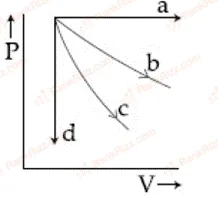
The given diagram shows four processes i.e., isochoric, isobaric, isothermal and adiabatic. The correct assignment of the processes, in the same order is given by:

a d b c
d a b c
a d c b
d a c b
A rigid diatomic ideal gas undergoes an adiabatic process at room temperature. The relation between temperature and volume for this process is = constant, then x is:
One mole of an ideal monoatomic gas is compressed isothermally in a rigid vessel to double its pressure at room temperature, 27C. The work done on the gas will be:
300R ln 6
300R
300R ln 7
300R ln 2
Consider a spherical shell of radius R at temperature T. The black body radiation inside it can be considered as an ideal gas of photons with internal energy per unit volume and pressure . If the shell now undergoes an adiabatic expansion the relation between T and R is:
During an adiabatic compression, 830 J of work is done on 2 moles of a diatomic ideal gas to reduce its volume by 50%. The change in its temperature is nearly: (R = 8.3 JK mol)
40 K
33 K
20 K
14 K
An ideal gas at atmospheric pressure is adiabatically compressed so that its density becomes 32 times of its initial value. If the final pressure of gas is 128 atmospheres, the value of '' of the gas is :
1.5
1.4
1.3
1.6
This question has Statement 1 and Statement 2. Of the four choices given after the Statements, choose the one that best describes the two Statements. Statement 1: In an adiabatic process, change in internal energy of a gas is equal to work done on/by the gas in the process. Statement 2: The temperature of a gas remains constant in an adiabatic process.
Statement 1 is true, Statement 2 is true, Statement 2 is a correct explanation of Statement 1.
Statement 1 is true, Statement 2 is false.
Statement 1 is false, Statement 2 is true.
Statement 1 is false, Statement 2 is true, Statement 2 is not a correct explanation of Statement 1.
An ideal monatomic gas with pressure , volume and temperature is expanded isothermally to a volume and a final pressure . If the same gas is expanded adiabatically to a volume , the final pressure is . The ratio is
A given ideal gas with at a temperature . If the gas is compressed adiabatically to one-fourth of its initial volume, the final temperature will be
The work of is performed in order to compress one kilo mole of gas adiabatically and in this process the temperature of the gas increases by . The gas is
monoatomic
diatomic
triatomic
a mixture of monoatomic and diatomic