JEE MAIN 2024 · 27 JAN S2Isothermal and adiabatic processes
During an adiabatic process, the pressure of a gas is found to be proportional to the cube of its absolute temperature. The ratio of for the gas is :
- A
- B
- C
- D
Isothermal and adiabatic processes has been asked 54 times in JEE Main, in 14 different years between 2006 and 2026, and in all of the last five exam years (2022–2026), 33 questions in all. That is 28% of Thermodynamics, its most-asked topic. Last asked in JEE Main 08 Apr 2026, Shift 2. 47 are multiple choice and 7 numerical-value; 16 easy and 34 medium by our difficulty labels. All of them are below, newest first, free to read.
Questions
54
Years asked
14
Since
2006
Of the chapter
28%
21–40 OF 54 · NEWEST FIRST
During an adiabatic process, the pressure of a gas is found to be proportional to the cube of its absolute temperature. The ratio of for the gas is :
The initial pressure and volume of an ideal gas are and . The final pressure of the gas when the gas is suddenly compressed to volume will be:
(Given = ratio of specific heats at constant pressure and at constant volume.)
Consider two containers A and B containing monoatomic gases at the same Pressure , Volume and Temperature . The gas in A is compressed isothermally to of its original volume while the gas in B is compressed adiabatically to of its original volume. The ratio of final pressure of gas in B to that of gas in A is
8
4
A gas is compressed adiabatically, which one of the following statement is NOT true?
There is no heat supplied to the system
There is no change in the internal energy
The temperature of the gas increases
The change in the internal energy is equal to the work done on the gas
A sample of gas at temperature is adiabatically expanded to double its volume. The work done by the gas in the process is, (given ):
A hypothetical gas expands adiabatically such that its volume changes from 08 litres to 27 litres. If the ratio of final pressure of the gas to initial pressure of the gas is . Then the ratio of will be.
Heat is given to an ideal gas in an isothermal process.
A. Internal energy of the gas will decrease.
B. Internal energy of the gas will increase.
C. Internal energy of the gas will not change.
D. The gas will do positive work.
E. The gas will do negative work.
Choose the correct answer from the options given below:
A and E only
B and D only
C and E only
C and D only
In an Isothermal change, the change in pressure and volume of a gas can be represented for three different temperature; as:
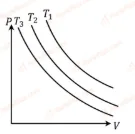
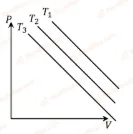
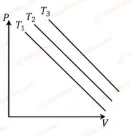
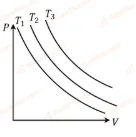
The pressure and density of diatomic gas changes suddenly to and respectively during an adiabatic process. The temperature of the gas increases and becomes _____ times of its initial temperature. (Given )
A monoatomic gas at pressure and volume is suddenly compressed to one eighth of its original volume. The final pressure at constant entropy will be
A certain amount of gas of volume at temperature and pressure expands isothermally until its volume gets doubled. Later it expands adiabatically until its volume gets redoubled. The final pressure of the gas will be (Use )
Starting with the same initial conditions, an ideal gas expands from volume to in three different ways. The work done by the gas is if the process is purely isothermal, , if the process is purely adiabatic and if the process is purely isobaric. Then, choose the correct option
Statement - I : When amount of an ideal gas undergoes adiabatic change from state to state , then work done is , where and = universal gas constant.
Statement - II : In the above case, when work is done on the gas, the temperature of the gas would rise.
Both statement-I and statement-II are true.
Both statement-I and statement-II are false.
Statement-I is true but statement-II is false.
Statement-I is false but statement-II is true.
A sample of gas with is taken through an adiabatic process in which the volume is compressed from 1200 cm to 300 cm. If the initial pressure is 200 kPa. The absolute value of the workdone by the gas in the process = _________ J.
One mole of an ideal gas is taken through an adiabatic process where the temperature rises from 27°C to 37°C. If the ideal gas is composed of polyatomic molecule that has 4 vibrational modes, which of the following is true? [R = 8.314 J mol K]
work done by the gas is close to 332 J
work done on the gas is close to 582 J
work done by the gas is close to 582 J
work done on the gas is close to 332 J
A monoatomic ideal gas, initially at temperature is enclosed in a cylinder fitted with a frictionless piston. The gas is allowed to expand adiabatically to a temperature by releasing the piston suddenly. If and are the lengths of the gas column, before and after the expansion respectively, then the value of will be:
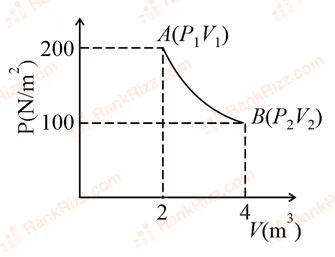
One mole of an ideal gas at 27 C is taken from A to B as shown in the given PV indicator diagram. The work done by the system will be ___ J. [Given, J mole K, ln 2 = 0.6931] (Round off to the nearest integer)
For an adiabatic expansion of an ideal gas, the fractional change in its pressure is equal to (where is the ratio of specific heats):
Which one is the correct option for the two different thermodynamic processes?

(c) and (a)
(c) and (d)
(a) only
(b) and (c)
In an adiabatic process, the density of a diatomic gas becomes times its initial value. The final pressure of the gas is found to be times the initial pressure. The value of is:
32
326
128