JEE MAIN 2022 · 24 JUN S2Kepler's laws and planetary motion
The distance between Sun and Earth is . The duration of year if the distance between Sun and Earth becomes will be :
- A
yr
- B
yr
- C
yr
- D
yr
Kepler's laws and planetary motion has been asked 45 times in JEE Main, in 13 different years between 2004 and 2026, and in all of the last five exam years (2022–2026), 21 questions in all. That is 22% of Gravitation, one of its three most-asked topics. Last asked in JEE Main 02 Apr 2026, Shift 1. 43 are multiple choice and 2 numerical-value; 18 easy, 23 medium and 2 hard by our difficulty labels. All of them are below, newest first, free to read.
Questions
45
Years asked
13
Since
2004
Of the chapter
22%
21–40 OF 45 · NEWEST FIRST
The distance between Sun and Earth is . The duration of year if the distance between Sun and Earth becomes will be :
yr
yr
yr
yr
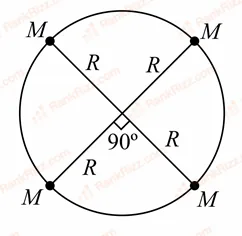
Four particles each of mass , move along a circle of radius under the action of their mutual gravitational attraction as shown in figure. The speed of each particle is:
Two satellites revolve around a planet in coplanar circular orbits in anticlockwise direction. Their period of revolutions are 1 hour and 8 hours respectively. The radius of the orbit of nearer satellite is km. The angular speed of the farther satellite as observed from the nearer satellite at the instant when both the satellites are closest is rad h, where is _________.
Two identical particles of mass 1 kg each go round a circle of radius , under the action of their mutual gravitational attraction. The angular speed of each particle is:
The minimum and maximum distances of a planet revolving around the Sun are and . If the minimum speed of the planet on its trajectory is , then its maximum speed will be:
The angular momentum of a planet of mass moving around the sun in an elliptical orbit is . The magnitude of the areal velocity of the planet is :
The maximum and minimum distances of a comet from the Sun are m and m respectively. If the speed of the comet at the nearest point is m s, the speed at the farthest point is:
m s
m s
m s
m s
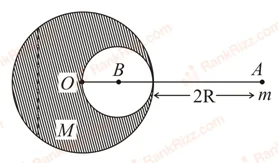
A solid sphere of radius gravitationally attracts a particle placed at from its centre with a force . Now a spherical cavity of radius is made in the sphere (as shown in figure) and the force becomes . The value of is:
41 : 50
50 : 41
25 : 36
36 : 25
Four identical particles of equal mass of 1 kg are made to move along the circumference of a circle of radius 1 m under the action of their own mutual gravitational attraction. The speed of each particle will be:
Two stars of masses and at a distance rotate about their common centre of mass in free space. The period of revolution is:
A satellite is in an elliptical orbit around a planet . It is observed that the velocity of the satellite when it is farthest from the planet is 6 times less than that when it is closest to the planet. The ratio of distances between the satellite and the planet at closest and farthest points is:
1 : 6
1 : 3
1 : 2
3 : 4
A spaceship orbits around a planet at a height of 20 km from its surface. Assuming that only gravitational field of the planet acts on the spaceship, what will be the number of complete revolutions made by the spaceship in 24 hours around the planet?
[Given: Mass of planet = kg, Radius of planet = m, Gravitational constant G = Nm/kg]
17
9
13
11
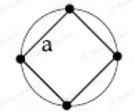
Four identical particles of mass M are located at the corners of a square of side 'a'. What should be their speed if each of them revolves under the influence of other's gravitational field in a circular orbit circumscribing the square?
A straight rod of length L extends from to . The gravitational force it exerts on a point mass 'm' at , if the mass per unit length of the rod is , is given by:
If the angular momentum of a planet of mass , moving around the Sun in a circular orbit is , about the center of the Sun, its areal velocity is:
A body of mass m is moving in a circular orbit of radius R about a planet of mass M. At some instant, it splits into two equal masses. The first mass moves in a circular orbit of radius , and the other mass, in a circular orbit of radius . The difference between the final and initial total energies is:
Take the mean distance of the moon and the sun from the earth to be km and km respectively. Their masses are kg and kg respectively. The radius of the earth is 6400 km. Let be the difference in the forces exerted by the moon at the nearest and farthest points on the earth and be the difference in the force exerted by the sun at the nearest and farthest points on the earth. Then, the number closest to is:
2
6
0.6
A particle is moving with a uniform speed in a circular orbit of radius R in a central force inversely proportional to the power of R. If the period of rotation of the particle is T, then:
for any n
An astronaut of mass is working on a satellite orbiting the earth at a distance from the earth's surface. The radius of the earth is , while its mass is . The gravitational pull on the astronaut is
Zero since astronaut feels weightless
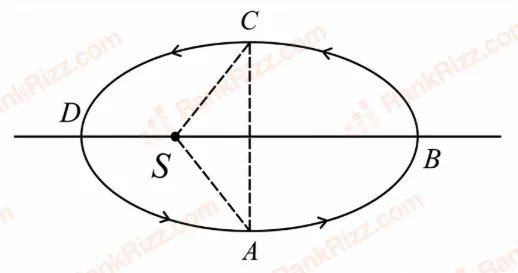
The figure shows an elliptical path of a planet around the sun such that the area of triangle is the area of the ellipse (see the figure below) with as the major axis, and as the minor axis. If is the time taken for the planet to go over the path and for the path taken over then: