JEE MAIN 2021 · 17 MAR S2Photoelectric effect and Einstein's equation
Two identical photocathodes receive the light of frequencies and respectively. If the velocities of the photo-electrons coming out are and respectively, then:
- A
- B
- C
- D
Photoelectric effect and Einstein's equation has been asked 98 times in JEE Main, in 19 different years between 2004 and 2026, and in all of the last five exam years (2022–2026), 52 questions in all. That is 45% of Dual Nature of Radiation & Matter, its most-asked topic. Last asked in JEE Main 08 Apr 2026, Shift 2. 91 are multiple choice and 7 numerical-value; 41 easy and 45 medium by our difficulty labels. All of them are below, newest first, free to read.
Questions
98
Years asked
19
Since
2004
Of the chapter
45%
61–80 OF 98 · NEWEST FIRST
Two identical photocathodes receive the light of frequencies and respectively. If the velocities of the photo-electrons coming out are and respectively, then:
The stopping potential in the context of photoelectric effect depends on the following property of incident electromagnetic radiation:
Phase
Intensity
Amplitude
Frequency
Two stream of photons, possessing energies equal to twice and ten times the work function of metal are incident on the metal surface successively. The value of ratio of maximum velocities of the photoelectrons emitted in the two respective cases is . The value of is
The stopping potential for electrons emitted from a photosensitive surface illuminated by light of wavelength 491 nm is 0.710 V. When the incident wavelength is changed to a new value, the stopping potential is 1.43 V. The new wavelength is:
382 nm
309 nm
329 nm
400 nm
The surface of a metal is illuminated alternately with photons of energies and respectively. The ratio of maximum speeds of the photoelectrons emitted in the two cases is 2. The work function of the metal in (eV) is..........
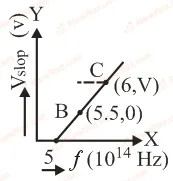
Given figure shows few data points in a photo-electric effect experiment for a certain metal. The minimum energy for ejection of electrons from its surface is: (Planck's constant h = 6.62 10 J.s)
2.27 eV
2.59 eV
1.93 eV
2.10 eV
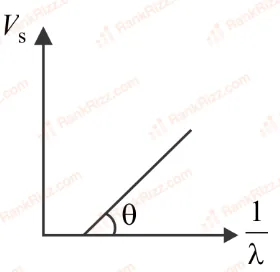
In a photoelectric effect experiment, the graph of stopping potential versus reciprocal of wavelength obtained is shown in the figure. As the intensity of incident radiation is increased:
Straight line shifts to right
Slope of the straight line get more steep
Straight line shifts to left
Graph does not change
When the wavelength of radiation falling on a metal is changed from 500 nm to 200 nm, the maximum kinetic energy of the photoelectrons becomes three times larger. The work function of the metal is close to:
0.81 eV
1.02 eV
0.52 eV
0.61 eV
When radiation of wavelength A is used to illuminate a metallic surface, the stopping potential is V. When the same surface is illuminated with radiation of wavelength 3A, the stopping potential is . If the threshold wavelength for the metallic surface is then value of n will be ___________.
Radiation, with wavelength Å falls on a metal surface to produce photoelectrons. The electrons are made to enter a uniform magnetic field of T. If the radius of the largest circular path followed by the electrons is mm, the work function of the metal is close to:
1.6 eV
0.8 eV
1.1 eV
1.8 eV
When photon of energy 4.0 eV strikes the surface of a metal A, the ejected photoelectrons have maximum kinetic energy eV and de-Broglie wavelength . The maximum kinetic energy of photoelectrons liberated from another metal B by photon of energy 4.50 eV is eV. If the de-Broglie wavelength of these photoelectrons , then the work function of metal B is:
4 eV
2 eV
1.5 eV
3 eV
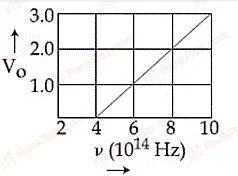
The stopping potential V (in volt) as a function of frequency () for a sodium emitter, is shown in the figure. The work function of sodium, from the data plotted in the figure, will be:
(Given: Planck's constant h = J s, electron charge (e) = C)
2.12 eV
1.82 eV
1.95 eV
1.66 eV
In a photoelectric effect experiment, the threshold wavelength of light is 380 nm. If the wavelength of incident light is 260 nm, the maximum kinetic energy of emitted electrons will be
Given E (in eV) =
4.5 eV
3.0 eV
1.5 eV
15.1 eV
The electric field of light wave is given as . This light falls on a metal plate of work function 2 eV. The stopping potential of the photo-electrons is: Given, E (in eV) =
0.72 V
2.0 V
2.48 V
0.48 V
When a certain photosensitive surface is illuminated with monochromatic light of frequency , the stopping potential of the photo current is . When the surface is illuminated by monochromatic light of frequency , the stopping potential is . The threshold frequency for photoelectric emission is
In a photoelectric experiment, the wavelength of the light incident on a metal is changed from 300 nm to 400 nm. The decrease in the stopping potential is close to:
0.5 V
1.5 V
1.0 V
2.0 V
A metal plate of area m is illuminated by a radiation of intensity 16 m W/m. The work function of the metal is 5 eV. The energy of the incident photons is 10 eV and only 10% of it produces photo electrons. The number of emitted photo electrons per second and their maximum energy, respectively, will be: [ J]
and 10 eV
and 5 eV
and 5 eV
and 5 eV
The surface of certain metal is first illuminated with light of wavelength nm and then, by a light of wavelength nm. It is found that the maximum speed of the photoelectrons in the two cases differ by a factor of 2. The work function of the metal (in eV) is close to (Energy of photon eV)
2.5
1.8
5.6
1.4
The magnetic field associated with a light wave is given, at the origin, by . If this light falls on a silver plate having a work function of 4.7 eV, what will be the maximum kinetic energy of the photoelectrons? ( m s, J s)
6.82 eV
7.72 eV
12.5 eV
8.52 eV
The maximum velocity of the photoelectrons emitted from the surface is when light of frequency falls on a metal surface. If the incident frequency is increased to , the maximum velocity of the ejected photoelectrons will be:
more than
equal to
less than
RELATED DUAL NATURE OF RADIATION & MATTER TOPICS