JEE MAIN 2020 · 09 JAN S1de Broglie wavelength of matter waves
A particle moving with kinetic energy has de Broglie wavelength . If energy is added to its energy, the wavelength become . Value of , is:
- A
- B
- C
- D
de Broglie wavelength of matter waves has been asked 82 times in JEE Main, in 14 different years between 2005 and 2026, and in all of the last five exam years (2022–2026), 40 questions in all. That is 38% of Dual Nature of Radiation & Matter, one of its three most-asked topics. Last asked in JEE Main 06 Apr 2026, Shift 2. 77 are multiple choice and 5 numerical-value; 38 easy, 41 medium and 2 hard by our difficulty labels. All of them are below, newest first, free to read.
Questions
82
Years asked
14
Since
2005
Of the chapter
38%
61–80 OF 82 · NEWEST FIRST
A particle moving with kinetic energy has de Broglie wavelength . If energy is added to its energy, the wavelength become . Value of , is:
An electron of mass and magnitude of charge at rest, gets accelerated by a constant electric field . The rate of change of de-Broglie wavelength of this electron at time is (ignore relativistic effects):
An electron (mass m) with initial velocity is in an electric field . If is initial de-Broglie wavelength of electron, its de-Broglie wave length at time is given by:
An electron (of mass ) and a photon have the same energy in the range of a few eV. The ratio of the de-Broglie wavelength associated with the electron and the wavelength of the photon is (c = speed of light in vacuum)
A particle 'P' is formed due to a completely inelastic collision of particles 'x' and 'y' having de-Broglie wavelengths '' and '' respectively. If x and y were moving in opposite directions, then the de-Broglie wavelength of 'P' is:
Two particles move at right angle to each other. Their de Broglie wavelengths are and respectively. The particles suffer perfectly inelastic collision. The de Broglie wavelength of the final particle, is given by:
A nucleus A, with a finite de-broglie wavelength , undergoes spontaneous fission into two nuclei B and C of equal mass. B flies in the same direction as that of A, while C flies in the opposite direction with a velocity equal to half of that of B. The de-Broglie wavelengths and of B and C are respectively:
A particle A of mass m and charge q is accelerated by a potential difference of 50 V. Another particle B of mass 4m and charge q is accelerated by a potential difference of 2500 V. The ratio of de-Broglie wavelengths is close to:
0.07
10.00
4.47
14.14
If the deBroglie wavelength of an electron is equal to times the wavelength of a photon of frequency Hz, then the speed of electron is equal to: (Speed of light m/s, Planck's constant J.s, Mass of electron kg)
m/s
m/s
m/s
m/s
In an electron microscope, the resolution that can be achieved is of the order of the wavelength of electrons used. To resolve a width of m, the minimum electron energy required is close to:
100 keV
25 keV
1 keV
500 keV
The de-Broglie wavelength () associated with the electron orbiting in the second excited state of hydrogen atom is related to that in the ground state () by:
Two electrons are moving with non-relativistic speeds perpendicular to each other. If corresponding de Broglie wavelengths are and , their de Broglie wavelength in the frame of reference attached to their centre of mass is:
If the de Broglie wavelengths associated with a proton and an -particle are equal, then the ratio of velocities of the proton and the -particle will be:
1 : 4
1 : 2
4 : 1
2 : 1
An electron beam is accelerated by a potential difference to hit a metallic target to produce X-rays. It produces continuous as well as characteristic X-rays. If is the smallest possible wavelength of X-ray in the spectrum, the variation of with is correctly represented in:
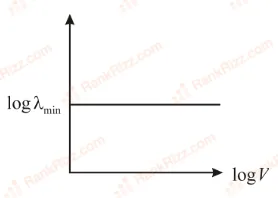
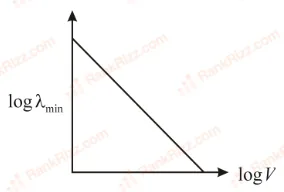
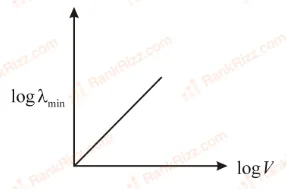
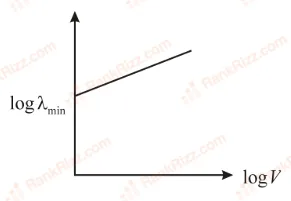
A particle of mass and initial velocity collides with a particle of mass which is at rest. The collision is head on, and elastic. The ratio of the de-Broglie wavelengths to after the collision is:
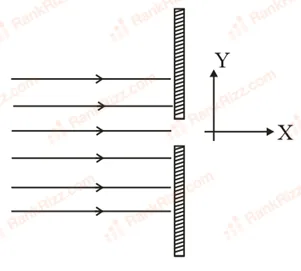
A parallel beam of electrons travelling in x - direction falls on a slit of width d (see the figure below). If after passing the slit, an electron acquires momentum in the y - direction, then for a majority of electrons passing through the slit (h is Planck's constant):
De-Broglie wavelength of an electron accelerated by a voltage of 50 V is close to C, kg, J s
0.5
1.2
1.7
2.4
Match List-I (Experiment performed) with List-II (Phenomena discovered/associated) and select the correct option from the options given below the lists.
List-I: List-II:
(a) Davisson and Germer experiment (i) Wave nature of electrons
(b) Millikan's oil drop experiment (ii) Charge of an electron
(c) Rutherford experiment (iii) Quantisation of energy levels
(d) Franck-Hertz experiment (iv) Existence of the nucleus
(a)-(iii), (b)-(iv), (c)-(i), (d)-(ii)
(a)-(i), (b)-(ii), (c)-(iv), (d)-(iii)
(a)-(iv), (b)-(iii), (c)-(ii), (d)-(i)
(a)-(i), (b)-(ii), (c)-(iii), (d)-(iv)
For which of the following particles will it be most difficult to experimentally verify the de-Broglie relationship?
An electron
An -particle
A dust particle
A proton
Electrons are accelerated through a potential difference V and protons are accelerated through a potential difference 4 V. The de-Broglie wavelengths are and for electrons and protons respectively. The ratio of is given by: (given is mass of electron and is mass of proton).
RELATED DUAL NATURE OF RADIATION & MATTER TOPICS