JEE MAIN 2021 · 24 FEB S2Properties of colloids and coagulation
Most suitable salt which can be used for efficient clotting of blood will be?
- A
- B
- C
- D
Properties of colloids and coagulation has been asked 71 times in JEE Main, in 13 different years between 2005 and 2023, and in 2 of the last five exam years (2022–2026), 25 questions in all. That is 58% of Surface Chemistry, its most-asked topic. Last asked in JEE Main 15 Apr 2023, Shift 1. 65 are multiple choice and 6 numerical-value; 52 easy, 15 medium and 1 hard by our difficulty labels. All of them are below, newest first, free to read.
Questions
71
Years asked
13
Since
2005
Of the chapter
58%
41–60 OF 71 · NEWEST FIRST
Most suitable salt which can be used for efficient clotting of blood will be?
Kraft temperature is the temperature:
below which the aqueous solution of detergents starts freezing
below which the formation of micelles takes place
above which the aqueous solution of detergents starts boiling
above which the formation of micelles takes place
Identify the correct molecular picture showing what happens at the critical micellar concentration (CMC) of an aqueous solution of a surfactant.

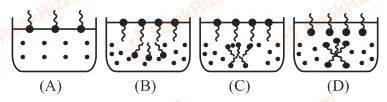
(D)
(B)
(A)
(C)
Match the following:
(i) Foam (a) smoke
(ii) Gel (b) cell fluid
(iii) Aerosol (c) jellies
(iv) Emulsion (d) rubber
(e) froth
(f) milk
(i)-(b), (ii)-(c), (iii)-(e), (iv)-(d)
(i)-(d), (ii)-(b), (iii)-(a), (iv)-(e)
(i)-(e), (ii)-(c), (iii)-(a), (iv)-(f)
(i)-(d), (ii)-(b), (iii)-(e), (iv)-(f)
A sample of red ink (a colloidal suspension) is prepared by mixing eosine dye, egg white, HCHO and water. The component which ensures stability of the ink sample is:
Egg white
Water
HCHO
Eosin dye
Tyndall effect is observed when:
The diameter of dispersed particles is much larger than the wavelength of light used.
The diameter of dispersed particles is much smaller than the wavelength of light used
The refractive index of dispersed phase is greater than that of the dispersion medium.
The diameter of dispersed particles is similar to the wavelength of light used.
An ionic micelle is formed on the addition of:
liquid diethyl ether to aqueous NaCl solution
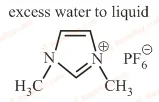
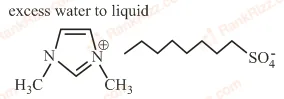
Sodium stearate to pure toluene
Which of the following is used for the preparation of colloids?
Ostwald process
Van Arkel Method
Bredig's Arc Method
Mond Process
As per Hardy-Schulze formulation, the flocculation values of the following for ferric hydroxide sol are in the order:
K[Fe(CN)] < KCrO < KBr = KNO = AlCl
K[Fe(CN)] < KCrO < AlCl < KBr < KNO
AlCl > K[Fe(CN)] > KCrO > KBr = KNO
K[Fe(CN)] > AlCl > KCrO > KBr > KNO
The flocculation value of HCl for arsenic sulphide sol is 30 mmolL. If HSO is used for the flocculation of arsenic sulphide, the amount, in grams, of HSO in 250 ml required for the above purpose is (molecular mass of HSO = 98 g/mol)
Peptization is a:
Process of converting a colloidal solution into precipitate
Process of converting soluble particles to form colloidal solution
Process of bringing colloidal molecule into solution
Process of converting precipitate into colloidal solution
Among the following, the incorrect statement about colloids is:
They are larger than small molecules and have high molar mass.
They can scatter light.
The osmotic pressure of a colloidal solution is of higher order than the true solution at the same concentration.
The range of diameters of colloidal particles is between 1 and 1000 nm.
The correct option among the following is.
Brownian motion in colloidal solution is faster if the viscosity of the solution is very high.
Colloidal particles in lyophobic sols can be precipitated by electrophoresis.
Colloidal medicines are more effective because they have small surface area.
Addition of alum to water makes it unfit for drinking.
The aerosol is a kind of colloid in which:
solid is dispersed in gas.
liquid is dispersed in water.
gas is dispersed in solid.
gas is dispersed in liquid.
Among the following, the false statement is:
Latex is a colloidal solution of rubber particles which are positively charged
Tyndall effect can be used to distinguish between a colloidal solution and a true solution.
It is possible to cause artificial rain by throwing electrified sand carrying charge opposite to the one on clouds from an aeroplane.
Lyophilic sols can be coagulated by adding an electrolyte.
An example of solid sol is:
Paint
Gem stones
Butter
Hair cream
Among the colloids cheese (C), milk (M) and smoke (S), the correct combination of the dispersed phase and dispersion medium, respectively is:
C : liquid in solid; M : liquid in solid; S : solid in gas
C : liquid in solid; M : liquid in liquid; S : solid in gas
C : solid in liquid; M : liquid in liquid; S : gas in solid
C : solid in liquid; M : solid in liquid; S : solid in gas
The haemoglobin and the gold sol are examples of:
positively charged sols
negatively and positively charged sols, respectively
negatively charged sols
positively and negatively charged sols, respectively
For coagulation of arsenious sulphide sol, which of the following salt solutions will be most effective?
Which of the following statements about colloids is false?
When silver nitrate solution is added to potassium iodide solution, a negatively charged colloidal solution is formed
Freezing point of colloidal solution is lower than true solution at same concentration of a solute
Colloidal particles can pass through ordinary filter paper
When excess of electrolyte is added to colloidal solution, colloidal particle will be precipitated
RELATED SURFACE CHEMISTRY TOPICS