In chromatography, which of the following statements is incorrect for R?
- A
Higher R value means higher adsorption.
- B
The value of R cannot be more than one.
- C
R value depends on the type of chromatography.
- D
R value of dependent on the mobile phase.
Methods of purification of organic compounds has been asked 70 times in JEE Main, in 12 different years between 2015 and 2026, and in all of the last five exam years (2022–2026), 44 questions in all. That is 46% of Purification and Characterisation of Organic Compounds, one of its three most-asked topics. Last asked in JEE Main 08 Apr 2026, Shift 2. 57 are multiple choice and 13 numerical-value; 51 easy and 14 medium by our difficulty labels. All of them are below, newest first, free to read.
Questions
70
Years asked
12
Since
2015
Of the chapter
46%
61–70 OF 70 · NEWEST FIRST
In chromatography, which of the following statements is incorrect for R?
Higher R value means higher adsorption.
The value of R cannot be more than one.
R value depends on the type of chromatography.
R value of dependent on the mobile phase.
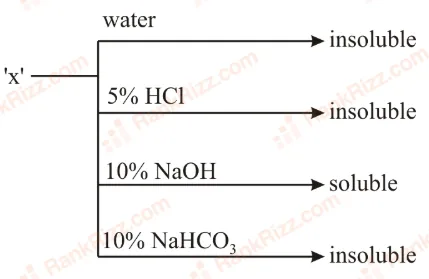
An organic compound 'X' showing the following solubility profile is:

m-Cresol
o-Toluidine
Oleic acid
Benzamide
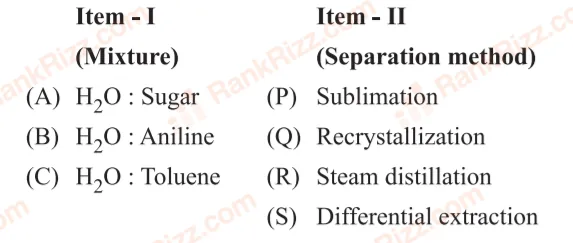
The correct match between items I and II is:

(A) (S); (B) (R); (C) (P)
(A) (Q); (B) (R); (C) (S)
(A) (R); (B) (P); (C) (S)
(A) (Q); (B) (R); (C) (P)
If Dichloromethane (DCM) and water are used for differential extraction, which one of the following statements is correct?
DCM and would stay as upper and lower layer respectively in the separating funnel (S.F.)
DCM and will be miscible clearly
DCM and would stay as lower and upper layer respectively in the S.F.
DCM and will make turbid/colloidal mixture
The correct match between Item I and Item II is:
Item I Item II
(A) Benzaldehyde (P) Mobile phase
(B) Alumina (Q) Adsorbent
(C) Acetonitrile (R) Adsorbate
(A) (P); (B) (R); (C) (Q)
(A) (R); (B) (Q); (C) (P)
(A) (Q); (B) (P); (C) (R)
(A) (Q); (B) (R); (C) (P)
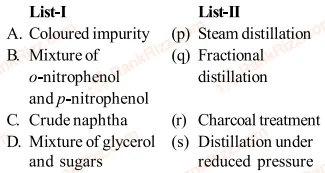
The correct match between items of List-I and List-II is:

(A)-(r), (B)-(s), (C)-(p), (D)-(q)
(A)-(p), (B)-(s), (C)-(r), (D)-(q)
(A)-(r), (B)-(p), (C)-(q), (D)-(s)
(A)-(r), (B)-(p), (C)-(s), (D)-(q)
Two compounds I and II are eluted by column chromatography (adsorption of I > II). Which one of the following is a correct statement?
II moves slower and has higher R value than I
II moves faster and has higher R value than I
I moves faster and has higher R value than II
I moves slower and has higher R value than I
Which of the following statements is not true about partition chromatography?
Stationary phase is a finely divided solid adsorbent.
Separation depends upon equilibration of solute between a mobile and a stationary phase.
Mobile phase can be a gas.
Paper chromatography is an example of partition chromatography.
The distillation technique most suited for separating glycerol from spent - lye in the soap industry is:
Steam distillation
Distillation under reduced pressure
Simple distillation
Fractional distillation
In Carius method of estimation of halogens, 250 mg of an organic compound gave 141 mg AgBr. What is the percentage of bromine in the compound (atomic mass of Ag = 108 and atomic number of Br = 80)?
60
24
36
48
RELATED PURIFICATION AND CHARACTERISATION OF ORGANIC COMPOUNDS TOPICS