JEE MAIN 2022 · 27 JUN S1Methods of purification of organic compounds
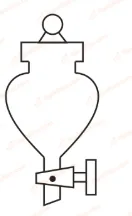
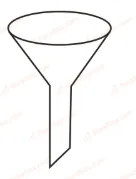
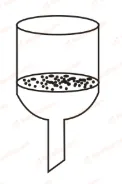
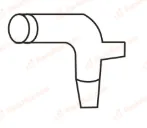
Which of the following is structure of a separating funnel?
- A
- B
- C
- D
Methods of purification of organic compounds has been asked 70 times in JEE Main, in 12 different years between 2015 and 2026, and in all of the last five exam years (2022–2026), 44 questions in all. That is 46% of Purification and Characterisation of Organic Compounds, one of its three most-asked topics. Last asked in JEE Main 08 Apr 2026, Shift 2. 57 are multiple choice and 13 numerical-value; 51 easy and 14 medium by our difficulty labels. All of them are below, newest first, free to read.
Questions
70
Years asked
12
Since
2015
Of the chapter
46%
41–60 OF 70 · NEWEST FIRST
Which of the following is structure of a separating funnel?
g of an organic compound containing chlorine gave g of silver chloride in Carius estimation. The percentage of chlorine present in the compound is ______ [in nearest integer]
(Given: Molar mass of Ag is g mol and that of Cl is g mol)
Phenol on reaction with dilute nitric acid, gives two products. Which method will be most efficient for large scale separation?
Chromatographic separation
Steam distillation
Fractional Crystallisation
Sublimation
Given below are two statements: one is labelled as Assertion and the other is labelled as Reason.
Assertion: A mixture contains benzoic acid and naphthalene. The pure benzoic acid can be separated out by the use of benzene.
Reason: Benzoic acid is soluble in hot water.
In the light of the above statements, choose the most appropriate answer from the options given below.
Both Assertion and Reason are true and Reason is the correct explanation of Assertion.
Both Assertion and Reason are true but Reason is not the correct explanation of Assertion.
Assertion is true but Reason is false.
Assertion is false but Reason is true.
Given below are two statements : one is labelled as Assertion (A) and the other is labelled as Reason.
Assertion (A): A simple distillation can be used to separate a mixture of propanol and propanone.
Reason (R): Two liquids with a difference of more than 20°C in their boiling points can be separated by simple distillations.
In the light of the above statements, choose the most appropriate answer from the options given below:
Both (A) and (R) are correct but (R) is not the correct explanation of (A).
Both (A) and (R) are correct and (R) is the correct explanation of (A).
(A) is true but (R) is false.
(A) is false but (R) is true.
In the sulphur estimation, 0.471 g of an organic compound gave 1.44 g of barium sulfate. The percentage of sulphur in the compound is _________ (Nearest integer) (Atomic Mass of Ba = 137u)
An organic compound is subjected to chlorination to get compound A using 5.0 g of chlorine. When 0.5 g of compound A is reacted with AgNO [Carius Method], the percentage of chlorine in compound A is when it forms 0.3849 g of AgCl. (Round off to the Nearest Integer)
(Atomic masses of Ag and Cl are 107.87 and 35.5 respectively)
Which purification technique is used for high boiling organic liquid compound (decomposes near its boiling point)?
Simple distillation
Steam distillation
Fractional distillation
Reduced pressure distillation
When 0.15 g of an organic compound was analyzed using Carius method for estimation of bromine, 0.2397 g of AgBr was obtained. The percentage of bromine in the organic compound is ___. (Nearest integer)
[Atomic mass : Silver = 108, Bromine = 80]
Given below are two statements:
Statement-I: Retardation factor () can be measured in meter/centimetre.
Statement-II: value of a compound remains constant in all solvents.
Choose the most appropriate answer from the options given below:
Statement-I is true but statement-II is false
Both statement-I and statement-II are true
Both statement-I and statement-II are false
Statement-I is false but statement-II is true
In chromatography technique, the purification of a compound is independent of:
Mobility or flow of solvent system
Solubility of the compound
Length of the column or TLC Plate
Physical state of the pure compound
Match List-I with List-II:
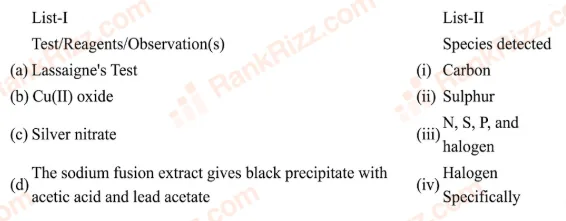
The correct match is:
(a)-(iii), (b)-(i), (c)-(ii), (d)-(iv)
(a)-(i), (b)-(iv), (c)-(iii), (d)-(ii)
(a)-(iii), (b)-(i), (c)-(iv), (d)-(ii)
(a)-(i), (b)-(ii), (c)-(iv), (d)-(iii)
Using the provided information in the following paper chromatogram:
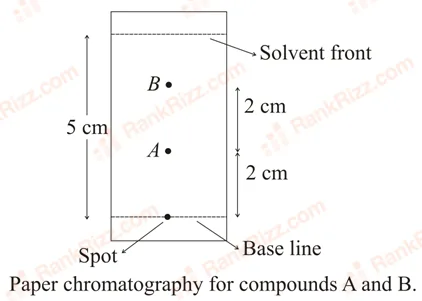
The calculated value of A is ______ .
Which of the following compound is added to the sodium extract before addition of silver nitrate for testing of halogens?
Nitric acid
Sodium hydroxide
Ammonia
Hydrochloric acid
The number of chiral centres present in [B] is __________

Glycerol is separated in soap industries by:
Fractional distillation
Differential distillation
Steam distillation
Distillation under reduced pressure
A flask contains a mixture of isohexane and 3-methylpentane. One of the liquids boils at 63C while the other boils at 60C. What is the best way to separate the two liquids and which one will be distilled out first?
fractional distillation, isohexane
simple distillation, 3-methylpentane
simple distillation, isohexane
fractional distillation, 3-methylpentane
A solution of m-chloroaniline, m-chlorophenol and m-chlorobenzoic acid in ethyl acetate was extracted initially with a saturated solution of NaHCO to give fraction A. The left over organic phase was extracted with dilute NaOH solution to give fraction B. The final organic layer was labelled as fraction C. Fractions A, B and C, contain respectively:
m-chlorobenzoic acid, m-chloroaniline and m-chlorophenol
m-chlorobenzoic acid, m-chlorophenol and m-chloroaniline
m-chlorophenol, m-chlorobenzoic acid and m-chloroaniline
m-chloroaniline, m-chlorobenzoic acid and m-chlorophenol
A chromatography column, packed with silica gel as stationary phase, was used to separate a mixture of compounds consisting of (A) benzanilide (B) aniline and (C) acetophenone. When the column is eluted with a mixture of solvents, hexane:ethyl acetate (20 : 80), the sequence of obtained compounds is:
(B), (C) and (A)
(B), (A) and (C)
(C), (A) and (B)
(A), (B) and (C)
The principle of column chromatography is:
Differential adsorption of the substances on the solid phase.
Differential absorption of the substances on the solid phase.
Gravitational force.
Capillary action
RELATED PURIFICATION AND CHARACTERISATION OF ORGANIC COMPOUNDS TOPICS