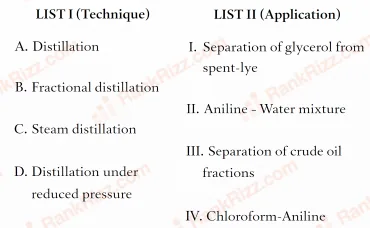
Match List I with List II:
Choose the correct answer from the options given below:
- A
A-IV, B-I, C-II, D-III
- B
A-IV, B-III, C-II, D-I
- C
A-I, B-II, C-IV, D-III
- D
A-II, B-III, C-I, D-IV
Methods of purification of organic compounds has been asked 70 times in JEE Main, in 12 different years between 2015 and 2026, and in all of the last five exam years (2022–2026), 44 questions in all. That is 46% of Purification and Characterisation of Organic Compounds, one of its three most-asked topics. Last asked in JEE Main 08 Apr 2026, Shift 2. 57 are multiple choice and 13 numerical-value; 51 easy and 14 medium by our difficulty labels. All of them are below, newest first, free to read.
Questions
70
Years asked
12
Since
2015
Of the chapter
46%
21–40 OF 70 · NEWEST FIRST
Match List I with List II:
Choose the correct answer from the options given below:
A-IV, B-I, C-II, D-III
A-IV, B-III, C-II, D-I
A-I, B-II, C-IV, D-III
A-II, B-III, C-I, D-IV
The fragrance of flowers is due to the presence of some steam volatile organic compounds called essential oils. These are generally insoluble in water at room temperature but are miscible with water vapour in the vapour phase. A suitable method for the extraction of these oils from the flowers is:
crystallisation
distillation under reduced pressure
distillation
steam distillation
On a thin layer chromatographic plate, an organic compound moved by , while the solvent moved by . The retardation factor of the organic compound is ____________ .
Which among the following purification methods is based on the principle of "Solubility" in two different solvents?
Column Chromatography
Sublimation
Distillation
Differential Extraction
Chromatographic technique/s based on the principle of differential adsorption is/are
A. Column chromatography B. Thin layer chromatography C. Paper chromatography
Choose the most appropriate answer from the options given below:
B only
A only
A & B only
C only
The technique used for purification of steam volatile water immiscible substance is :
Fractional distillation
Fractional distillation under reduced pressure
Distillation
Steam distillation
Which of the following statement is correct for paper chromatography?
Water present in the pores of the paper forms the stationary phase.
Paper sheet forms the stationary phase.
Water present in the mobile phase gets absorbed by the paper which then forms the stationary phase.
Paper and water present in its pores together form the stationary phase.
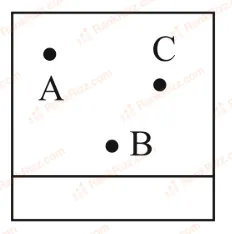
Three organic compounds A, B and C were allowed to run in thin layer chromatography using hexane and gave the following result (see figure). The R value of the most polar compound is _____

Thin layer chromatography of a mixture shows the following observation.
The correct order of elution in the silica gel column chromatography is
B, A, C
B, C, A
A, C, B
C, A, B
Using column chromatography, mixture of two compounds 'A' and 'B' was separated. 'A' eluted first, this indicates 'B' has
low Rf, stronger adsorption
high Rf, weaker adsorption
high Rf, stronger adsorption
low Rf, weaker adsorption
A, B and D only
A, B and C only
B and D only
B, C and D only
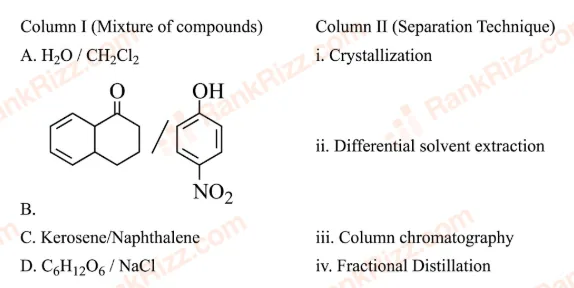
Match items of column I and II

A - (iii), B - (iv), C - (ii), D - (i)
A - (ii), B - (iii), C - (iv), D - (i)
A - (i), B - (iii), C - (ii), D - (iv)
A - (ii), B - (iv), C - (i), D - (iii)
Match List I with List II:
| List I (Mixture) | List II (Separation Technique) |
|---|---|
| (A) CHCl + CHNH | I. Steam distillation |
| (B) CH + CH | II. Differential extraction |
| (C) CHNH + HO | III. Distillation |
| (D) Organic compound in HO | IV. Fractional distillation |
A-IV, B-I, C-III, D-II
A-III, B-IV, C-I, D-II
A-II, B-I, C-III, D-IV
A-III, B-I, C-IV, D-II
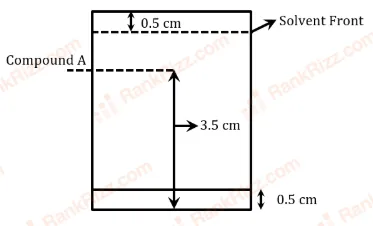
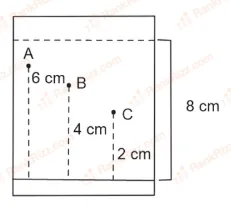
Following chromatogram was developed by adsorption of compound 'A' on a 6 cm TLC glass plate. Retardation factor of the compound 'A' is ______ .

Given below are two statements: One is labelled as Assertion A and the other is labelled as Reason R
Assertion A: Thin layer chromatography is an adsorption chromatography.
Reason R: A thin layer of silica gel is spread over a glass plate of suitable size in thin layer chromatography which acts as an adsorbent.
In the light of the above statements, choose the correct answer from the options given below
Both A and R are true and R is the correct explanation of A
Both A and R are true but R is NOT the correct explanation of A
A is true but R is false
A is false but R is true
Match List-I with List-II
| List-I (Mixture) | List-II (Purification Process) |
|---|---|
| A. Chloroform & Aniline | I. Steam distillation |
| B. Benzoic acid & Naphthalene | II. Sublimation |
| C. Water & Aniline | III. Distillation |
| D. Naphthalene & Sodium chloride | IV. Crystallisation |
A-IV, B-III, C-I, D-II
A-III, B-I, C-IV, D-II
A-III, B-IV, C-II, D-I
A-III, B-IV, C-I, D-II
Which technique among the following, is most appropriate in separation of a mixture of of -nitrophenol and picric acid?
Steam distillation
ft long column of silica gel
Sublimation
Preparative TLC (Thin Layer Chromatography)
The separation of two coloured substances was done by paper chromatography. The distances travelled by solvent front, substance A and substance B from the base line are , and respectively. The ratio of values of A to B is ______ (Answer the nearest integer).
Which one of the following techniques is not used to spot components of a mixture separated on thin layer chromatographic plate?
(Solid)
U.V. Light
Visualisation agent as a component of mobile phase
Spraying of an appropriate reagent
In the estimation of bromine, g of an organic compound gave g of silver bromide. The percentage of bromine in the given compound is ______ % (nearest integer)
(Relative atomic masses of Ag and Br are 108u and 80u, respectively).
RELATED PURIFICATION AND CHARACTERISATION OF ORGANIC COMPOUNDS TOPICS