JEE MAIN 2020 · 06 SEP S2Law of mass action and equilibrium constants Kc and Kp
The value of is 64 at 800 K for the reaction
The value of for the following reaction is:
- A
1/64
- B
8
- C
1/4
- D
1/8
Law of mass action and equilibrium constants Kc and Kp has been asked 93 times in JEE Main, in 18 different years between 2004 and 2026, and in all of the last five exam years (2022–2026), 47 questions in all. That is 34% of Chemical and Ionic Equilibrium, its most-asked topic. Last asked in JEE Main 08 Apr 2026, Shift 2. 54 are multiple choice and 39 numerical-value; 37 easy and 48 medium by our difficulty labels. All of them are below, newest first, free to read.
Questions
93
Years asked
18
Since
2004
Of the chapter
34%
61–80 OF 93 · NEWEST FIRST
The value of is 64 at 800 K for the reaction
The value of for the following reaction is:
1/64
8
1/4
1/8
Consider the following reaction:
For each of the following cases (a, b), the direction in which the equilibrium shifts is:
(a) Temperature is decreased.
(b) Pressure is increased by adding at constant T.
(a) towards product, (b) towards reactant
(a) towards reactant, (b) towards product
(a) towards reactant, (b) no change
(a) towards product, (b) no change
For a reaction , of X, of Y and of Z were taken in a 1L vessel and allowed to react. At equilibrium, the concentration of Z was . The equilibrium constant of the reaction is . The value of x is.......
For the equilibrium , the variation of the rate of the forward (a) and reverse (b) reaction with time is given by:
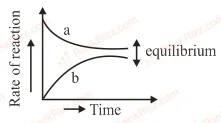
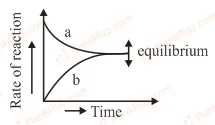
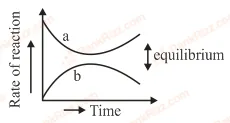
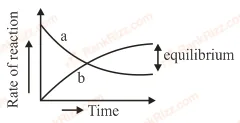
If the equilibrium constant for is and that of is , the equilibrium constant for is:
In the figure shown below reactant A (represented by square) is in equilibrium with product B (represented by circle). The equilibrium constant is (approx):
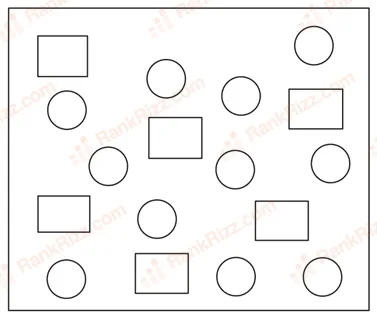
4
8
1
2
In which one of the following equilibria, K ≠ K?
2HI(g) H(g) + I(g)
2C(s) + O(g) 2CO(g)
2NO(g) N(g) + O(g)
NO(g) + SO(g) NO(g) + SO(g)
For the following reaction, equilibrium constants are given:
The equilibrium constant for the reaction, is:
In a chemical reaction, , the initial concentration of B was 1.5 times the concentration of A, but the equilibrium concentrations of A and B were found to be equal. The equilibrium constant (K) for the chemical reaction is:
1
4
16
Two solids dissociate as follows: ; atm, ; atm. The total pressure when both the solids dissociate simultaneously is:
atm
atm
(x + y) atm
atm
Consider the reaction . The equilibrium constant of the above reaction is . If pure ammonia is left to dissociate, the partial pressure of ammonia at equilibrium is given by (Assume that at equilibrium)
What are the values of for the following reactions at 300 K respectively?
(At 300 K, RT = 24.62 dm atm mol)
24.63 dm atm mol, 606.0 dm atm mol, dm atm mol
1, 24.62 dm atm mol, 606.0 dm atm mol
1, 24.62 dm atm mol, dm atm mol
1, dm atm mol, 606 dm atm mol
5.1 g is introduced in 3.0 L evacuated flask at 327C. 30% of the solid is decomposed to and as gases. The of the reaction at 327C is: ( L atm mol K, Molar mass of S = 32 g mol, Molar mass of N = 14 g mol)
0.242 atm
atm
atm
atm
Consider the following reversible chemical reactions:
The relation between and is:
At a certain temperature in a 5L vessel, 2 moles of carbon monoxide and 3 moles of chlorine were allowed to reach equilibrium according to the reaction, CO + Cl COCl. At equilibrium, if one mole of CO is present then equilibrium constant (K) for the reaction is:
2.5
4
2
3
A solid XY kept in an evacuated sealed container undergoes decomposition to form a mixture of gases X and Y at temperature T. The equilibrium pressure is 10 bar in this vessel. for this reaction is?
25
100
10
5
The equilibrium constant at 298 K for a reaction is 100. If the initial concentration of all the four species were 1 M each, then the equilibrium concentration of D (in mol ) will be:
1.818
1.182
0.182
0.818
Gaseous dissociates into gaseous according to the reaction . At 300 K and 1 atm pressure, the degree of dissociation of is 0.2. If one mole of gas is contained in a vessel, then the density of the equilibrium mixture is:
3.11 g/L
1.56 g/L
4.56 g/L
6.22 g/L
The standard Gibbs energy change at 300 K for the reaction is 2494.2 J. At a given time, the composition of the reaction mixture is , and . The reaction proceeds in the:
[R = 8.314 J/K-mol, e = 2.718] {Given antilog (-0.44) = 0.36}
Reverse direction because
Forward direction because
Reverse direction because
Forward direction because
For the decomposition of the compound, represented as NHCOONH(s) 2NH(g) + CO(g), the K = atm. If the reaction is started with 1 mole of the compound, the total pressure at equilibrium would be:
atm
atm
atm
atm
RELATED CHEMICAL AND IONIC EQUILIBRIUM TOPICS