Identify the factor from the following that does not affect electrolytic conductance of a solution.
- A
The nature of the electrolyte added.
- B
The nature of the electrode used.
- C
Concentration of the electrolyte.
- D
The nature of solvent used.
Conductance, conductivity and molar conductivity has been asked 70 times in JEE Main, in 14 different years between 2005 and 2026, and in all of the last five exam years (2022–2026), 42 questions in all. That is 31% of Electrochemistry, one of its three most-asked topics. Last asked in JEE Main 06 Apr 2026, Shift 1. 36 are multiple choice and 34 numerical-value; 23 easy, 43 medium and 2 hard by our difficulty labels. All of them are below, newest first, free to read.
Questions
70
Years asked
14
Since
2005
Of the chapter
31%
21–40 OF 70 · NEWEST FIRST
Identify the factor from the following that does not affect electrolytic conductance of a solution.
The nature of the electrolyte added.
The nature of the electrode used.
Concentration of the electrolyte.
The nature of solvent used.
One Faraday of electricity liberates gram atom of copper from copper sulphate, is ______.
The values of conductivity of some materials at 298.15 K in S m are , , , , , , . The number of conductors among the materials is
The mass of zinc produced by the electrolysis of zinc sulphate solution with a steady current of A for minutes is _______ g. (Atomic mass of zinc amu)
The mass of silver (Molar mass of Ag : ) displaced by a quantity of electricity which displaces mL of at S.T.P. will be ______ g.
The number of correct statements from the following is _____
(A) Conductivity always decreases with decrease in concentration for both strong and weak electrolytes.
(B) The number of ions per unit volume that carry current in a solution increases on dilution.
(C) Molar conductivity increases with decrease in concentration.
(D) The variation in molar conductivity is different for strong and weak electrolytes.
(E) For weak electrolytes, the change in molar conductivity with dilution is due to decrease in degree of dissociation.
A metal surface of cm area has to be coated with nickel layer of thickness mm. A current of 2A was passed through a solution of Ni(NO) for 'x' seconds to coat the desired layer. The value of x is _____. (Nearest integer)
(Ni (density of Nickel) is g mL, Molar mass of Nickel is g mol, F C mol)
The specific conductance of 0.0025M acetic acid is S cm at a certain temperature. The dissociation constant of acetic acid is _______ . (Nearest integer)
Consider limiting molar conductivity of CHCOOH as 400 S cm mol
M AgNO is added to L of saturated solution of AgBr. The conductivity of this solution at 298 K is _______ S m.
[Given: K(AgBr) at 298 K, Sm mol, Sm mol, Sm mol]
Which one of the following statements is correct for electrolysis of brine solution?
Cl is formed at cathode
O is formed at cathode
H is formed at anode
OH is formed at cathode
The resistivity of a 0.8M solution of an electrolyte is cm. Its molar conductivity is cm mol. (Nearest integer)
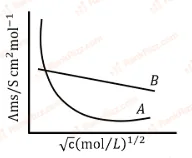
Following figure shows dependence of molar conductance of two electrolytes on concentration. is the limiting molar conductivity.
The number of Incorrect statement(s) from the following is ______
(A) for electrolyte A is obtained by extrapolation
(B) For electrolyte B, Vs graph is a straight line with intercept equal to
(C) At infinite dilution, the value of degree of dissociation approach zero for electrolyte B.
(D) for any electrolyte A or B can be calculated using for individual ions.
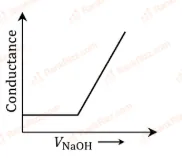
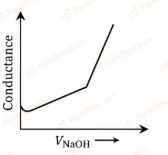
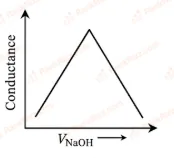
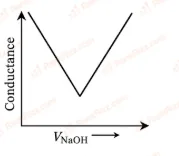
Choose the correct representation of conductometric titration of benzoic acid vs sodium hydroxide.


Resistance of a conductivity cell (cell constant 129 m) filled with 74.5 ppm solution of KCl is 100 (labelled as solution 1). When the same cell is filled with KCl 149 ppm solution of KCl, the resistance is 50 (labelled as solution 2). The ratio of molar conductivity of solution 1 and solution 2 is i.e. . The value of x is _____ (Given, molar mass of KCl is 74.5 g mol)
Given below are two statements:
Statement I: For KI, molar conductivity increases steeply with dilution.
Statement II: For carbonic acid, molar conductivity increases slowly with dilution.
In the light of the above statements, choose the correct answer from the options given below:
Statement I is correct and Statement II is incorrect
Both Statement I and Statement II are false
Statement I is true but Statement II is false
Statement I is false but Statement II is true
The molar conductivity of a conductivity cell filled with moles of solution is and that of moles of another identical cell having solution is . The conductivities exhibited by these two cells are same. The relationship between and is
A dilute solution of sulphuric acid is electrolysed using a current of 0.10 A for 2 hours to produce hydrogen and oxygen gas. The total volume of gases produced at STP is ______ cm. (Nearest integer) [Given: Faraday constant F = 96500 C mol at STP, molar volume of an ideal gas is 22.7 L mol]
The solubility product of a sparingly soluble salt is . If specific conductance of the solution is S m mol. The value of is ______
The quantity of electricity in Faraday needed to reduce mol of to is ______
The limiting molar conductivities of NaI, and are and mS m mol, respectively (all at C). The limiting molar conductivity of AgI at this temperature is ______ mS m mol.