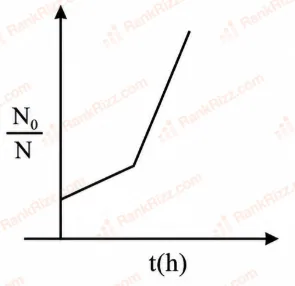
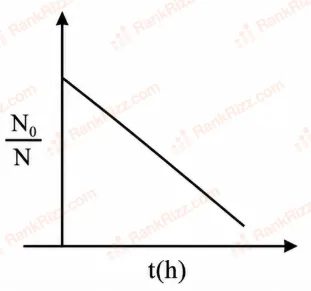
A reaction has a half life of 1 min. The time required for 99.9% completion of the reaction is ___ min.
(Round off to the Nearest integer)
[Use : ln 2 = 0.69, ln 10 = 2.3]
Integrated rate laws and half-life (zero and first order) has been asked 85 times in JEE Main, in 18 different years between 2004 and 2026, and in all of the last five exam years (2022–2026), 53 questions in all. That is 37% of Chemical Kinetics, its most-asked topic. Last asked in JEE Main 06 Apr 2026, Shift 1. 40 are multiple choice and 45 numerical-value; 32 easy and 47 medium by our difficulty labels. All of them are below, newest first, free to read.
Questions
85
Years asked
18
Since
2004
Of the chapter
37%
61–80 OF 85 · NEWEST FIRST
A reaction has a half life of 1 min. The time required for 99.9% completion of the reaction is ___ min.
(Round off to the Nearest integer)
[Use : ln 2 = 0.69, ln 10 = 2.3]
For a certain first order reaction 32% of the reactant is left after 570 s. The rate constant of this reaction is ________ s. (Round off to the Nearest Integer).
[Given: , ]
A and B decompose via first order kinetics with half-lives 54.0 min and 18.0 min respectively. Starting from an equimolar non-reactive mixture of A and B, the time taken for the concentration of A to become 16 times that of B is ________ min. (Round off to the Nearest Integer).
Gaseous cyclobutene isomerizes to butadiene in a first order process which has a 'K' value of s at 153°C. The time in minutes it takes for the isomerization to proceed 40% to completion at this temperature is ______ (Rounded off to the nearest integer)
Sucrose hydrolyses in acid solution into glucose and fructose following first order rate law with a half-life of 3.33 h at 25°C. After 9 h, the fraction of sucrose remaining is f. The value of is ______ .
(Rounded off to the nearest integer)
[Assume: ln10 = 2.303, ln 2 = 0.693]
A flask contains a mixture of compounds A and B. Both compounds decompose by first-order kinetics. The half-lives for A and B are and , respectively. If the concentrations of A and B are equal initially, the time required for the concentration of A to be four times that of B (in s) is: (Use )
180
900
300
120
If 75% of a first order reaction was completed in 90 minutes, 60% of the same reaction would be completed in approximately (in minutes) __________ (Take: log 2 = 0.30; log 2.5 = 0.40)
It is true that:
A second order reaction is always a multistep reaction
A zero order reaction is a multi-step reaction
A first order reaction is always a single step reaction
A zero order reaction is a single step reaction
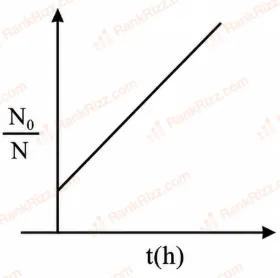
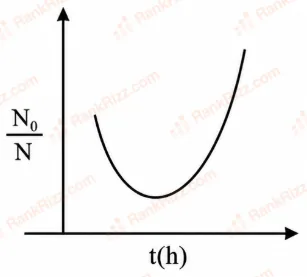
A bacterial infection in an internal wound grows as N'(t) = Nexp(t), where the time t is in hours. A dose of antibiotic, taken orally, needs 1 hour to reach the wound. Once it reaches there, the bacterial population goes down as . What will be the plot of vs t after 1 hour?


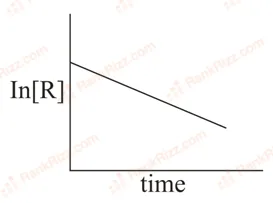
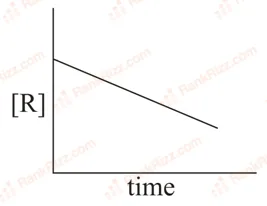
The given plots represent the variation of the concentration of a reactant R with time for two different reactions (i) and (ii). The respective orders of the reaction are:

1, 1
0, 1
1, 0
0, 2
Decomposition of X exhibits a rate constant of 0.05 g/year. How many years are required for the decomposition of 5 g of X into 2.5 g?
20
40
25
50
The reaction is a zeroth order reaction. If the initial concentration of X is 0.2M, the half-life is 6 h. When the initial concentration of X is 0.5M, the time required to reach its final concentration of 0.2M will be
9.0 h
12.0 h
18.0 h
7.2 h
If 50% of a reaction occurs in 100 second and 75% of the reaction occurs in 200 second, the order of this reaction is:
2
3
Zero
1
NO decomposes to NO and O and follows first order kinetics. After 50 minutes, the pressure inside the vessel increases from 50 mm Hg to 87.5 mm Hg. The pressure of the gaseous mixture after 100 minutes at constant temperature will be:
136.25 mm Hg
106.25 mm Hg
175.0 mm Hg
116.25 mm Hg
For a first order reaction, A P, t (half-life) is 10 days. The time required for th conversion of A (in days) is: (ln 2 = 0.693, ln 3 = 1.1)
3.2
2.5
4.1
5
Decomposition of follows a first order reaction. In fifty minutes the concentration of decreases from 0.5 to 0.125 M in one such decomposition. When the concentration of reaches 0.05 M, the rate of formation of will be:
L min at STP
mol min
mol min
mol min
The reaction follows first order kinetics. The pressure of a vessel containing only was found to increase from 50 mm Hg to 87.5 mm Hg in 30 min. The pressure exerted by the gases after 60 min. will be (Assume temperature remains constant):
106.25 mm Hg
125 mm Hg
116.25 mm Hg
150 mm Hg
Higher order (>3) reactions are rare due to:
Loss of active species on collision.
Low probability of simultaneous collision of all the reacting species.
Increase in entropy and activation energy as more molecules are involved.
Shifting of equilibrium towards reactants due to elastic collisions.
The half-life period of a first-order reaction is 15 minutes. The amount of substance left after one hour will be:
of the original amount
The rate constant of a zero order reaction is mol L s. If the concentration of the reactant after 25 seconds is 0.5M. What is the initial concentration?
0.5M
1.25M
12.5M
1.0M