RankRizz

Integrated rate laws and half-life (zero and first order) — JEE Main Previous Year Questions

Integrated rate laws and half-life (zero and first order) has been asked 85 times in JEE Main, in 18 different years between 2004 and 2026, and in all of the last five exam years (2022–2026), 53 questions in all. That is 37% of Chemical Kinetics, its most-asked topic. Last asked in JEE Main 06 Apr 2026, Shift 1. 40 are multiple choice and 45 numerical-value; 32 easy and 47 medium by our difficulty labels. All of them are below, newest first, free to read.

Questions

85

Years asked

18

Since

2004

Of the chapter

37%

Every Integrated rate laws and half-life (zero and first order) question

21–40 OF 85 · NEWEST FIRST

JEE MAIN 2025 · 24 JAN S2Integrated rate laws and half-life (zero and first order)
page12_img1

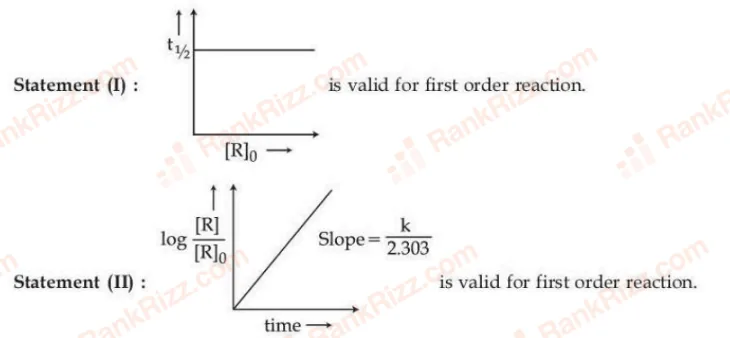
Given below are two statements :
In the light of the above statements, choose the correct answer from the options given below :

  1. A

    Both Statement I and Statement II are true

  2. B

    Statement I is false but Statement II is true

  3. C

    Statement I is true but Statement II is false

  4. D

    Both Statement I and Statement II are false
JEE MAIN 2025 · 23 JAN S1Integrated rate laws and half-life (zero and first order)

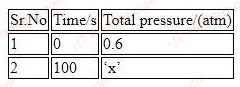
For the thermal decomposition of N2O5(g)N_{2}O_{5}(g) at constant volume, the following table can be formed, for the reaction mentioned below. 2N2O5(g)→2N2O4(g)+O2(g)2 N_{2}O_{5}(g)\rightarrow 2 N_{2}O_{4}(g)+O_{2}(g)
x=....×10−3x= .... \times 10^{-3} atm [nearest integer] Given : Rate constant for the reaction is 4.606×10⁻²s−1.4.606 \times 10^{-2} s^{-1}.

page12_img2
JEE MAIN 2025 · 23 JAN S2Integrated rate laws and half-life (zero and first order)

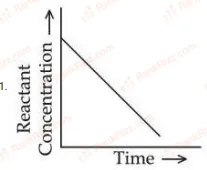
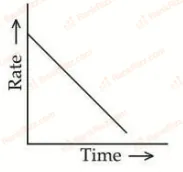
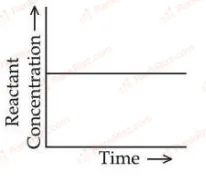
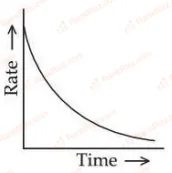
Which of the following graphs most appropriately represents a zero order reaction ?

  1. A
    page9_img1
  2. B
    page9_img2
  3. C
    page9_img3
  4. D
    page9_img4
JEE MAIN 2024 · 09 APR S2Integrated rate laws and half-life (zero and first order)

Consider the following first order gas phase reaction at constant temperature A(g)→2B(g)+C(g)A(g) \to 2B(g) + C(g). If the total pressure of the gases is found to be 200 torr after 23 sec. and 300 torr upon the complete decomposition of A after a very long time, then the rate constant of the given reaction is ______ ×10−2 s−1\times 10^{-2} \text{ s}^{-1} (nearest integer) [Given : log⁡10(2)=0.301\log_{10}(2) = 0.301]

JEE MAIN 2024 · 06 APR S1Integrated rate laws and half-life (zero and first order)

Time required for 99.9% completion of a first order reaction is _______ times the time required for completion of 90% reaction. (nearest integer)

JEE MAIN 2024 · 06 APR S2Integrated rate laws and half-life (zero and first order)

Consider the two different first order reactions given below A+B→CA + B \rightarrow C (Reaction 1) P→QP \rightarrow Q (Reaction 2). The ratio of the half life of Reaction 1 : Reaction 2 is 5:25 : 2. If t1t_1 and t2t_2 represent the time taken to complete 23rd\frac{2}{3}^{rd} and 45th\frac{4}{5}^{th} of Reaction 1 and Reaction 2, respectively, then the value of the ratio t1:t2t_1 : t_2 is ___________ ×10−1\times 10^{-1} (nearest integer). [Given : log⁡10(3)=0.477\log_{10}(3) = 0.477 and log⁡10(5)=0.699\log_{10}(5) = 0.699]

JEE MAIN 2024 · 04 APR S2Integrated rate laws and half-life (zero and first order)

Consider the following reaction, the rate expression of which is given below: 

A+B→CA + B \rightarrow C, rate=k[A]1/2[B]1/2= k[A]^{1/2}[B]^{1/2}.
The reaction is initiated by taking concentration of 11M of AA and BB each. If the rate constant (k)(k) is 4.6×10−24.6 \times 10^{-2} s−1^{-1}, then the time taken for AA to become 0.10.1M is ______ sec. (nearest integer)

JEE MAIN 2024 · 01 FEB S2Integrated rate laws and half-life (zero and first order)

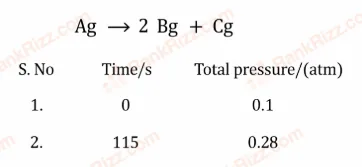
The following data were obtained during the first order thermal decomposition of a gas A at constant volume:

Figure for JEE Main 2024 Chemistry question on Integrated rate laws and half-life (zero and first order)


The rate constant of the reaction is ______ ×10−2 s−1\times 10^{-2} \text{ s}^{-1} (nearest integer)

JEE MAIN 2024 · 31 JAN S1Integrated rate laws and half-life (zero and first order)

Integrated rate law equation for a first order gas phase reaction is given by (where PiP_i is initial pressure and PtP_t is total pressure at time tt)

  1. A

    k=2.303t×log⁡Pi2Pi−Ptk = \frac{2.303}{t} \times \log\frac{P_i}{2P_i - P_t}

  2. B

    k=2.303t×log⁡2Pi2Pi−Ptk = \frac{2.303}{t} \times \log\frac{2P_i}{2P_i - P_t}

  3. C

    k=2.303t×log⁡2Pi−PtPik = \frac{2.303}{t} \times \log\frac{2P_i - P_t}{P_i}

  4. D

    k=2.303t×Pi2Pi−Ptk = \frac{2.303}{t} \times \frac{P_i}{2P_i - P_t}

JEE MAIN 2024 · 31 JAN S2Integrated rate laws and half-life (zero and first order)

r=kAr = kA for a reaction, 50% of A is decomposed in 120 minutes. The time taken for 90% decomposition of A is ______ minutes.

JEE MAIN 2024 · 30 JAN S1Integrated rate laws and half-life (zero and first order)

The rate of first order reaction is 0.04 mol L−1s−10.04 \text{ mol L}^{-1} \text{s}^{-1} at 1010 minutes and 0.03 mol L−1s−10.03 \text{ mol L}^{-1} \text{s}^{-1} at 2020 minutes after initiation. Half life of the reaction is ______ minutes. (Given log⁡2=0.3010\log 2 = 0.3010, log⁡3=0.4771\log 3 = 0.4771)
Round off your answer to the nearest integer.

JEE MAIN 2024 · 27 JAN S2Integrated rate laws and half-life (zero and first order)

Time required for completion of 99.9% of first order reaction is _____ times of half life (t1/2t_{1/2}) of the reaction

JEE MAIN 2023 · 13 APR S1Integrated rate laws and half-life (zero and first order)

t87.5_{87.5} is the time required for the reaction to undergo 87.5%87.5\% completion and t50_{50} is the time required for the reaction to undergo 50%50\% completion. The relation between t87.5_{87.5} and t50_{50} for a first order reaction is
t87.5_{87.5} = x ×\times t50_{50}
The value of x is _____. (Nearest integer)

JEE MAIN 2023 · 13 APR S2Integrated rate laws and half-life (zero and first order)

A(g) →\to 2B(g) + C(g) is a first order reaction. The initial pressure of the system was found to be 800800 mm Hg which increased to 16001600 mm Hg after 1010 min. The total pressure of the system after 3030 min will be _____ mm Hg. (Nearest integer)

JEE MAIN 2023 · 10 APR S1Integrated rate laws and half-life (zero and first order)

A molecule undergoes two independent first order reactions whose respective half lives are 12 min and 3 min. If both the reactions are occurring then the time taken for the 50% consumption of the reactant is _______ min. (Nearest integer)

JEE MAIN 2023 · 10 APR S2Integrated rate laws and half-life (zero and first order)

The number of incorrect statement/s from the following is _______
A. The successive half lives of zero order reactions decreases with time.
B. A substance appearing as reactant in the chemical equation may not affect the rate of reaction
C. Order and molecularity of a chemical reaction can be a fractional number
D. The rate constant units of zero and second order reaction are mol L−1^{-1} s−1^{-1} and mol−1^{-1} L s−1^{-1} respectively

JEE MAIN 2023 · 06 APR S2Integrated rate laws and half-life (zero and first order)

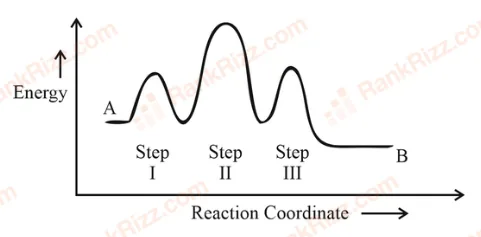
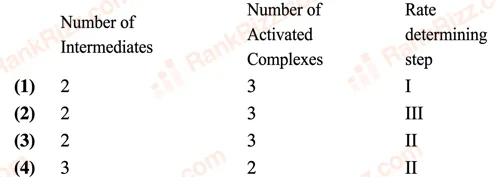
Consider the following reaction that goes from A to B in three steps as shown below:

Figure for JEE Main 2023 Chemistry question on Integrated rate laws and half-life (zero and first order)


Choose the correct option

Figure for JEE Main 2023 Chemistry question on Integrated rate laws and half-life (zero and first order)
  1. A

    (1)

  2. B

    (2)

  3. C

    (3)

  4. D

    (4)

JEE MAIN 2023 · 01 FEB S1Integrated rate laws and half-life (zero and first order)

A and B are two substances undergoing radioactive decay in a container. The half life of A is 15 min and that of B is 5 min. If the initial concentration of B is 4 times that of A and they both start decaying at the same time, how much time will it take for the concentration of both of them to be same? _____ min.

JEE MAIN 2023 · 01 FEB S2Integrated rate laws and half-life (zero and first order)

A→B\text{A} \to \text{B}
The above reaction is of zero order. Half life of this reaction is 5050 min. The time taken for the concentration of A to reduce to one-fourth of its initial value is ______ min. (Nearest integer)

JEE MAIN 2023 · 31 JAN S2Integrated rate laws and half-life (zero and first order)

The rate constant for a first order reaction is 20 min−1^{-1}. The time required for the initial concentration of the reactant to reduce to its 132\dfrac{1}{32} level is ______ ×10−2\times 10^{-2} min. (Nearest integer)