If compound A reacts with B following first order kinetics with rate constant s. The time taken by A (in seconds) to reduce from g to g will be ______. (Nearest Integer)
log5 = 0.698, log7 = 0.845, log2 = 0.301
Integrated rate laws and half-life (zero and first order) has been asked 85 times in JEE Main, in 18 different years between 2004 and 2026, and in all of the last five exam years (2022–2026), 53 questions in all. That is 37% of Chemical Kinetics, its most-asked topic. Last asked in JEE Main 06 Apr 2026, Shift 1. 40 are multiple choice and 45 numerical-value; 32 easy and 47 medium by our difficulty labels. All of them are below, newest first, free to read.
Questions
85
Years asked
18
Since
2004
Of the chapter
37%
41–60 OF 85 · NEWEST FIRST
If compound A reacts with B following first order kinetics with rate constant s. The time taken by A (in seconds) to reduce from g to g will be ______. (Nearest Integer)
log5 = 0.698, log7 = 0.845, log2 = 0.301
An organic compound undergoes first order decomposition. If the time taken for the decomposition is s, then the time required for decomposition will be ______ s. (Nearest integer).
Given: ;
For the first order reaction A B the half life is 30 min. The time taken for 75% completion of the reaction is _____ min. (Nearest integer)
Given: log 2 = 0.3010
log 3 = 0.4771
log 5 = 0.6989
A first order reaction has the rate constant, k = 4.6 s. The number of correct statement/s from the following is/are Given: log 3 = 0.48.
A. Reaction completes in 1000 s.
B. The reaction has a half-life of 500 s.
C. The time required for 10% completion is 25 times the time required for 90% completion.
D. The degree of dissociation is equal to .
E. The rate and the rate constant have the same unit.
For the given first order reaction the half life of the reaction is 0.3010 min. The ratio of the initial concentration of reactant to the concentration of reactant at time 2.0 min will be equal to _____. (Nearest integer)
Reactant Product
If formation of compound [B] follows the first order of kinetics and after 70 minutes the concentration of [A] was found to be half of its initial concentration. Then the rate constant of the reaction is . The value of is ____
For a reaction , the half lives are and when the concentration of reactant A is and respectively. The order of the reaction is ______.
At , the half life for the decomposition of is and is independent of the initial concentration of . The time required for of the to decompose is (Given: ; )
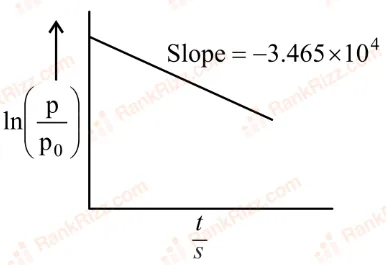
For the decomposition of azomethane , a first order reaction, the variation in partial pressure with time at is given as shown.
The half life of the reaction is ______ s.
For a first order reaction A B, the rate constant, s. The time required for completion of reaction is times the half life of reaction. The value of is ______ Nearest integer) (Given : )
A radioactive element has a half life of 200 days. The percentage of original activity remaining after 83 days is ______ (Nearest integer)
(Given: antilog 0.125 = 1.333, antilog 0.693 = 4.93)
A flask is filled with equal moles of A and B. The half lives of A and B are s and s respectively and are independent of the initial concentration. The time required for the concentration of A to be four times that of B is ______ s.
(Given : )
For a first order reaction, the time required for completion of reaction is '' times the half life of the reaction. The value of '' is
(Given: and )
1.12
2.43
3.32
33.31
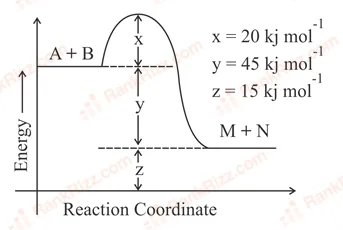
According to the following figure, the magnitude of the enthalpy change of the reaction A + B M + N in kJ mol is equal to _________. (Integer answer)

For a first order reaction, the ratio of the time for 75% completion of a reaction to the time for 50% completion is _________. (Integer answer)
For the first order reaction A 2B, 1 mole of reactant A gives 0.2 moles of after 100 minutes. The half life of the reaction is _________ min. (Round off to nearest integer).
[
Properties of logarithms:
]
(Round off to the nearest integer)
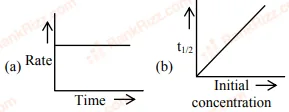
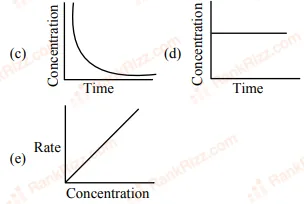
For the following graphs,
Choose from the options given below, the correct one regarding order of reaction is:
(b) zero order (c) and (e) First order
(a) and (b) Zero order (e) First order
(b) and (d) Zero order (e) First order
(a) and (b) Zero order (c) and (e) First order
NO 2NO + O
In the above first order reaction the initial concentration of NO is mol L at 318 K. The concentration of NO after 1 hour was mol L. The rate constant of the reaction at 318 K is ___ min (Nearest integer):
[Given : log 3 = 0.477, log 5 = 0.699]
The inactivation rate of a viral preparation is proportional to the amount of virus. In the first minute after preparation, 10% of the virus is inactivated. The rate constant for viral inactivation is ___ min.
(Nearest integer) [Use : ln 10 = 2.303; property of logarithm: ]
PCl(g) PCl(g) + Cl(g)
In the above first order reaction the concentration of PCl reduces from initial concentration 50 mol L to 10 mol L in 120 minutes at 300 K. The rate constant for the reaction at 300 K is x min. The value of x is ___.
[Given log 5 = 0.6989]