RankRizz

JEE Main 09 Jan 2020, Shift 2: Maths

The 25 Maths questions of JEE Main 09 Jan 2020, Shift 2, numbered across the whole paper. Pick an answer on any question to check it against the key. Free to read, nothing to download.

Maths

Q51Venn diagrams and cardinality of sets

If A={x∈R:∣x∣<2}A = \{x \in R : |x| < 2\} and B={x∈R:∣x−2∣≥3}B = \{x \in R : |x - 2| \ge 3\}; then:

  1. A

    A∩B=(−2,−1)A \cap B = (-2, -1)

  2. B

    B−A=R−(−2,5)B - A = R - (-2, 5)

  3. C

    A∪B=R−(2,5)A \cup B = R - (2, 5)

  4. D

    A−B=[−1,2)A - B = [-1, 2)

Q52Common roots of equations

Let a,b∈R,a≠0a, b \in R, a \ne 0 be such that the equation, ax2−2bx+5=0ax^2 - 2bx + 5 = 0 has a repeated root α\alpha, which is also a root of the equation, x2−2bx−10=0x^2 - 2bx - 10 = 0. If β\beta is the other root of this equation, then α2+β2\alpha^2 + \beta^2 is equal to:

  1. A

    25

  2. B

    26

  3. C

    28

  4. D

    24

Q53Modulus and conjugate

If zz is a complex number satisfying ∣Re(z)∣+∣Im(z)∣=4|Re(z)| + |Im(z)| = 4, then ∣z∣|z| cannot be:

  1. A

    172\sqrt{\frac{17}{2}}

  2. B

    10\sqrt{10}

  3. C

    7\sqrt{7}

  4. D

    8\sqrt{8}

Q54Geometric progression and infinite GP

Let ana_n be the nthn^{th} term of a G.P. of positive terms. If ∑n=1100a2n+1=200\sum_{n=1}^{100} a_{2n+1} = 200 and ∑n=1100a2n=100\sum_{n=1}^{100} a_{2n} = 100, then ∑n=1200an\sum_{n=1}^{200} a_n is equal to:

  1. A

    300

  2. B

    225

  3. C

    175

  4. D

    150

Q55Trigonometric series and products

If x=∑n=0∞(−1)ntan⁡2nθx = \sum_{n=0}^{\infty} (-1)^n \tan^{2n}\theta and y=∑n=0∞cos⁡2nθy = \sum_{n=0}^{\infty} \cos^{2n}\theta, for 0<θ<π40 < \theta < \frac{\pi}{4}, then:

  1. A

    x(1+y)=1x(1 + y) = 1

  2. B

    y(1−x)=1y(1 - x) = 1

  3. C

    y(1+x)=1y(1 + x) = 1

  4. D

    x(1−y)=1x(1 - y) = 1

Q56General term and specific coefficients

In the expansion of (xcos⁡θ+1xsin⁡θ)16\left(\frac{x}{\cos\theta} + \frac{1}{x\sin\theta}\right)^{16}, if l1l_1 is the least value of the term independent of xx when π8≤θ≤π4\frac{\pi}{8} \le \theta \le \frac{\pi}{4} and l2l_2 is the least value of the term independent of xx when π16≤θ≤π8\frac{\pi}{16} \le \theta \le \frac{\pi}{8}, then the ratio l2:l1l_2 : l_1 is equal to:

  1. A

    1 : 8

  2. B

    16 : 1

  3. C

    8 : 1

  4. D

    1 : 16

Q57Tangents, pair of tangents and chord of contact

If one end of a focal chord ABAB of the parabola y2=8xy^2 = 8x is at A(12,−2)A\left(\frac{1}{2}, -2\right), then the equation of the tangent to it at BB is:

  1. A

    2x+y−24=02x + y - 24 = 0

  2. B

    x−2y+8=0x - 2y + 8 = 0

  3. C

    x+2y+8=0x + 2y + 8 = 0

  4. D

    2x−y−24=02x - y - 24 = 0

Q58Tangents to an ellipse

The length of the minor axis (along y-axis) of an ellipse in the standard form is 43\frac{4}{\sqrt{3}}. If this ellipse touches the line x+6y=8x + 6y = 8 then its eccentricity is:

  1. A

    12113\frac{1}{2}\sqrt{\frac{11}{3}}

  2. B

    56\sqrt{\frac{5}{6}}

  3. C

    1253\frac{1}{2}\sqrt{\frac{5}{3}}

  4. D

    13113\frac{1}{3}\sqrt{\frac{11}{3}}

Q59Logical connectives, truth tables and tautologies

If p→(p∧∼q)p \to (p \wedge \sim q) is false, then the truth values of pp and qq are respectively:

  1. A

    F,FF, F

  2. B

    T,FT, F

  3. C

    T,TT, T

  4. D

    F,TF, T

Q60Systems of linear equations

The following system of linear equations
7x+6y−2z=07x + 6y - 2z = 0
3x+4y+2z=03x + 4y + 2z = 0
x−2y−6z=0x - 2y - 6z = 0, has:

  1. A

    infinitely many solutions, (x,y,z)(x, y, z) satisfying y=2zy = 2z

  2. B

    no solution

  3. C

    infinitely many solutions, (x,y,z)(x, y, z) satisfying x=2zx = 2z

  4. D

    only the trivial solution

Q61Properties of determinants

Let a−2b+c=1a - 2b + c = 1.
If f(x)=∣x+ax+2x+1x+bx+3x+2x+cx+4x+3∣f(x) = \begin{vmatrix} x+a & x+2 & x+1 \\ x+b & x+3 & x+2 \\ x+c & x+4 & x+3 \end{vmatrix}, then:

  1. A

    f(−50)=501f(-50) = 501

  2. B

    f(−50)=−1f(-50) = -1

  3. C

    f(50)=−501f(50) = -501

  4. D

    f(50)=1f(50) = 1

Q62Continuity at a point

Let [t][t] denote the greatest integer ≤t\le t and lim⁡x→0x[4x]=A\lim_{x \to 0} x\left[\frac{4}{x}\right] = A. Then the function, f(x)=[x2]sin⁡(πx)f(x) = [x^2]\sin(\pi x) is discontinuous, when xx is equal to:

  1. A

    A+1\sqrt{A+1}

  2. B

    A+5\sqrt{A+5}

  3. C

    A+21\sqrt{A+21}

  4. D

    A\sqrt{A}

Q63Implicit and parametric differentiation

If x=2sin⁡θ−sin⁡2θx = 2\sin\theta - \sin 2\theta and y=2cos⁡θ−cos⁡2θy = 2\cos\theta - \cos 2\theta, θ∈[0,2π]\theta \in [0, 2\pi], then d2ydx2\frac{d^2y}{dx^2} at θ=π\theta = \pi is:

  1. A

    34\frac{3}{4}

  2. B

    −38-\frac{3}{8}

  3. C

    32\frac{3}{2}

  4. D

    −34-\frac{3}{4}

Q64Derivatives of standard and composite functions

Let ff and gg be differentiable functions on RR such that fogfog is the identity function. If for some a,b∈Ra, b \in R, g′(a)=5g'(a) = 5 and g(a)=bg(a) = b, then f′(b)f'(b) is equal to:

  1. A

    15\frac{1}{5}

  2. B

    1

  3. C

    5

  4. D

    25\frac{2}{5}

Q65Leibniz rule for differentiating integrals

Let a function f:[0,5]→Rf : [0, 5] \to R be continuous, f(1)=3f(1) = 3 and FF be defined as:
F(x)=∫1xt2g(t)  dtF(x) = \int_1^x t^2 g(t) \; dt, where g(t)=∫1tf(u)  dug(t) = \int_1^t f(u) \; du.
Then for the function F(x)F(x), the point x=1x = 1 is:

  1. A

    a point of local minima

  2. B

    not a critical point

  3. C

    a point of local maxima

  4. D

    a point of inflection

Q66Integration by substitution

If ∫dθcos⁡2θ(tan⁡2θ+sec⁡2θ)=λtan⁡θ+2log⁡e∣f(θ)∣+C\int \frac{d\theta}{\cos^2\theta(\tan 2\theta + \sec 2\theta)} = \lambda \tan\theta + 2\log_e|f(\theta)| + C where CC is a constant of integration, then the ordered pair (λ,f(θ))(\lambda, f(\theta)) is equal to:

  1. A

    (1,1−tan⁡θ)(1, 1 - \tan\theta)

  2. B

    (−1,1−tan⁡θ)(-1, 1 - \tan\theta)

  3. C

    (−1,1+tan⁡θ)(-1, 1 + \tan\theta)

  4. D

    (1,1+tan⁡θ)(1, 1 + \tan\theta)

Q67Area between curves

Given: f(x)={x,0≤x<1212,x=121−x,12<x≤1f(x) = \begin{cases} x, & 0 \le x \lt \frac{1}{2} \\ \frac{1}{2}, & x = \frac{1}{2} \\ 1-x, & \frac{1}{2} \lt x \le 1 \end{cases}
and g(x)=(x−12)2,x∈Rg(x) = \left(x - \frac{1}{2}\right)^2, x \in R. Then, the area (in sq. units) of the region bounded by the curves, y=f(x)y = f(x) and y=g(x)y = g(x) between the lines 2x=12x = 1 and 2x=32x = \sqrt{3}, is:

  1. A

    13+34\frac{1}{3} + \frac{\sqrt{3}}{4}

  2. B

    34−13\frac{\sqrt{3}}{4} - \frac{1}{3}

  3. C

    12−34\frac{1}{2} - \frac{\sqrt{3}}{4}

  4. D

    12+34\frac{1}{2} + \frac{\sqrt{3}}{4}

Q68Variable separable equations

If dydx=xyx2+y2\frac{dy}{dx} = \frac{xy}{x^2+y^2}; y(1)=1y(1) = 1; then a value of xx satisfying y(x)=ey(x) = e is:

  1. A

    123e\frac{1}{2}\sqrt{3}e

  2. B

    e2\frac{e}{\sqrt{2}}

  3. C

    2e\sqrt{2}e

  4. D

    3e\sqrt{3}e

Q69Probability using permutations and combinations

If 10 different balls are to be placed in 4 distinct boxes at random, then the probability that two of these boxes contain exactly 2 and 3 balls is:

  1. A

    965211\frac{965}{2^{11}}

  2. B

    965210\frac{965}{2^{10}}

  3. C

    945210\frac{945}{2^{10}}

  4. D

    945211\frac{945}{2^{11}}

Q70Random variables, mean and variance

A random variable XX has the following probability distribution:
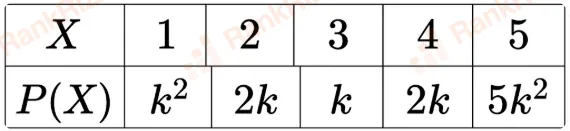
Figure for JEE Main 2020 Mathematics question on Random variables, mean and variance

Then, P(X>2)P(X > 2) is equal to:

  1. A

    712\frac{7}{12}

  2. B

    136\frac{1}{36}

  3. C

    16\frac{1}{6}

  4. D

    2336\frac{23}{36}

Q71Arithmetic progression

The number of terms common to the two A.P.'s 3, 7, 11, ..., 407 and 2, 9, 16, ..., 709 is ___________.

Q72Sums of binomial coefficients

If Cr≡25CrC_r \equiv {}^{25}C_r and C0+5⋅C1+9⋅C2+…+(101)⋅C25=225⋅kC_0 + 5 \cdot C_1 + 9 \cdot C_2 + \ldots + (101) \cdot C_{25} = 2^{25} \cdot k, then kk is equal to ___________.

Q73Orthogonal circles, common chord and radical axis

If the curves, x2−6x+y2+8=0x^2 - 6x + y^2 + 8 = 0 and x2−8y+y2+16−k=0x^2 - 8y + y^2 + 16 - k = 0, (k>0)(k \gt 0) touch each other at a point, then the largest value of kk is ___________.

Q74Vector (cross) product and area

Let a⃗,b⃗\vec{a}, \vec{b} and c⃗\vec{c} be three vectors such that ∣a⃗∣=3|\vec{a}| = \sqrt{3}, ∣b⃗∣=5|\vec{b}| = 5, b⃗⋅c⃗=10\vec{b} \cdot \vec{c} = 10 and the angle between b⃗\vec{b} and c⃗\vec{c} is π3\frac{\pi}{3}. If a⃗\vec{a} is perpendicular to the vector b⃗×c⃗\vec{b} \times \vec{c}, then ∣a⃗×(b⃗×c⃗)∣\left|\vec{a} \times (\vec{b} \times \vec{c})\right| is equal to ___________.

Q75Line and plane: intersection, coplanarity and projection

If the distance between the plane, 23x−10y−2z+48=023x - 10y - 2z + 48 = 0 and the plane containing the lines x+12=y−34=z+13\frac{x+1}{2} = \frac{y-3}{4} = \frac{z+1}{3} and x+32=y+26=z−1λ\frac{x+3}{2} = \frac{y+2}{6} = \frac{z-1}{\lambda} (λ∈R)(\lambda \in R) is equal to k633\frac{k}{\sqrt{633}}, then kk is equal to ___________.