Q1Dimensional analysis: deriving and checking relations
If speed V, area A and force F are chosen as fundamental units, then the dimension of Young's modulus will be:
- A
- B
- C
- D
All 75 questions of JEE Main 02 Sep 2020, Shift 1, in the order they were asked, one subject to a page. Pick an answer on any question to check it against the key. Free to read, nothing to download.
Questions
75
Physics · Chemistry · Maths
Answer key
73
questions with a checked key
Price
Free
no sign-up
If speed V, area A and force F are chosen as fundamental units, then the dimension of Young's modulus will be:
Train A and train B are running on parallel tracks in the opposite directions with speed of 36 km hour and 72 km hour, respectively. A person is walking in train A in the direction opposite to its motion with a speed of 1.8 km hour. Speed (in m s) of this person as observed from train B will be close to: (take the distance between the tracks as negligible)
29.5 m s
28.5 m s
31.5 m s
30.5 m s
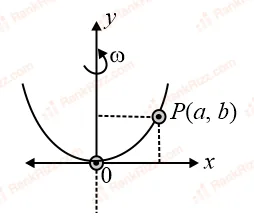
A bead of mass m stays at point P(a, b) on a wire bent in the shape of a parabola and rotating with angular speed (see figure). The value of is (neglect friction):
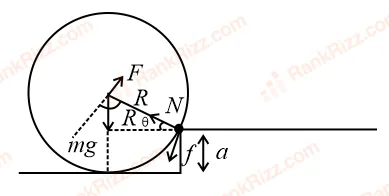
A uniform cylinder of mass M and radius R is to be pulled over a step of height a (a < R) by applying a force F at its centre 'O' perpendicular to the plane through the axes of the cylinder on the edge of the step (see figure). The minimum value of F required is:
In a reactor, 2 kg of fuel is fully used up in 30 days. The energy released fission is 200 MeV. Given that the Avogadro number, per kilo mole and J. The power output of the reactor is close to:
35 MW
60 MW
125 MW
54 MW
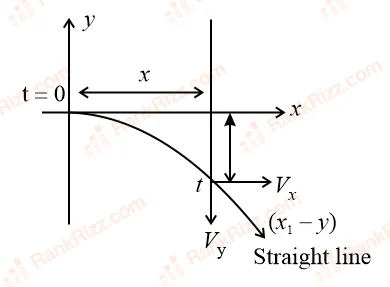
A particle of mass m with an initial velocity collides perfectly elastically with a mass 3m at rest. It moves with a velocity after collision, then, v is given by:
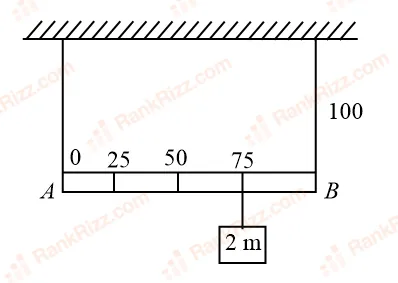
Shown in the figure is a rigid and uniform one meter long rod AB held in horizontal position by two strings tied to its ends and attached to the ceiling. The rod is of mass 'm' and has another weight of mass 2m hung at a distance of 75 cm from A. The tension in the string at A is:
0.5 mg
2 mg
0.75 mg
1 mg
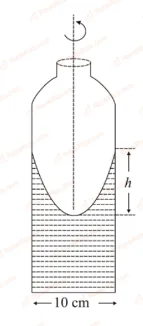
A cylindrical vessel containing a liquid is rotated about its axis so that the liquid rises at its sides as shown in the figure. The radius of vessel is 5 cm and the angular speed of rotation is rad s. The difference in the height, h (in cm) of liquid at the Centre of vessel and at the sides of the vessel will be:
The mass density of a spherical galaxy varies as over a large distance from its center. In that region, a small star is in a circular orbit of radius R. Then the period of revolution, T depends on R as:
A gas mixture consists of 3 moles of oxygen and 5 moles of argon at temperature T. Assuming the gases to be ideal and the oxygen bond to be rigid, the total internal energy (in units of RT) of the mixture is:
15
13
20
11
Two identical strings X and Z made of same material have tension and in them. If their fundamental frequencies are 450 Hz and 300 Hz, respectively, then the ratio is:
2.25
0.44
1.25
1.5
Consider four conducting materials copper, tungsten, mercury and aluminium with resistivity , , and respectively. Then:
A beam of protons with speed m s enters a uniform magnetic field of 0.3 T at an angle of 60 to the magnetic field, the pitch of the resulting helical path of protons is close to: (Mass of the proton kg, charge of the proton C)
2 cm
5 cm
12 cm
4 cm
A charged particle (mass m and charge q) moves along X axis with velocity . When it passes through the origin it enters a region having uniform electric field which extends upto . Equation of path of electron in the region is:
Magnetic materials used for making permanent magnets (P) and magnets in a transformer (T) have different properties of the following, which property best matches for the type of magnet required?
T : Large retentivity, small coercivity
P : small retentivity, large coercivity
T : Large retentivity, large coercivity
P : large retentivity, large coercivity
A plane electromagnetic wave, has frequency of Hz and its energy density is J m in vacuum. The amplitude of the magnetic field of the wave is close to and speed of light m s.
150 nT
160 nT
180 nT
190 nT
A spherical mirror is obtained as shown in the figure from a hollow glass sphere, if an object is positioned in front of the mirror, what will be the nature and magnification of the image of the object? (Figure down as schematic and not to scale)
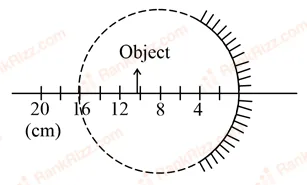
Inverted, real and magnified
Erect, virtual and magnified
Erect, virtual and unmagnified
Inverted, real and unmagnified
Interference fringes are observed on a screen by illuminating two thin slits 1 mm apart with a light source . The distance between the screen and the slits is 100 cm. If a bright fringe is observed on a screen at distance of 1.27 mm from the central bright fringe, then the path difference between the waves, which are reaching this point from the slits is close to:
1.27 m
2.87 nm
2 nm
2.05 m
An amplitude modulated wave is represented by expression V. The minimum and maximum amplitudes of the amplitude modulated wave are, respectively:
V, 5 V
V, 8 V
5 V, 8 V
3 V, 5 V
The least count of the main scale of a vernier calipers is 1 mm. Its vernier scale is divided into 10 divisions and coincide with 9 divisions of the main scale. When jaws are touching each other, the 7 division of the vernier scale coincides with a division of the main scale and the zero of vernier scale is lying right side of the zero of the main scale. When this vernier is used to measure the length of the cylinder the zero of the vernier scale between 3.1 cm and 3.2 cm and 4 VSD coincides with the main scale division. The length of the cylinder is (VSD is vernier scale division):
3.2 cm
3.21 cm
3.07 cm
2.99 cm
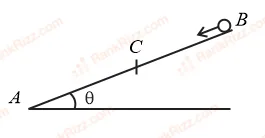
A small block starts slipping down from a point B on an inclined plane AB, which is making an angle with the horizontal section BC is smooth and the remaining section CA is rough with a coefficient of friction . It is found that the block comes to rest as it reaches the bottom (point A) of the inclined plane. If , the coefficient of friction is given by . The value of is ___________.
An engine takes in 5 moles of air at 20 C and 1 atm, and compresses it adiabatically to of the original volume. Assuming air to be a diatomic ideal gas made up of rigid molecules, the change in its internal energy during this process comes out to be X kJ. The value of X to the nearest integer is:
A 5 F capacitor is charged fully by a 220 V supply. It is then disconnected from the supply and is connected in series to another uncharged 2.5 F capacitor. If the energy change during the charge redistribution is J then value of X to the nearest integer is:
A circular coil of radius 10 cm is placed in a uniform magnetic field of T with its plane perpendicular to the field initially. It is rotated at constant angular speed about an axis along the diameter of coil and perpendicular to magnetic field so that it undergoes half of rotation in 0.2 s. The maximum value of EMF induced (in V) in the coil will be close to the integer ___________.
When radiation of wavelength A is used to illuminate a metallic surface, the stopping potential is V. When the same surface is illuminated with radiation of wavelength 3A, the stopping potential is . If the threshold wavelength for the metallic surface is then value of n will be ___________.