RankRizz

JEE Main 09 Jan 2020, Shift 2 Question Paper

All 75 questions of JEE Main 09 Jan 2020, Shift 2, in the order they were asked, one subject to a page. Pick an answer on any question to check it against the key. Free to read, nothing to download.

Questions

75

Physics · Chemistry · Maths

Answer key

71

questions with a checked key

Price

Free

no sign-up

Physics

Q1Errors in measurement and significant figures

For the four sets of three measured physical quantities as given below. Which of the following options is correct?
(i)(i) A1=24.36,B1=0.0724,C1=256.2A_1 = 24.36, B_1 = 0.0724, C_1 = 256.2
(ii)(ii) A2=24.44,B2=16.082,C2=240.2A_2 = 24.44, B_2 = 16.082, C_2 = 240.2
(iii)(iii) A3=25.2,B3=19.2812,C3=236.183A_3 = 25.2, B_3 = 19.2812, C_3 = 236.183
(iv)(iv) A4=25,B4=236.191,C4=19.5A_4 = 25, B_4 = 236.191, C_4 = 19.5

  1. A

    A4+B4+C4<A1+B1+C1<A3+B3+C3<A2+B2+C2A_4 + B_4 + C_4 < A_1 + B_1 + C_1 < A_3 + B_3 + C_3 < A_2 + B_2 + C_2

  2. B

    A1+B1+C1=A2+B2+C2=A3+B3+C3=A4+B4+C4A_1 + B_1 + C_1 = A_2 + B_2 + C_2 = A_3 + B_3 + C_3 = A_4 + B_4 + C_4

  3. C

    A1+B1+C1<A2+B2+C2=A3+B3+C3<A4+B4+C4A_1 + B_1 + C_1 < A_2 + B_2 + C_2 = A_3 + B_3 + C_3 < A_4 + B_4 + C_4

  4. D

    A1+B1+C1<A3+B3+C3<A2+B2+C2<A4+B4+C4A_1 + B_1 + C_1 < A_3 + B_3 + C_3 < A_2 + B_2 + C_2 < A_4 + B_4 + C_4

Q2Dynamics of horizontal circular motion: conical pendulum, rotating drums

A spring mass system (mass mm, spring constant kk and natural length ll) rests in equilibrium on a horizontal disc. The free end of the spring is fixed at the centre of the disc. If the disc together with spring mass system rotates about it's axis with an angular velocity ω\omega, (k>>mω2)(k >> m\omega^2) the relative change in the length of the spring is best given by the option:

  1. A

    23(mω2k)\sqrt{\frac{2}{3}\left(\frac{m\omega^2}{k}\right)}

  2. B

    2mω2k\frac{2m\omega^2}{k}

  3. C

    mω2k\frac{m\omega^2}{k}

  4. D

    mω23k\frac{m\omega^2}{3k}

Q3Kinematics in two dimensions using position vectors

A particle starts from the origin at t=0t = 0 with an initial velocity of 3.0i^3.0\hat{i} m/s and moves in the x−yx - y plane with a constant acceleration (6.0i^+4.0j^)(6.0\hat{i} + 4.0\hat{j}) m/s2^2. The x−x- coordinate of the particle at the instant when its y−y- coordinate is 32m32m is DD meters. The value of DD is:

  1. A

    32

  2. B

    50

  3. C

    60

  4. D

    40

Q4Centre of mass of continuous bodies and cavities

A rod of length ll has non-uniform linear mass density given by ρ(x)=a+b(xl)2\rho(x) = a + b\left(\frac{x}{l}\right)^2, where aa and bb are constants and 0<x≤l0 < x \le l. The value of xx for the centre of mass of the rod is at:

  1. A

    32(a+b2a+b)L\frac{3}{2}\left(\frac{a+b}{2a+b}\right)L

  2. B

    34(2a+b3a+b)L\frac{3}{4}\left(\frac{2a+b}{3a+b}\right)L

  3. C

    43(a+b2a+3b)L\frac{4}{3}\left(\frac{a+b}{2a+3b}\right)L

  4. D

    32(2a+b3a+b)L\frac{3}{2}\left(\frac{2a+b}{3a+b}\right)L

Q5Head-on collisions and coefficient of restitution

A particle of mass mm is projected with a speed uu from the ground at an angle θ=π3\theta = \frac{\pi}{3} w.r.t. horizontal (x-axis). When it has reached its maximum height, it collides completely inelastically with another particle of the same mass and velocity ui^u\hat{i}. The horizontal distance covered by the combined mass before reaching the ground is:

  1. A

    338u2g\frac{3\sqrt{3}}{8}\frac{u^2}{g}

  2. B

    324u2g\frac{3\sqrt{2}}{4}\frac{u^2}{g}

  3. C

    58u2g\frac{5}{8}\frac{u^2}{g}

  4. D

    22u2g2\sqrt{2}\frac{u^2}{g}

Q6Angular momentum of particles and rigid bodies

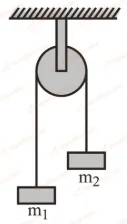
A uniformly thick wheel with moment of inertia II and radius RR is free to rotate about its centre of mass (see fig). A massless string is wrapped over its rim and two blocks of masses m1m_1 and m2m_2 (m1>m2)(m_1 > m_2) are attached to the ends of the string. The system is released from rest. The angular speed of the wheel when m1m_1 descends by a distance hh is:

Figure for JEE Main 2020 Physics question on Angular momentum of particles and rigid bodies
  1. A

    [2(m1−m2)gh(m1+m2)R2+I]12\left[\dfrac{2(m_1-m_2)gh}{(m_1+m_2)R^2+I}\right]^{\dfrac{1}{2}}

  2. B

    [2(m1+m2)gh(m1+m2)R2+I]12\left[\dfrac{2(m_1+m_2)gh}{(m_1+m_2)R^2+I}\right]^{\dfrac{1}{2}}

  3. C

    [(m1−m2)(m1+m2)R2+1]12gh\left[\dfrac{(m_1-m_2)}{(m_1+m_2)R^2+1}\right]^{\dfrac{1}{2}}gh

  4. D

    [m1+m2(m1+m2)R2+I]12gh\left[\dfrac{m_1+m_2}{(m_1+m_2)R^2+I}\right]^{\dfrac{1}{2}}gh

Q7Satellites: orbital speed, period, energy and geostationary orbits

Planet AA has mass MM and radius RR. Planet BB has half the mass and half the radius of Planet AA. If the escape velocities from the Planets AA and BB are vAv_A and vBv_B, respectively, then vAvB=n4\frac{v_A}{v_B} = \frac{n}{4}. The value of nn is:

  1. A

    4

  2. B

    1

  3. C

    2

  4. D

    3

Q8Elastic potential energy in stretched wires

Two steel wires having same length are suspended from a ceiling under the same load. If the ratio of their energy stored per unit volume is 1 : 4, the ratio of their diameters is:

  1. A

    2:1\sqrt{2} : 1

  2. B

    1 : 2

  3. C

    2 : 1

  4. D

    1:21 : \sqrt{2}

Q9Surface tension and surface energy

A small spherical droplet of density dd is floating exactly half immersed in a liquid of density ρ\rho and surface tension TT. The radius of the droplet is (take note that the surface tension applies an upward force on the droplet):

  1. A

    r=2T3(d+ρ)gr = \sqrt{\frac{2T}{3(d+\rho)g}}

  2. B

    r=T(d−ρ)gr = \sqrt{\frac{T}{(d-\rho)g}}

  3. C

    r=T(d+ρ)gr = \sqrt{\frac{T}{(d+\rho)g}}

  4. D

    r=3T(2d−ρ)gr = \sqrt{\frac{3T}{(2d-\rho)g}}

Q10Mean free path

Two gases - argon (atomic radius 0.07 nm, atomic weight 40) and xenon (atomic radius 0.1 nm, atomic weight 140) have the same number density and are at the same temperature. The ratio of their respective mean free times is closest to:

  1. A

    3.67

  2. B

    1.83

  3. C

    2.3

  4. D

    1.09

Q11Superposition, interference and beats

A wire of length LL and mass per unit length 6.0×10−36.0 \times 10^{-3} kg m−1^{-1} is put under tension of 540 N. Two consecutive frequencies that it resonates at are: 420 Hz and 490 Hz. Then LL in meters is:

  1. A

    2.1 m

  2. B

    1.1 m

  3. C

    8.1 m

  4. D

    5.1 m

Q12Magnetic dipole moment of current loops and torque on loops

A small circular loop of conducting wire has radius aa and carries current II. It is placed in a uniform magnetic field BB perpendicular to its plane such that when rotated slightly about its diameter and released, it starts performing simple harmonic motion of time period TT. The mass of the loop is mm then:

  1. A

    T=2mIBT = \sqrt{\frac{2m}{IB}}

  2. B

    T=πm2IBT = \sqrt{\frac{\pi m}{2IB}}

  3. C

    T=2πmIBT = \sqrt{\frac{2\pi m}{IB}}

  4. D

    T=πmIBT = \sqrt{\frac{\pi m}{IB}}

Q13Motion of charged particles in a magnetic field

An electron gun is placed inside a long solenoid of radius RR on its axis. The solenoid has nn turns/length and carries a current II. The electron gun shoots an electron along the radius of the solenoid with speed vv. If the electron does not hit the surface of the solenoid, maximum possible value of vv is (all symbols have their standard meaning):
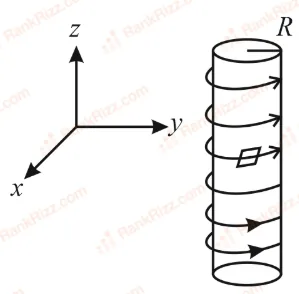
Figure for JEE Main 2020 Physics question on Motion of charged particles in a magnetic field
  1. A

    eμ0nIRm\frac{e\mu_0 nIR}{m}

  2. B

    eμ0nIR2m\frac{e\mu_0 nIR}{2m}

  3. C

    eμ0nIR4m\frac{e\mu_0 nIR}{4m}

  4. D

    2eμ0nIRm\frac{2e\mu_0 nIR}{m}

Q14Series LCR circuits: impedance and phase

In LCLC circuit the inductance L=40L = 40 mH and capacitance C=100C = 100 μ\muF. If a voltage V(t)=10sin⁡(314t)V(t) = 10\sin(314t) is applied to the circuit, the current in the circuit is given as:

  1. A

    0.52 cos(314t)

  2. B

    10 cos(314t)

  3. C

    5.2 cos(314t)

  4. D

    0.52 sin(314t)

Q15RC circuits: charging and discharging

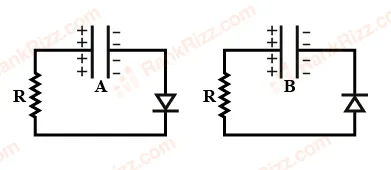
Two identical capacitors AA and BB, charged to the same potential 5V5V are connected in two different circuits as shown below at time t=0t = 0. If the charge on capacitors AA and BB at time t=CRt = CR is QAQ_A and QBQ_B respectively, then (Here ee is the base of natural logarithm)

Figure for JEE Main 2020 Physics question on RC circuits: charging and discharging
  1. A

    QA=VCe,QB=CV2Q_A = \frac{VC}{e}, Q_B = \frac{CV}{2}

  2. B

    QA=VC,QB=CVQ_A = VC, Q_B = CV

  3. C

    QA=VC,QB=VCeQ_A = VC, Q_B = \frac{VC}{e}

  4. D

    QA=CV2,QB=VCeQ_A = \frac{CV}{2}, Q_B = \frac{VC}{e}

Q16Properties of EM waves: fields, energy, intensity and momentum

A plane electromagnetic wave is propagating along the direction i^+j^2\frac{\hat{i}+\hat{j}}{\sqrt{2}}, with its polarization along the direction k^\hat{k}. The correct form of the magnetic field of the wave would be (here B0B_0 is an appropriate constant):

  1. A

    B0i^−j^2cos⁡(ωt−ki^+j^2)B_0\frac{\hat{i}-\hat{j}}{\sqrt{2}}\cos\left(\omega t - k\frac{\hat{i}+\hat{j}}{\sqrt{2}}\right)

  2. B

    B0j^−i^2cos⁡(ωt+ki^+j^2)B_0\frac{\hat{j}-\hat{i}}{\sqrt{2}}\cos\left(\omega t + k\frac{\hat{i}+\hat{j}}{\sqrt{2}}\right)

  3. C

    B0k^cos⁡(ωt−ki^+j^2)B_0\hat{k}\cos\left(\omega t - k\frac{\hat{i}+\hat{j}}{\sqrt{2}}\right)

  4. D

    B0i^+j^2cos⁡(ωt−ki^+j^2)B_0\frac{\hat{i}+\hat{j}}{\sqrt{2}}\cos\left(\omega t - k\frac{\hat{i}+\hat{j}}{\sqrt{2}}\right)

Q17Refraction at plane surfaces, Snell's law and apparent depth

There is a small source of light at some depth below the surface of water (refractive index =43= \frac{4}{3}) in a tank of large cross sectional surface area. Neglecting any reflection from the bottom and absorption by water, percentage of light that emerges out of surface is (nearly):
[Use the fact that surface area of a spherical cap of height hh and radius of curvature rr is 2πrh2\pi rh]

  1. A

    21%

  2. B

    34%

  3. C

    17%

  4. D

    50%

Q18de Broglie wavelength of matter waves

An electron of mass mm and magnitude of charge ee at rest, gets accelerated by a constant electric field EE. The rate of change of de-Broglie wavelength of this electron at time tt is (ignore relativistic effects):

  1. A

    dλdt=−heEt\frac{d\lambda}{dt} = -\frac{h}{eEt}

  2. B

    dλdt=−2heEt\frac{d\lambda}{dt} = -\frac{2h}{eEt}

  3. C

    dλdt=−2heEt2\frac{d\lambda}{dt} = -\frac{2h}{eEt^2}

  4. D

    dλdt=−heEt2\frac{d\lambda}{dt} = -\frac{h}{eEt^2}

Q19Hydrogen spectrum and spectral series

The energy required to ionise a hydrogen like ion in its ground state is 9 Rydbergs. What is the wavelength of the radiation emitted when the electron in this ion jumps from the second excited state to the ground state?

  1. A

    24.2 nm

  2. B

    11.4 nm

  3. C

    35.8 nm

  4. D

    8.6 nm

Q20Diode circuits and rectifiers

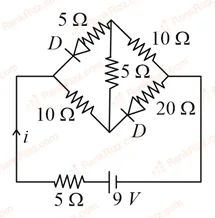
The current ii in the network is:

Figure for JEE Main 2020 Physics question on Diode circuits and rectifiers
  1. A

    0.2 A

  2. B

    0.6 A

  3. C

    0.3 A

  4. D

    0 A

Q21Isothermal and adiabatic processes

Starting at temperature 300K300K, one mole of an ideal diatomic gas (γ=1.4)(\gamma = 1.4) is first compressed adiabatically from volume V1V_1 to V2=V116V_2 = \frac{V_1}{16}. It is then allowed to expand isobarically to volume 2V22V_2. If all the processes are the quasi-static then the final temperature of the gas (in °K°K) is (to the nearest integer) ___________.

Q22Electric flux and Gauss's law

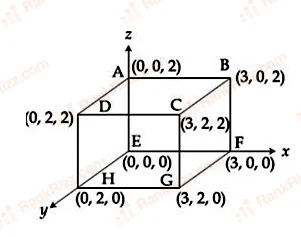
An electric field E⃗=4xi^−(y2+1)j^\vec{E} = 4x\hat{i} - (y^2 + 1)\hat{j} N/C passes through the box shown in figure. The flux of the electric field through surfaces ABCD and BCGF are marked as ϕI\phi_I and ϕII\phi_{II} respectively. The absolute difference between (ϕI−ϕII)(\phi_I - \phi_{II}) is (in Nm2^2/C) ___________.

Figure for JEE Main 2020 Physics question on Electric flux and Gauss's law
Q23Meter bridge

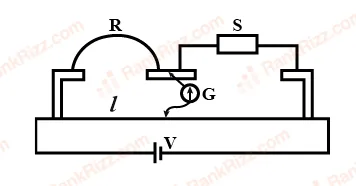
In a meter bridge experiment SS is a standard resistance. RR is a resistance wire. It is found that balancing length is l=25l = 25 cm. If RR is replaced by a wire of half length and half diameter that of RR of same material, then the balancing distance l′l' (in cm) will now be ___________.

Figure for JEE Main 2020 Physics question on Meter bridge
Q24Young's double slit experiment: fringe width and intensity

In a Young's double slit experiment 15 fringes are observed on a small portion of the screen when light of wavelength 500 nm is used. Ten fringes are observed on the same section of the screen when another light source of wavelength λ\lambda is used. Then the value of λ\lambda is (in nm) ___________.

Q25Zener diode, LED, photodiode and solar cell

In the circuit shown below, is working as a 8 V dc regulated voltage source. When 12 V is used as an input, the power dissipated (in mW) in each diode is (Considering both zener diodes are identical) ___________.
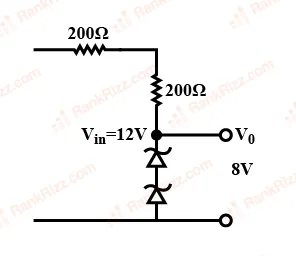
Figure for JEE Main 2020 Physics question on Zener diode, LED, photodiode and solar cell
NEXT IN THIS PAPER →Chemistry, Q26 onwards