Q1Dimensional analysis: deriving and checking relations
A quantity is given by where is speed of light, is universal gravitational constant and is the Planck's constant. Dimension of is that of:
- A
area
- B
energy
- C
momentum
- D
volume
All 75 questions of JEE Main 09 Jan 2020, Shift 1, in the order they were asked, one subject to a page. Pick an answer on any question to check it against the key. Free to read, nothing to download.
Questions
75
Physics · Chemistry · Maths
Answer key
72
questions with a checked key
Price
Free
no sign-up
A quantity is given by where is speed of light, is universal gravitational constant and is the Planck's constant. Dimension of is that of:
area
energy
momentum
volume
Consider a force . The work done by this force in moving a particle from point to along the line segment is: (all quantities are in SI units)
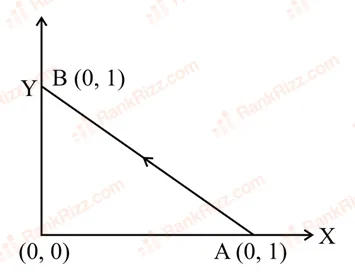
2
1
Two particles of equal mass have respective initial velocities and . They collide completely inelastically. The energy lost in the process is:
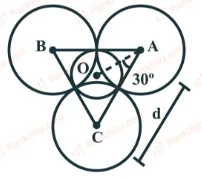
Three solid spheres each of mass and diameter are stuck together such that the lines connecting the centres form an equilateral triangle of side of length . The ratio of moment of inertia of the system about an axis passing the centroid and about center of any of the spheres and perpendicular to the plane of the triangle is:
A body A of mass is moving in a circular orbit of radius about a planet. Another body B of mass collides with A with a velocity which is half the instantaneous velocity of A. The collision is completely inelastic. Then, the combined body:
continues to move in a circular orbit
Escapes from the Planet's Gravitational field
Falls vertically downwards towards the planet
starts moving in an elliptical orbit around the planet
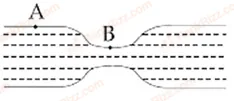
Water flows in a horizontal tube (see figure). The pressure of water changes by between and where the area of cross section are and , respectively. Find the rate of flow of water through the tube. (density of water )
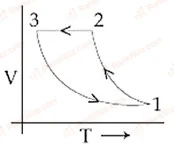
Which of the following is an equivalent cyclic process corresponding to the thermodynamic cyclic given in the figure? Where, is adiabatic. (Graphs are schematic and are not to scale)
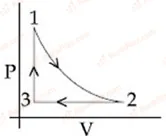
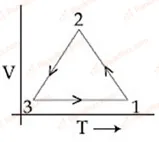
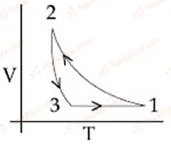
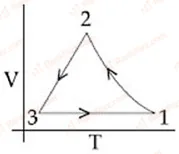
Consider two ideal diatomic gases and at some temperature . Molecules of the gas are rigid, and have a mass . Molecules of the gas have an additional vibrational mode and have a mass . The ratio of the specific heats and of gas and , respectively is:
7 : 9
5 : 9
3 : 5
5 : 7
Three harmonic waves having equal frequency and same intensity , have phase angles , and respectively. When they are superimposed the intensity of the resultant wave is close to:
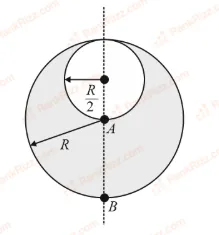
Consider a sphere of radius which carries a uniform charge density . If a sphere of radius is carved out of it, as shown, the ratio of magnitude of electric field and , respectively, at points and due to the remaining portion is:
An electric dipole of moment C m at the origin . The electric field due to this dipole at (note that ) is parallel to:
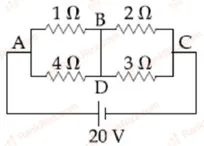
In the given circuit diagram, a wire is joining points B and D. The current in this wire is:
0.4A
2A
4A
zero
Radiation, with wavelength Å falls on a metal surface to produce photoelectrons. The electrons are made to enter a uniform magnetic field of T. If the radius of the largest circular path followed by the electrons is mm, the work function of the metal is close to:
1.6 eV
0.8 eV
1.1 eV
1.8 eV
A long, straight wire of radius carries a current distributed uniformly over its cross-section. The ratio of the magnetic fields due to the wire at distance and , respectively from the axis of the wire is:
2
A charged particle of mass 'm' and charge 'q' moving under the influence of uniform electric field and a uniform magnetic field follows a trajectory from point P to Q as shown in figure. The velocities at P and Q are respectively, and . Then which of the following statements (A, B, C, D) are the correct? (Trajectory shown is schematic and not to scale)
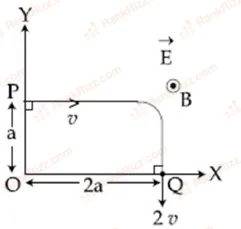
(A)
(B) Rate of work done by the electric field at P is
(C) Rate of work done by both the fields at Q is zero
(D) The difference between the magnitude of angular momentum of the particle at P and Q is .
The electric fields of two plane electromagnetic waves in vacuum are given by and . At , a particle of charge is at origin with a velocity ( is the speed of light in vacuum). The instantaneous force experienced by the particle is:
A vessel of depth is half filled with a liquid of refractive index and the upper half with another liquid of refractive index . The liquids are immiscible. The apparent depth of the inner surface of the bottom of the vessel will be:
The aperture diameter of a telescope is m. The separation between the moon and the earth is km. With light of wavelength Å, the minimum separation between objects on the surface of moon, so that they are just resolved, is close to:
60 m
20 m
200 m
600 m
A particle moving with kinetic energy has de Broglie wavelength . If energy is added to its energy, the wavelength become . Value of , is:
If the screw on a screw-gauge is given six rotations, it moves by on the main scale. If there are 50 divisions on the circular scale the least count of the screw gauge is:
0.001 cm
0.02 m
0.01 cm
0.001 mm
The distance covered by a particle in one dimensional motion varies with time as . If the acceleration of the particle depends on as , where is an integer, the value of is ___________.
One end of a straight uniform long bar is pivoted on horizontal table. It is released from rest when it makes an angle from the horizontal (see figure). Its angular speed when it hits the table is given as rad , where is an integer. The value of is ___________.
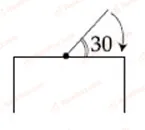
A body of mass kg is attached to one end of a wire of length m. What is the maximum angular speed (in rad ) with which it can be rotated about its other end in a space station without breaking the wire?
[Breaking stress of wire N and area of cross-section of the wire ]
In a fluorescent lamp choke (a small transformer) of reverse voltage is produced when the choke current changes uniformly from to in a duration of . The self-inductance of the choke (in ) is estimated to be ___________.
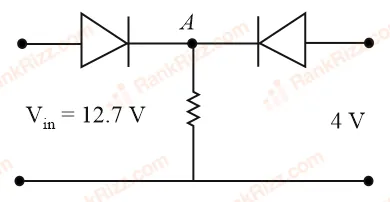
Both the diodes used in the circuit shown are assumed to be ideal and have negligible resistance when these are forward biased. Built in potential in each diode is . For the input voltages shown in the figure, the voltage (in Volts) at point A is ___________.