RankRizz

JEE Main 08 Jan 2020, Shift 2 Question Paper

All 75 questions of JEE Main 08 Jan 2020, Shift 2, in the order they were asked, one subject to a page. Pick an answer on any question to check it against the key. Free to read, nothing to download.

Questions

75

Physics · Chemistry · Maths

Answer key

74

questions with a checked key

Price

Free

no sign-up

Physics

Q1Errors in measurement and significant figures

A simple pendulum is being used to determine the value of gravitational acceleration gg at a certain place. The length of the pendulum is 25.0 cm and a stopwatch with 1 s resolution measures the time taken for 40 oscillations to be 50 s. The accuracy in g is:

  1. A

    5.40%

  2. B

    3.40%

  3. C

    4.40%

  4. D

    2.40%

Q2Motion and equilibrium of charged bodies in electric fields

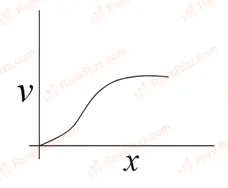
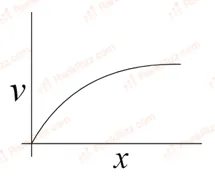
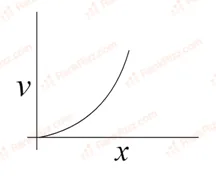
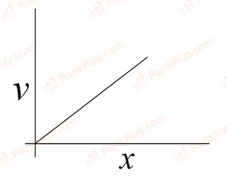
A particle of mass mm and charge qq is released from rest in a uniform electric field. If there is no other force on the particle, the dependence of its speed vv on the distance xx travelled by it is correctly given by (graphs are schematic and not drawn to scale)

  1. A
    Figure for JEE Main 2020 Physics question on Motion and equilibrium of charged bodies in electric fields
  2. B
    Figure for JEE Main 2020 Physics question on Motion and equilibrium of charged bodies in electric fields
  3. C
    Figure for JEE Main 2020 Physics question on Motion and equilibrium of charged bodies in electric fields
  4. D
    Figure for JEE Main 2020 Physics question on Motion and equilibrium of charged bodies in electric fields
Q3Kinematics in two dimensions using position vectors

A particle moves such that its position vector r⃗(t)=cos⁡ωt i^+sin⁡ωt j^\vec{r}(t) = \cos\omega t\,\hat{i} + \sin\omega t\,\hat{j} where ω\omega is a constant and tt is time. Then which of the following statements is true for the velocity v⃗(t)\vec{v}(t) and acceleration a⃗(t)\vec{a}(t) of the particle:

  1. A

    v⃗\vec{v} is perpendicular to r⃗\vec{r} and a⃗\vec{a} is directed away from the origin

  2. B

    v⃗\vec{v} and a⃗\vec{a} both are perpendicular to r⃗\vec{r}

  3. C

    v⃗\vec{v} and a⃗\vec{a} both are parallel to r⃗\vec{r}

  4. D

    v⃗\vec{v} is perpendicular to r⃗\vec{r} and a⃗\vec{a} is directed towards the origin

Q4Centre of mass of continuous bodies and cavities

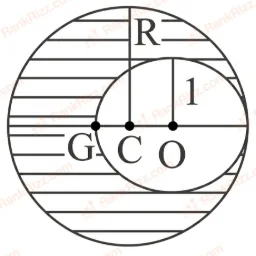
As shown in figure. When a spherical cavity (centred at O) of radius 1 is cut out of a uniform sphere of radius R (centred at C), the centre of mass of remaining (shaded part of sphere is at G, i.e., on the surface of the cavity. R can be determined by the equation:

Figure for JEE Main 2020 Physics question on Centre of mass of continuous bodies and cavities
  1. A

    (R2+R+1)(2−R)=1(R^2 + R + 1)(2 - R) = 1

  2. B

    (R2−R−1)(2−R)=1(R^2 - R - 1)(2 - R) = 1

  3. C

    (R2−R+1)(2−R)=1(R^2 - R + 1)(2 - R) = 1

  4. D

    (R2+R−1)(2−R)=1(R^2 + R - 1)(2 - R) = 1

Q5Motion of centre of mass, momentum conservation and explosions

A particle of mass mm is dropped from a height hh above the ground. At the same time another particle of the same mass is thrown vertically upwards from the ground with a speed of 2gh\sqrt{2gh}. If they collide head-on completely inelastically, the time taken for the combined mass to reach the ground, in units of hg\sqrt{\frac{h}{g}} is

  1. A

    12\sqrt{\frac{1}{2}}

  2. B

    34\sqrt{\frac{3}{4}}

  3. C

    12\frac{1}{2}

  4. D

    32\sqrt{\frac{3}{2}}

Q6Rolling with friction, slipping and impulsive forces

A uniform sphere of mass 500 g rolls without slipping on a plane horizontal surface with its centre moving at a speed of 5.00 cm s−1^{-1}. Its kinetic energy is:

  1. A

    8.75×10−48.75 \times 10^{-4} J

  2. B

    8.75×10−38.75 \times 10^{-3} J

  3. C

    6.25×10−46.25 \times 10^{-4} J

  4. D

    1.13×10−31.13 \times 10^{-3} J

Q7Fluid pressure, Pascal's law and accelerated/rotating liquids

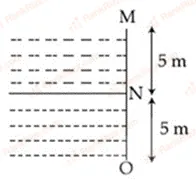
Two liquids of densities ρ1\rho_1 and ρ2\rho_2 (ρ2=2ρ1\rho_2 = 2\rho_1) are filled up behind a square wall of side 10 m as shown in figure. Each liquid has a height of 5 m. The ratio of the forces due to these liquids exerted on upper part MN to that at the lower part NO is (Assume that the liquids are not mixing):

Figure for JEE Main 2020 Physics question on Fluid pressure, Pascal's law and accelerated/rotating liquids
  1. A

    13\frac{1}{3}

  2. B

    23\frac{2}{3}

  3. C

    12\frac{1}{2}

  4. D

    14\frac{1}{4}

Q8Carnot engine and Carnot cycle

A Carnot engine having an efficiency of 110\frac{1}{10} is being used as a refrigerator. If the work done on the refrigerator is 10 J, the amount of heat absorbed from the reservoir at a lower temperature is

  1. A

    99 J

  2. B

    100 J

  3. C

    1 J

  4. D

    90 J

Q9Molar specific heats of gases, Mayer's relation and gas mixtures

Consider a mixture of nn moles of helium gas and 2n2n moles of oxygen gas (molecules taken to be rigid) as an ideal gas. Its CPCV\frac{C_P}{C_V} value will be:

  1. A

    1913\frac{19}{13}

  2. B

    6745\frac{67}{45}

  3. C

    4027\frac{40}{27}

  4. D

    2315\frac{23}{15}

Q10Progressive waves: wave equation, phase and intensity

A transverse wave travels on a taut steel wire with a velocity of vv when tension in it is 2.06×1042.06 \times 10^4 N. When the tension is changed to T, the velocity changed to v2\frac{v}{2}. The value of T is close to:

  1. A

    2.50×1042.50 \times 10^4 N

  2. B

    5.15×1035.15 \times 10^3 N

  3. C

    30.5×10430.5 \times 10^4 N

  4. D

    10.2×10210.2 \times 10^2 N

Q11Electric potential and potential energy

Consider two charged metallic spheres S1S_1 and S2S_2 of radii R1R_1 and R2R_2, respectively. The electric fields E1E_1 (on S1S_1) and E2E_2 (on S2S_2) on their surfaces are such that E1E2=R1R2\frac{E_1}{E_2} = \frac{R_1}{R_2}. Then the ratio V1V_1 (on S1S_1)/V2V_2 (on S2S_2) of the electrostatic potentials on each sphere is:

  1. A

    R1R2\frac{R_1}{R_2}

  2. B

    (R1R2)2\left(\frac{R_1}{R_2}\right)^2

  3. C

    (R2R1)\left(\frac{R_2}{R_1}\right)

  4. D

    (R1R2)3\left(\frac{R_1}{R_2}\right)^3

Q12Capacitance of isolated conductors and spherical/cylindrical capacitors

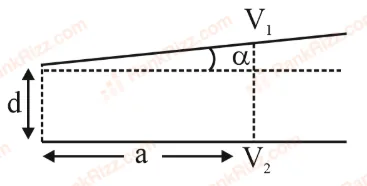
A capacitor is made of two square plates each of side 'a' making a very small angle α\alpha between them, as shown in figure. The capacitance will be close to:

Figure for JEE Main 2020 Physics question on Capacitance of isolated conductors and spherical/cylindrical capacitors
  1. A

    ε0a2d(1−αa2d)\frac{\varepsilon_0 a^2}{d}\left(1 - \frac{\alpha a}{2d}\right)

  2. B

    ε0a2d(1−αa4d)\frac{\varepsilon_0 a^2}{d}\left(1 - \frac{\alpha a}{4d}\right)

  3. C

    ε0a2d(1+αad)\frac{\varepsilon_0 a^2}{d}\left(1 + \frac{\alpha a}{d}\right)

  4. D

    ε0a2d(1−3αa2d)\frac{\varepsilon_0 a^2}{d}\left(1 - \frac{3\alpha a}{2d}\right)

Q13Galvanometer conversion to ammeter and voltmeter

A galvanometer having a coil resistance 100 Ω\Omega gives a full scale deflection when a current of 1 mA is passed through it. What is the value of the resistance which can convert this galvanometer into a voltmeter giving full scale deflection for a potential difference of 10 V?

  1. A

    10 kΩ\Omega

  2. B

    8.9 kΩ\Omega

  3. C

    7.9 kΩ\Omega

  4. D

    9.9 kΩ\Omega

Q14Biot-Savart law: straight wires and moving charges

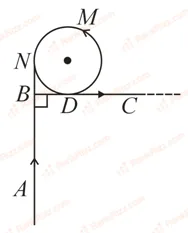
A very long wire ABDMNDC is shown in figure carrying current I. AB and BC parts are straight, long and at right angle. At D wire forms a circular turn DMND of radius R. AB, BC parts are tangential to circular turn at N and D. Magnetic field at the center of circle is:

Figure for JEE Main 2020 Physics question on Biot-Savart law: straight wires and moving charges
  1. A

    μ0I2πR(π+12)\frac{\mu_0 I}{2\pi R}\left(\pi + \frac{1}{\sqrt{2}}\right)

  2. B

    μ0I2πR(π−12)\frac{\mu_0 I}{2\pi R}\left(\pi - \frac{1}{\sqrt{2}}\right)

  3. C

    μ0I2πR(π+1)\frac{\mu_0 I}{2\pi R}(\pi + 1)

  4. D

    μ0I2R\frac{\mu_0 I}{2R}

Q15Self inductance and energy stored in inductors

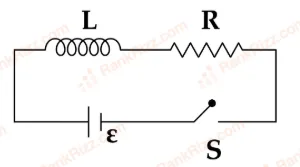
As shown in the figure, a battery of emf ε\varepsilon is connected to an inductor L and resistance R in series. The switch is closed at t=0t = 0. The total charge that flows from the battery, between t=0t = 0 and t=tct = t_c (tct_c is the time constant of the circuit) is:

Figure for JEE Main 2020 Physics question on Self inductance and energy stored in inductors
  1. A

    εLeR2\frac{\varepsilon L}{eR^2}

  2. B

    εLR2(1−1e)\frac{\varepsilon L}{R^2}\left(1 - \frac{1}{e}\right)

  3. C

    εLR2\frac{\varepsilon L}{R^2}

  4. D

    εRεL2\frac{\varepsilon R}{\varepsilon L^2}

Q16Properties of EM waves: fields, energy, intensity and momentum

A plane electromagnetic wave of frequency 25 GHz is propagating in vacuum along the z-direction. At a particular point in space and time, the magnetic field is given by B⃗=5×10⁻⁸j^\vec{B} = 5 \times 10^{-8}\hat{j} T. The corresponding electric field E⃗\vec{E} is (speed of light = 3×1083 \times 10^8 m s−1^{-1})

  1. A

    1.66×10⁻¹⁶i^1.66 \times 10^{-16} \hat{i} V/m

  2. B

    −1.66×10⁻¹⁶i^-1.66 \times 10^{-16} \hat{i} V/m

  3. C

    −15i^-15\hat{i} V/m

  4. D

    15i^15\hat{i} V/m

Q17Spherical mirrors: mirror formula and magnification

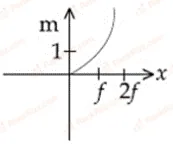
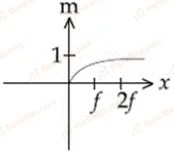
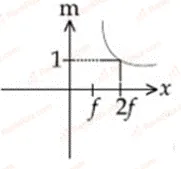
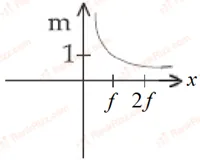
An object is gradually moving away from the focal point of a concave mirror along the axis of the mirror. The graphical representation of the magnitude of linear magnification (m) versus distance of the object from the mirror (x) is correctly given by (Graphs are drawn schematically and are not to scale)

  1. A
    Figure for JEE Main 2020 Physics question on Spherical mirrors: mirror formula and magnification
  2. B
    Figure for JEE Main 2020 Physics question on Spherical mirrors: mirror formula and magnification
  3. C
    Figure for JEE Main 2020 Physics question on Spherical mirrors: mirror formula and magnification
  4. D
    Figure for JEE Main 2020 Physics question on Spherical mirrors: mirror formula and magnification
Q18Wavefronts and Huygens' principle

In a double-slit experiment, at a certain point on the screen the path difference between the two interfering waves is 18\frac{1}{8}th of a wavelength. The ratio of the intensity of light at that point to that at the center of a bright fringe is:

  1. A

    0.853

  2. B

    0.672

  3. C

    0.568

  4. D

    0.760

Q19de Broglie wavelength of matter waves

An electron (mass m) with initial velocity v⃗=v0i^+v0j^\vec{v} = v_0\hat{i} + v_0\hat{j} is in an electric field E⃗=−E0k^\vec{E} = -E_0\hat{k}. If λ0\lambda_0 is initial de-Broglie wavelength of electron, its de-Broglie wave length at time tt is given by:

  1. A

    λ021+e2E02t2m2v02\frac{\lambda_0\sqrt{2}}{\sqrt{1 + \frac{e^2E_0^2t^2}{m^2v_0^2}}}

  2. B

    λ01+e2E02t2m2v02\frac{\lambda_0}{\sqrt{1 + \frac{e^2E_0^2t^2}{m^2v_0^2}}}

  3. C

    λ01+e2E02t22m2v02\frac{\lambda_0}{\sqrt{1 + \frac{e^2E_0^2t^2}{2m^2v_0^2}}}

  4. D

    λ02+e2E02t2m2v02\frac{\lambda_0}{\sqrt{2 + \frac{e^2E_0^2t^2}{m^2v_0^2}}}

Q20Logic gates and digital circuits

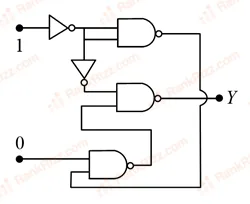
In the given circuit, value of Y is:

Figure for JEE Main 2020 Physics question on Logic gates and digital circuits
  1. A

    0

  2. B

    toggles between 0 and 1

  3. C

    will not execute

  4. D

    1

Q21Vertical motion under gravity

A ball is dropped from the top of a 100 m high tower on a planet. In the last 12\frac{1}{2} s before hitting the ground, it covers a distance of 19 m. Acceleration due to gravity (in m s−2^{-2}) near the surface on that planet is

Q22Escape speed

An asteroid is moving directly towards the centre of the earth. When at a distance of 10R (R is the radius of the earth) from the centre of the earth, it has a speed of 12 km s−1^{-1}. Neglecting the effect of earth's atmosphere, what will be the speed of the asteroid when it hits the surface of the earth (escape velocity from the earth is 11.2 km s−1^{-1})? Give your answer to the nearest integer in km s−1^{-1}

Q23Calorimetry and specific heat capacity

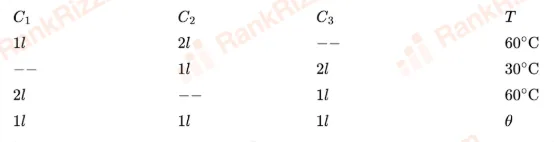
Three containers C1C_1, C2C_2 and C3C_3 have water at different temperatures. The table below shows the final temperature T when different amounts of water (given in liters) are taken from each container and mixed (assume no loss of heat during the process)

Figure for JEE Main 2020 Physics question on Calorimetry and specific heat capacity

The value of θ\theta (in ∘^\circC to the nearest integer) is__________

Q24Cells: emf, internal resistance and combinations

The series combination of two batteries, both of the same emf 10 V, but different internal resistance of 20 Ω\Omega and 5 Ω\Omega, is connected to the parallel combination of two resistors 30 Ω\Omega and x Ω\Omega. The voltage difference across the battery of internal resistance 20 Ω\Omega is zero, the value of x (in Ω\Omega) is

Q25Hydrogen spectrum and spectral series

The first member of the Balmer series of hydrogen atom has a wavelength of 6561 A˚\mathring{A}. The wavelength of the second member of the Balmer series (in nm) is

NEXT IN THIS PAPER →Chemistry, Q26 onwards