Q1Dimensional analysis: deriving and checking relations
The dimension of stopping potential in photoelectric effect in units of Planck's constant 'h', speed of light 'c' and Gravitational constant 'G' and ampere A is:
- A
- B
- C
- D
All 75 questions of JEE Main 08 Jan 2020, Shift 1, in the order they were asked, one subject to a page. Pick an answer on any question to check it against the key. Free to read, nothing to download.
Questions
75
Physics · Chemistry · Maths
Answer key
73
questions with a checked key
Price
Free
no sign-up
The dimension of stopping potential in photoelectric effect in units of Planck's constant 'h', speed of light 'c' and Gravitational constant 'G' and ampere A is:
A particle of mass is fixed to one end of a light spring having force constant and unstretched length . The other end is fixed. The system is given an angular speed about the fixed end of the spring such that it rotates in a circle in gravity free space. Then the stretch in the spring is:
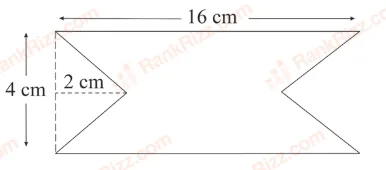
The coordinates of the centre of mass of a uniform flag-shaped lamina (thin flat plate) of mass 4 kg. (The coordinates of the same are shown in the figure) are:
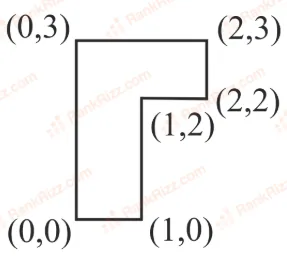
(1.25 m, 1.50 m)
(0.75 m, 1.75 m)
(0.75 m, 0.75 m)
(1 m, 1.75 m)
Consider a uniform rod of mass m and length pivoted about its centre. A mass moving with velocity making angle to the rod's long axis collides with one end of the rod and sticks to it. The angular speed of the rod-mass system just after the collision is:
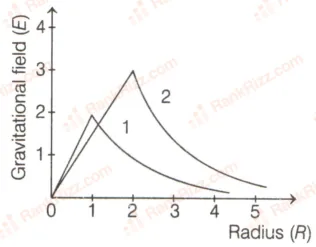
Consider two solid spheres of radii m, m and masses and , respectively. The gravitational field due to sphere (1) and (2) are shown. The value of is:
A leak proof cylinder of length 1 m, made of a metal which has very low coefficient of expansion is floating vertically in water at 0C such that its height above the water surface is 20 cm. When the temperature of water is increased to 4C, the height of the cylinder above the water surface becomes 21 cm. The density of water at T = 4C, relative to the density at T = 0C is close to:
1.26
1.04
1.01
1.03
Consider a solid sphere of radius and mass density , . The minimum density of a liquid in which it will float is:
A thermodynamic cycle xyzx is shown on a V-T diagram.
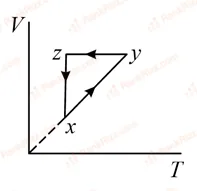
The P-V diagram that best describes this cycle is: (Diagrams are schematic and not to scale)
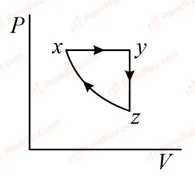
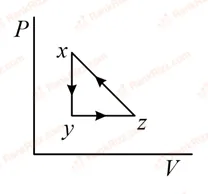
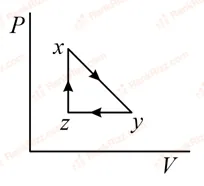
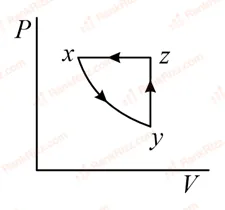
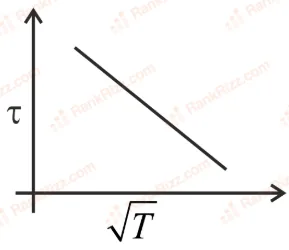
The plot that depicts the behavior of the mean free time (time between two successive collisions) for the molecules of an ideal gas, as a function of temperature (T), qualitatively, is: (Graphs are schematic and not drawn to scale)
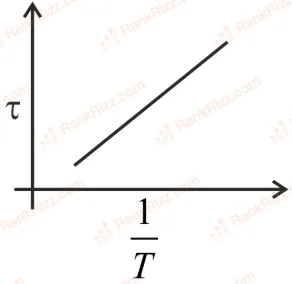
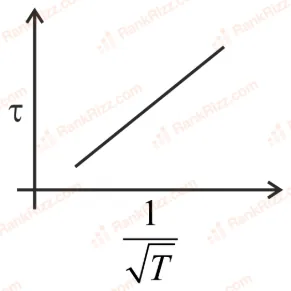
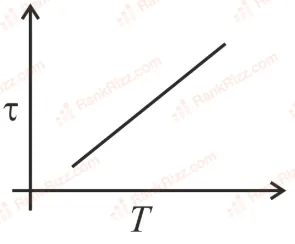
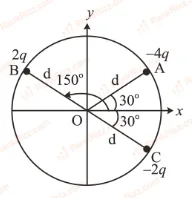
Three charged particles A, B and C with charges , and are present on the circumference of a circle of radius . The charged particles A, C and centre O of the circle formed an equilateral triangle as shown in the figure. The electric field at the point O is
In finding the electric field using Gauss law the formula is applicable. In the formula is permittivity of free space, A is the area of the Gaussian surface and is charge enclosed by the Gaussian surface. This equation can be used in which of the following situation?
Only when the Gaussian surface is an equipotential surface
Only when the Gaussian surface is an equipotential surface and is constant on the surface.
Only when = constant on the surface.
For any choice of Gaussian surface.
Effective capacitance of parallel combination of two capacitors and is 10F. When these capacitors are individually connected to a voltage source of 1V, the energy stored in the capacitor is 4 times that of . If these capacitors are connected in series, their effective capacitance will be:
4.2 F
3.2 F
1.6 F
8.4 F
The length of a potentiometer wire is 1200 cm and it carries a current of 60 mA. For a cell of emf 5 V and internal resistance of 20 the null point on it is found to be at 1000 cm. The resistance of whole wire is:
80
120
60
100
Proton with kinetic energy of 1 MeV moves from south to north. It gets an acceleration of m/s by an applied magnetic field (west to east). The value of magnetic field: (Rest mass of proton is kg)
0.71 mT
7.1 mT
0.071 mT
71 mT
At time magnetic field of 1000 Gauss is passing perpendicularly through the area defined by the closed loop shown in the figure. If the magnetic field reduces linearly to 500 Gauss, in the next 5s, then induced EMF in the loop is:
56 V
28 V
48 V
36 V
The critical angle of a medium for a specific wavelength, if the medium has relative permittivity 3 and relative permeability for this wavelength, will be:
15
30
45
60
The magnifying power of a telescope with tube length 60 cm is 5. What is the focal length of its eye piece?
20 cm
40 cm
30 cm
10 cm
When photon of energy 4.0 eV strikes the surface of a metal A, the ejected photoelectrons have maximum kinetic energy eV and de-Broglie wavelength . The maximum kinetic energy of photoelectrons liberated from another metal B by photon of energy 4.50 eV is eV. If the de-Broglie wavelength of these photoelectrons , then the work function of metal B is:
4 eV
2 eV
1.5 eV
3 eV
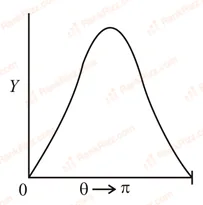
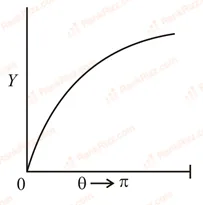
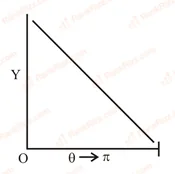
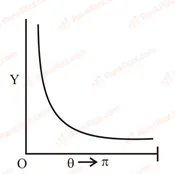
The graph which depicts the results of Rutherford gold foil experiment with -particles is:
: Scattering angle
Y: Number of scattered -particles detected
(Plots are schematic and not to scale)
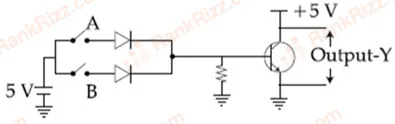
Boolean relation at the output stage Y for the following circuit is:
A particle is moving along the -axis with its coordinate with time given by . Another particle is moving along the -axis with its coordinate as a function of time given by . At s, the speed of the second particle as measured in the frame of the first particle is given as . Then (in m s) is
A body A of mass kg has an initial velocity of m s. It collides elastically with another body B of the same mass which has an initial velocity of m s. After the collision, A moves with a velocity m s. The energy of B after the collision is written as J. The value of is
A one metre long (both ends open) organ pipe is kept in a gas that has double the density of air at STP. Assuming the speed of sound in air at STP is 300 m/s, the frequency difference between the fundamental and second harmonic of this pipe is __________ Hz.
Four resistances of 15 , 12 , 4 and 10 respectively in cyclic order to form Wheatstone's network. The resistance that is to be connected in parallel with the resistance of 10 to balance the network is __________ .
A point object in air is in front of the curved surface of a plano-convex lens. The radius of curvature of the curved surface is 30 cm and the refractive index of the lens material is 1.5, then the focal length of the lens (in cm) is