JEE Main 2020 Physics question — Calorimetry and specific heat capacity
Three containers , and have water at different temperatures. The table below shows the final temperature T when different amounts of water (given in liters) are taken from each container and mixed (assume no loss of heat during the process)
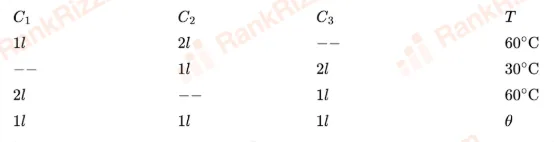
The value of (in C to the nearest integer) is__________
SOLUTION
We begin by recalling the principle of calorimetry for ideal mixtures. When different masses (or, for a liquid of uniform density, different volumes) of water at temperatures are mixed and no heat is lost to the surroundings, the final equilibrium temperature is the weighted average:
where are the respective masses or volumes. Here each litre of water is taken to have the same mass, so we may write all equations directly in litres.
Let the unknown temperatures of the three containers be
Now we translate every piece of experimental data into an equation.
First mixture: 1 L from and 2 L from are mixed, giving a final temperature of . Substituting in the formula,
Multiplying both sides by 3, we obtain
Second mixture: 1 L from and 2 L from are mixed, giving . Thus,
which simplifies, after multiplying by 3, to
Third mixture: 2 L from and 1 L from are mixed, again giving . Hence,
and multiplying through by 3 yields
We now have a system of three linear equations in the three unknowns :
From equation (1) we solve for in terms of :
Substituting (4) in equation (3):
Expanding the left side gives
Isolating we find
Now substitute (5) into equation (2):
Simplifying the left-hand side,
which combines to
Adding 360 to both sides gives
and dividing by 9 yields
Back-substitution: Using in equation (4),
Using in equation (5),
So the individual container temperatures are
Finally, we turn to the required mixture of 1 L from each container. The total volume is litres, so
So, the answer is .