Q1Dimensional analysis: deriving and checking relations
Which of the following combinations has the dimension of electrical resistance ( is the permittivity of vacuum and is the permeability of vacuum)?
- A
- B
- C
- D
All 90 questions of JEE Main 12 Apr 2019, Shift 1, in the order they were asked, one subject to a page. Pick an answer on any question to check it against the key. Free to read, nothing to download.
Questions
90
Physics · Chemistry · Maths
Answer key
90
questions with a checked key
Price
Free
no sign-up
Which of the following combinations has the dimension of electrical resistance ( is the permittivity of vacuum and is the permeability of vacuum)?
The trajectory of a projectile near the surface of the earth is given as . If it were launched at an angle with speed then g = 10 m s:
and ms
and ms
and ms
and ms
A shell is fired from a fixed artillery gun with an initial speed u such that it hits the target on the ground at a distance R from it. If t and t are the values of the time taken by it to hit the target in two possible ways, the product tt is:
R/2g
R/g
2R/g
R/4g
A man (mass = 50 kg) and his son (mass = 20 kg) are standing on a frictionless surface facing each other. The man pushes his son so that he starts moving at a speed of 0.70 m s with respect to the man. The speed of the man with respect to the surface is:
0.20 m s
0.14 m s
0.47 m s
0.28 m s
A person of mass M is sitting on a swing of length L and swinging with an angular amplitude . If the person stands up when the swing passes through its lowest point, the work done by him, assuming that his centre of mass moves by a distance (), is close to:
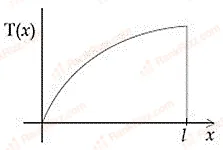
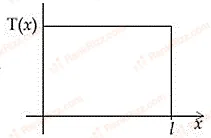
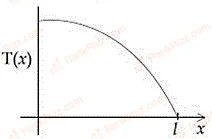
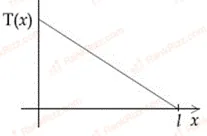
A uniform rod of length is being rotated in a horizontal plane with a constant angular speed about an axis passing through one of its ends. If the tension generated in the rod due to rotation is T(x) at a distance x from the axis, then which of the following graphs depicts it most closely?
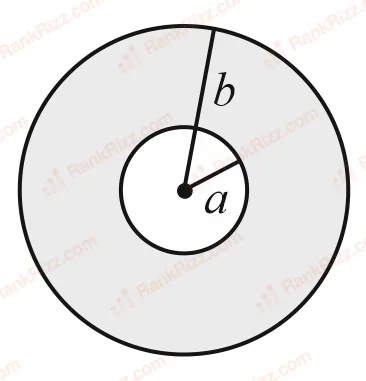
A circular disc of radius b has a hole of radius a at its centre (see figure). If the mass per unit area of the disc varies as , then the radius of gyration of the disc about its axis passing through the center is
At 40°C, a brass wire of 1 mm radius is hung from the ceiling. A small mass, M is hung from the free end of the wire. When the wire is cooled down from 40°C to 20°C it regains its original length of 0.2 m. The value of M is close to:
(Coefficient of linear expansion of brass are /°C and Young's modulus of brass is N/m, respectively; g = 10 m s)
0.9 kg
0.5 kg
1.5 kg
9 kg
When M gram of ice at -10°C (specific heat = 0.5 cal g °C) is added to M gram of water at 50°C, finally no ice is left and the water is at 0°C. The value of latent heat of ice, in cal g is:
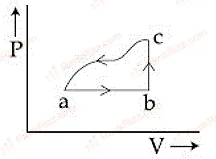
A sample of an ideal gas is taken through the cyclic process abca as shown in the figure. The change in the internal energy of the gas along the path ca is -180 J. The gas absorbs 250 J of heat along the path ab and 60 J along the path bc. The work done by the gas along the path abc is:
130 J
100 J
120 J
140 J
Two moles of helium gas is mixed with three moles of hydrogen molecules (taken to be rigid). What is the molar specific heat of mixture at constant volume? R = 8.3 J/mol K
17.4 J/mol K
19.7 J/mol K
15.7 J/mol K
21.6 J/mol K
A submarine A travelling at 18 km hr is being chased along the line of its velocity by another submarine B travelling at 27 km hr. B sends a sonar signal of 500 Hz to detect A and receives a reflected sound of frequency v. The value of v is close to (Speed of sound in water 1500 m s)
504 Hz
499 Hz
502 Hz
507 Hz
A progressive wave travelling along the positive x-direction is represented by . Its snapshot at t = 0 is given in the figure.
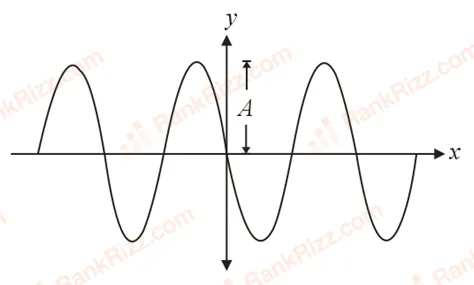
For this wave, the phase is:
0
Shown in the figure is a shell made of a conductor. It has inner radius a and outer radius b, and carries charge Q. At its centre a dipole is placed as shown then:
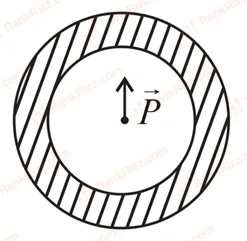
Surface charge density on the inner surface of the shell is zero everywhere.
Electric field outside the shell is the same as that of a point charge at the centre of the shell.
Surface charge density on the inner surface is uniform and equal to .
Surface charge density on the outer surface depends on .
A Point dipole is kept at the origin. The potential and electric field due to this dipole on the y-axis at a distance d are, respectively: (Taken V = 0 at infinity)
,
,
,
,
Two identical parallel plate capacitors, of capacitance C each, have plates of area A, separated by a distance d. The space between the plates of the two capacitors, is filled with three dielectrics, of equal thickness and dielectric constants K, K and K. The first capacitor is filled as shown in figure I, and the second one is filled as shown in figure II.
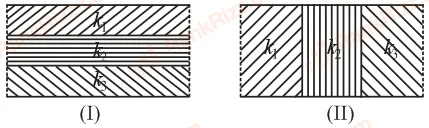
If these two modified capacitors are charged by the same potential V, the ratio of the energy stored in the two, would be (E refers to capacitor I and E to capacitor II):
To verify Ohm's law, a student connects the voltmeter across the battery as shown in the figure. The measured voltage is plotted as a function of the current, and the following graph is obtained.
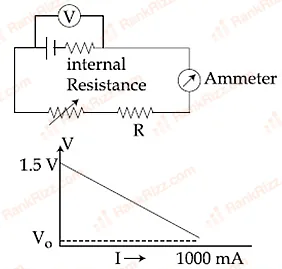
If V is almost zero, identify the correct statement:
The emf of the battery is 1.5 V and its internal resistance is 1.5 Ω
The value of the resistance R is 1.5 Ω
The potential difference across the battery is 1.5 V when it sends a current of 1000 mA
The emf of the battery is 1.5 V and the value of R is 1.5 Ω
A galvanometer of resistance 100 Ω has 50 divisions on its scale and has sensitivity of 20 μA/division. It is to be converted to voltmeter with three ranges, of 0 - 2 V, 0 - 10 V and 0 - 20 V. The appropriate circuit to do so is:
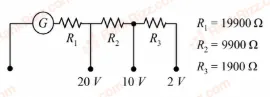
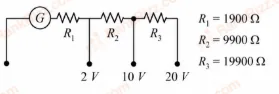
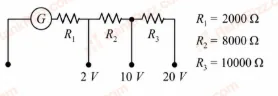
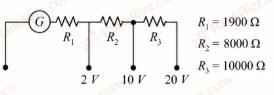
The resistive network shown below is connected to a D.C. source of 16 V. The power consumed by the network is 4 Watt. The value of R is:
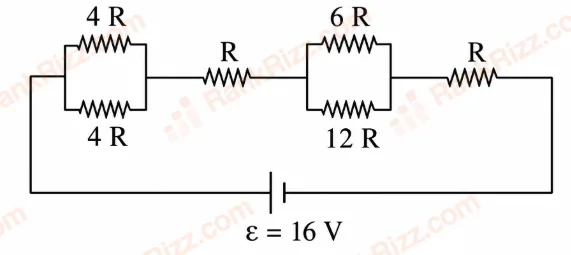
16 Ω
8 Ω
6 Ω
1 Ω
A magnetic compass needle oscillates 30 times per minute at a place where the dip is 45° and 40 times per minute where the dip is 30°. If B and B are the net magnetic fields due to the earth at the two places respectively, then the ratio B/B is approximately equal to
3.6
1.8
1.2
0.7
A thin ring of 10 cm radius carries a uniformly distributed charge. The ring rotates at a constant angular speed of rad s about its axis, perpendicular to its plane. If the magnetic field at its centre is T, then the charge carried by the ring is close to N/A.
C
C
C
C
The figure shows a square loop L of side 5 cm which is connected to a network of resistances. The whole setup is moving towards the right with a constant speed of 1 cm s. At some instant, a part of L is in a uniform magnetic field of 1T perpendicular to the plane of the loop. If the resistance of L is 1.7 Ω, the current in the loop at that instant will be close to:
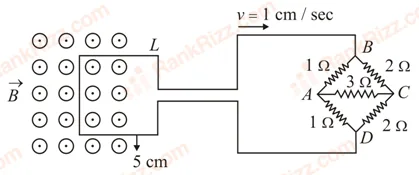
115 μA
60 μA
150 μA
170 μA
An electromagnetic wave is represented by the electric field . Taking unit vectors in x, y and z directions to be , the direction of propagation , is:
A concave mirror has radius of curvature of 40 cm. It is at the bottom of a glass that has water filled up to 5 cm (see figure). If a small particle is floating on the surface of water, its image as seen, from directly above the glass, is at a distance d from the surface of water. The value of d is close to: (Refractive index of water = 1.33)
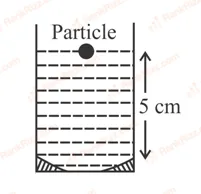
13.4 cm
8.8 cm
6.7 cm
11.7 cm
The value of numerical aperture of the objective lens of a microscope is 1.25. If light of wavelength 5000 Å is used, the minimum separation between two points, to be seen as distinct, will be:
0.48 μm
0.24 μm
0.38 μm
0.12 μm
In a double slit experiment, when a thin film of thickness t having refractive index μ is introduced in front of one of the slits, the maximum at the centre of the fringe pattern shifts by one fringe width. The value of t is ( is the wavelength of the light used):
The stopping potential V (in volt) as a function of frequency () for a sodium emitter, is shown in the figure. The work function of sodium, from the data plotted in the figure, will be:
(Given: Planck's constant h = J s, electron charge (e) = C)
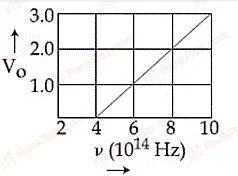
2.12 eV
1.82 eV
1.95 eV
1.66 eV
An excited He ion emits two photons in succession, with wavelengths 108.5 nm and 30.4 nm in making a transition to the ground state. The quantum number n, corresponding to its initial excited state is
(for a photon of wavelength , energy E = )
n = 6
n = 5
n = 7
n = 4
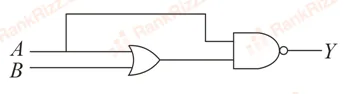
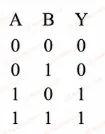
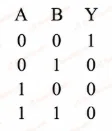
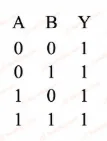
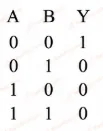
The truth table for the circuit given in the figure is:
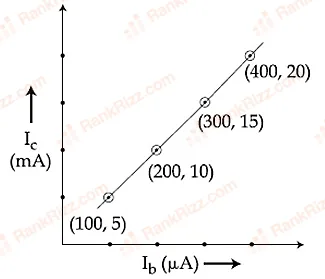
The transfer characteristic curve of a transistor, having input and output resistance 100 Ω and 100 kΩ respectively, is shown in the figure. The voltage and power gain, are respectively:
,
,
,
,