Q1Non-uniform acceleration using calculus
A particle is moving with speed along positive x-axis. Calculate the speed of the particle at time (assume that the particle is at origin at t = 0)
- A
- B
- C
- D
All 90 questions of JEE Main 12 Apr 2019, Shift 2, in the order they were asked, one subject to a page. Pick an answer on any question to check it against the key. Free to read, nothing to download.
Questions
90
Physics · Chemistry · Maths
Answer key
90
questions with a checked key
Price
Free
no sign-up
A particle is moving with speed along positive x-axis. Calculate the speed of the particle at time (assume that the particle is at origin at t = 0)
Two particles are projected from the same point with the same speed u such that they have the same range R, but different maximum heights, h and h. Which of the following is correct?
R = hh
R = 4hh
R = 2hh
R = 16hh
A block of mass 5 kg is (i) pushed in case (A) and (ii) pulled in case (B), by a force F = 20 N, making an angle of 30° with the horizontal, as shown in the figures. The coefficient of friction between the block and floor is = 0.2. The difference between the accelerations of the block, in case (B) and case (A) will be: (g = 10 m s)
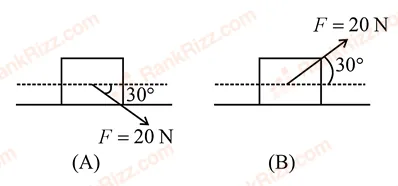
3.2 m s
0 m s
0.8 m s
0.4 m s
A spring whose unstretched length is has a force constant k. The spring is cut into two pieces of unstretched lengths and where, and n is an integer. The ratio of the corresponding force constants, k and k will be:
n
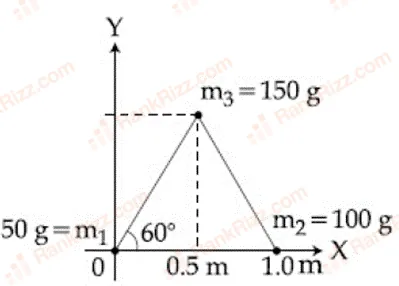
Three particles of masses 50 g, 100 g and 150 g are placed at the vertices of an equilateral triangle of side 1 m (as shown in the figure). The (x, y) coordinates of the centre of mass will be:
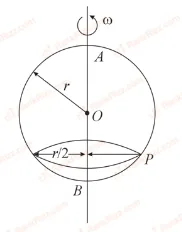
A smooth wire of length is bent into a circle and kept in a vertical plane. A bead can slide smoothly on the wire. When the circle is rotating with angular speed about the vertical diameter AB, as shown in figure, the bead is at rest with respect to the circular ring at position P as shown. Then the value of is equal to:
The ratio of the weights of a body on Earth's surface to that on the surface of a planet is 9:4. The mass of the planet is th of that of the Earth. If R is the radius of the Earth, what is the radius of the planet? (Take the planets to have the same mass density)
A solid sphere, of radius R acquires a terminal velocity when falling (due to gravity) through a viscous fluid having a coefficient of viscosity . The sphere is broken into 27 identical solid spheres. If each of these spheres acquires a terminal velocity, , when falling through the same fluid, the ratio equals:
27
9
A uniform cylindrical rod of length L and radius r, is made from a material whose Young's modulus of Elasticity equals Y. When this rod is heated by temperature T and simultaneously subjected to a net longitudinal compressional force F, its length remains unchanged. The coefficient of volume expansion, of the material of the rod, is (nearly) equal to:
1 kg of water, at 20°C is heated in an electric kettle whose heating element has a mean (temperature averaged) resistance of 20 Ω. The rms voltage in the mains is 200 V. Ignoring heat loss from the kettle, time taken for water to evaporate fully is close to
[Specific heat of water = 4200 J kg °C Latent heat of water = 2260 kJ kg]
3 min
16 min
22 min
10 min
A Carnot engine has an efficiency of . When the temperature of the sink is reduced by 62°C, its efficiency is doubled. The temperatures of the source and the sink are, respectively,
124 °C, 62 °C
37 °C, 99 °C
99 °C, 37 °C
62 °C, 124 °C
A diatomic gas with rigid molecules does 10 J of work when expanded at constant pressure. What would be the heat energy absorbed by the gas, in this process?
40 J
35 J
25 J
30 J
The number density of molecules of a gas depends on their distance r from the origin as, . Then the numer of molecules is proportional to:
A small speaker delivers 2 W of audio output. At what distance from the speaker will one detect 120 dB intensity sound? [Given reference intensity of sound as W/m]
40 cm
20 cm
10 cm
30 cm
Two sources of sound S and S produce sound waves of same frequency 660 Hz. A listener is moving from source S towards S with a constant speed u m/s and he hears 10 beats/s. The velocity of sound is 330 m/s. Then, u equals:
10.0 m/s
2.5 m/s
5.5 m/s
15.0 m/s
Let a total charge 2Q be distributed in a sphere of radius R, with the charge density given by , where r is the distance from the centre. Two charges A and B, of -Q each, are placed on diametrically opposite points, at equal distance, a, from the centre. If A and B do not experience any force, then:
a =
a =
a =
a =
In the given circuit, the charge on 4 μF capacitor will be:
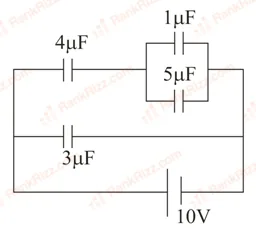
9.6 μC
5.4 μC
24 μC
13.4 μC
A moving coil galvanometer, having a resistance G, produces full scale deflection when a current I flows through it. This galvanometer can be converted into (i) an ammeter of range 0 to I (I > I) by connecting a shunt resistance R to it and (ii) into a voltmeter of range 0 to V (V = GI) by connecting a series resistance R to it. Then,
RR = G and
RR = G and
RR = G and
RR = G and
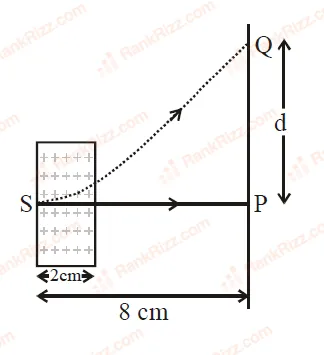
An electron, moving along the x-axis with an initial energy of 100 eV, enters a region of magnetic field T) at S (see figure). The field extends between x = 0 and x = 2 cm. The electron is detected at the point Q on a screen placed 8 cm away from the point S. The distance d between P and Q (on the screen) is:
(electron’s charge , mass of electron )
1.22 cm
12.87 cm
11.65 cm
2.25 cm
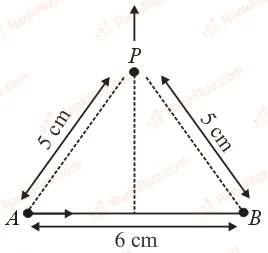
Find the magnetic field at point P due to a straight line segment AB of length 6 cm carrying a current of 5 A. (See figure) ( NA)
T
T
T
T
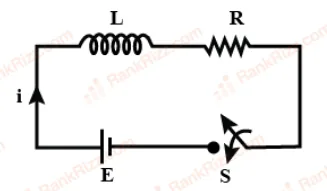
Consider the LR circuit shown in the figure. If the switch S is closed at t = 0 then the amount of charge that passes through the battery between t = 0 and t = is:
A plane electromagnetic wave having a frequency f = 23.9 GHz propagates along the positive z-direction in free space. The peak value of the Electric Field is 60 V/m. Which among the following is the acceptable magnetic field component in the electromagnetic wave?
A transparent cube of side d, made of a material of refractive index , is immersed in a liquid of refractive index (). A ray is incident on the face AB at an angle (shown in the figure). Total internal reflection takes place at point E on the face BC.
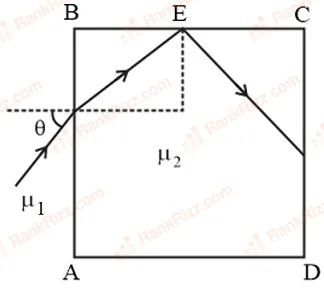
Then must satisfy
A system of three polarizers P, P, P is set up such that the pass axis of P is crossed with respect to that of P. The pass axis of P is inclined at 60° to the pass axis of P. When a beam of unpolarized light of intensity I is incident on P, the intensity of light transmitted by the three polarizers is I. The ratio (I/I) equals (nearly):
5.33
16.00
1.80
10.67
Consider an electron in a hydrogen atom, revolving in its second excited state (having radius 4.65 Å). The de-Broglie wavelength of this electron is:
12.9 Å
6.6 Å
9.7 Å
3.5 Å
The electron in a hydrogen atom first jumps from the third excited state to the second excited state and subsequently to the first excited state. The ratio of the respective wavelengths, , of the photons emitted in this process is:
Half lives of two radioactive nuclei A and B are 10 minutes and 20 minutes, respectively. If, initially a sample has equal number of nuclei, then after 60 minutes, the ratio of decayed numbers of nuclei A and B will be:
3 : 8
8 : 1
1 : 8
9 : 8
Figure shows a DC voltage regulator circuit, with a Zener diode of breakdown voltage = 6 V. If the unregulated input voltage varies between 10 V to 16 V, then what is the maximum Zener current?
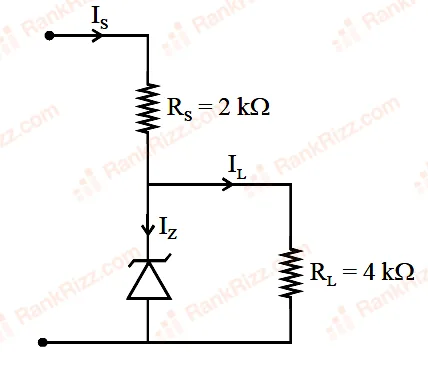
1.5 mA
3.5 mA
7.5 mA
2.5 mA
In a CE transistor amplifier, the audio signal voltage across the collector resistance of 2 kΩ is 2 V, if the base resistance is 1 kΩ and the current amplification of the transistor is 100 then the input signal voltage is
10 mV
1 mV
0.1 V
1 V
A tuning fork of frequency 480 Hz is used in an experiment for measuring speed of sound (v) in air by resonance tube method. Resonance is observed to occur at two successive lengths of the air column, l = 30 cm and l = 70 cm. Then, v is equal to:
384 m s
332 m s
338 m s
379 m s