JEE Main 2019 Physics question — Transistors (older syllabus)
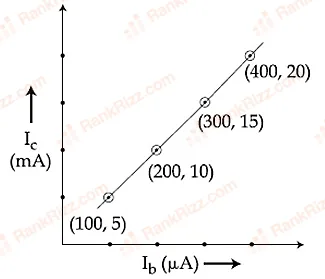
The transfer characteristic curve of a transistor, having input and output resistance 100 Ω and 100 kΩ respectively, is shown in the figure. The voltage and power gain, are respectively:
SOLUTION
The graph supplied in the question is the transfer (current-current) characteristic of the transistor, that is, it plots the small-signal output current (collector current) against the corresponding small-signal input current (base current). The slope of this straight-line graph is therefore
which is the small-signal current gain of the transistor. From the figure we read that for every change in input current the output current changes by , so
We are asked next for the voltage gain. First we recall the general relationship connecting voltage gain, current gain and the resistances of the input and output circuits. For small signals,
Now and , so substituting these into the above definition gives
We already have , and the data in the statement give the resistances
Hence
Finally, the power gain is required. The small-signal power gain is defined as
Substituting the numerical values we have just obtained,
Thus the voltage gain is and the power gain is .
Hence, the correct answer is Option A.
Topic: Transistors (older syllabus)