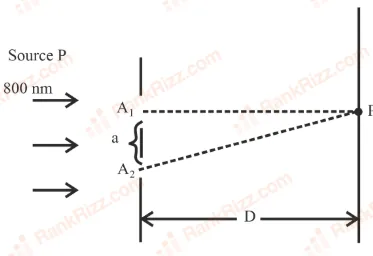
In a Young's double slit experiment, the intensity at a point is of the maximum intensity, the minimum distance of the point from the central maximum is _______ m. (Given : nm, mm, m)
Young's double slit experiment: fringe width and intensity has been asked 68 times in JEE Main, in 19 different years between 2004 and 2026, and in all of the last five exam years (2022–2026), 37 questions in all. That is 34% of Wave Optics, its most-asked topic. Last asked in JEE Main 06 Apr 2026, Shift 2. 51 are multiple choice and 17 numerical-value; 22 easy, 36 medium and 1 hard by our difficulty labels. All of them are below, newest first, free to read.
Questions
68
Years asked
19
Since
2004
Of the chapter
34%
21–40 OF 68 · NEWEST FIRST
In a Young's double slit experiment, the intensity at a point is of the maximum intensity, the minimum distance of the point from the central maximum is _______ m. (Given : nm, mm, m)
In Young's double slit experiment, carried out with light of wavelength , the distance between the slits is and the screen is at from the slits. The central maximum is at . The value of for third maxima is ______ mm.
In Young's double slit experiment, light from two identical sources are superimposing on a screen. The path difference between the two lights reaching at a point on the screen is . The ratio of intensity of fringe at this point with respect to the maximum intensity of the fringe is:
In a Young's double slit experiment, the ratio of amplitude of light coming from slits is . The ratio of the maximum to minimum intensity in the interference pattern is
The ratio of intensities at two points P and Q on the screen in a Young's double slit experiment where phase difference between two waves of same amplitude are and , respectively are
2 : 3
1 : 3
3 : 1
3 : 2
The width of fringe is 2 mm on the screen in a double slit experiment for the light of wavelength of 400 nm. The width of the fringe for the light of wavelength 600 nm will be:
4 mm
2 mm
1.33 mm
3 mm
Given below are two statements: one is labelled as Assertion A and the other is labelled as Reason R
Assertion A: The phase difference of two light waves change if they travel through different media having same thickness, but different indices of refraction.
Reason R: The wavelengths of waves are different in different media.
In the light of the above statements, choose the most appropriate answer from the options given below
Both A and R are correct but R is NOT the correct explanation of A
A is not correct but R is correct
A is correct but R is not correct
Both A and R are correct and R is the correct explanation of A
A beam of light consisting of two wavelengths 7000 and 5500 is used to obtain interference pattern in Young's double slit experiment. The distance between the slits is 2.5 mm and the distance between the plane of slits and the screen is 150 cm. The least distance from the central fringe, where the bright fringes due to both the wavelengths coincide, is m. The value of is ______.
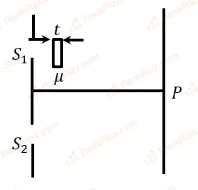
As shown in the figure, in Young's double slit experiment, a thin plate of thickness m and refractive index is inserted infront of slit . The experiment is conducted in air () and uses a monochromatic light of wavelength nm. Due to the insertion of the plate, central maxima is shifted by a distance of . is the fringe-width before the insertion of the plate. The value of is ______.

Two light waves of wavelengths 800 and 600 nm are used in Young's double slit experiment to obtain interference fringes on a screen placed 7 m away from plane of slits. If the two slits are separated by 0.35 mm, then shortest distance from the central bright maximum to the point where the bright fringes of the two wavelength coincide will be ______ mm.
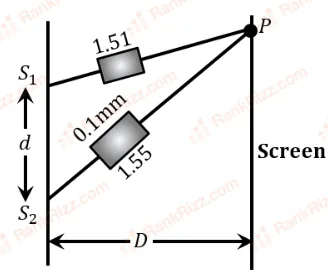
In Young's double slit experiment, two slits and are distance apart and the separation from slits to screen is (as shown in figure). Now if two transparent slabs of equal thickness mm but refractive index and are introduced in the path of beam from and respectively. The central bright fringe spot will shift by ______ number of fringes.

In a Young's double slit experiment, the intensities at two points, for the path difference and ( being the wavelength of light used) are and respectively. If denotes the intensity produced by each one of the individual slits, then ______.
In a Young's double slit experiment, two slits are illuminated with a light of wavelength nm. The line joining is perpendicular to as shown in the figure. If the first minimum is detected at , the value of slits separation will be:
The distance of screen from slits cm. Answer in mm.
0.4 mm
0.5 mm
0.2 mm
0.1 mm
In Young's double slits experiment, the position of 5 bright fringe from the central maximum is 5 cm. The distance between slits and screen is 1 m and wavelength of used monochromatic light is 600 nm. The separation between the slits is:
60 m
48 m
12 m
36 m
Two beams of light having intensities and interfere to produce a fringe pattern on a screen. The phase difference between the two beams are and at points and respectively. The difference between the resultant intensities at the two points is . The value of will be ______.
In Young's double slit experiment, the fringe width is . If the entire arrangement is placed in water of refractive index , then the fringe width becomes (in mm)
The interference pattern is obtained with two coherent light sources of intensity ratio . And the ratio is . Then, the value of will be equal to :
3
4
2
1
The light waves from two coherent sources have same intensity . In interference pattern the intensity of light at minima is zero. What will be the intensity of light at maxima?
In Young's double slit experiment, if the source of light changes from orange to blue then:
the central bright fringe will become a dark fringe.
the distance between consecutive fringes will decrease.
the distance between consecutive fringes will increase.
the intensity of the minima will increase.
In the Young's double slit experiment, the distance between the slits varies in time as ; where , and are constants. The difference between the largest fringe width and the smallest fringe width obtained over time is given as: