JEE MAIN 2022 · 25 JUN S1Errors in measurement and significant figures
If , then the relative error in will be
- A
- B
- C
- D
Errors in measurement and significant figures has been asked 75 times in JEE Main, in 16 different years between 2008 and 2026, and in all of the last five exam years (2022–2026), 42 questions in all. That is 34% of Units, Dimensions & Errors, one of its three most-asked topics. Last asked in JEE Main 06 Apr 2026, Shift 2. 63 are multiple choice and 12 numerical-value; 29 easy, 40 medium and 1 hard by our difficulty labels. All of them are below, newest first, free to read.
Questions
75
Years asked
16
Since
2008
Of the chapter
34%
41–60 OF 75 · NEWEST FIRST
If , then the relative error in will be
For , where '' is a constant. If percentage error in measurement of '' and '' are and , respectively, then the percentage error for '' will be ______ %.
A student determined Young's Modulus of elasticity using the formula . The value of is taken to be 9.8 m s without any significant error, his observations are as following.
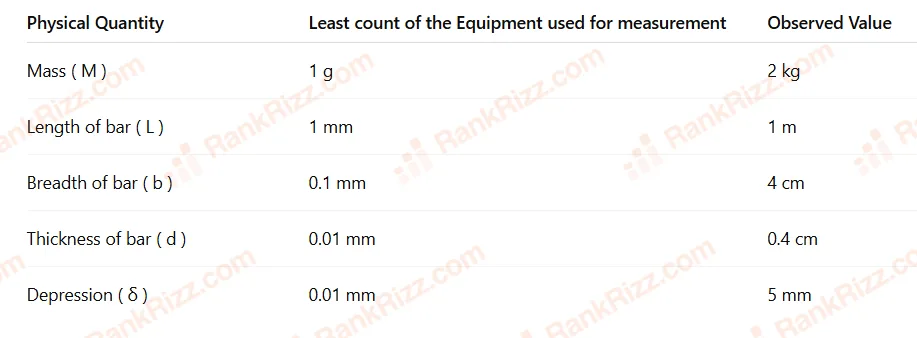
Then the fractional error in the measurement of is:
0.155
0.0083
0.083
0.0155
Two resistors and are connected in parallel. The equivalent resistance of their parallel combination will be:
If the length of the pendulum in pendulum clock increases by 0.1%, then the error in time per day is:
43.2 s
8.64 s
86.4 s
4.32 s
The acceleration due to gravity is found up to an accuracy of 4% on a planet. The energy supplied to a simple pendulum of known mass to undertake oscillations of time period is being estimated. If time period is measured to an accuracy of 3%, the accuracy to which is known is _________ %
A physical quantity is represented by the formula . If the percentage errors found in , , , and are 18, 1, 0.5, 4 and respectively, then find the value of and .
5 and
4 and
and
8 and
Three students , and perform an experiment for determining the acceleration due to gravity using a simple pendulum. They use different lengths of pendulum and record time for different number of oscillations. The observations are as shown in the table.

(Least count of length = 0.1 m, least count for time = 0.1 s)
If , and are the percentage errors in for students 1, 2 and 3, respectively, then the minimum percentage error is obtained by student no ___.
The radius of a sphere is measured to be cm. Suppose the percentage error in its volume is . The value of , to the nearest integer x, is ___.
The resistance , where V and A. The percentage error in is %. The value of to the nearest integer is ________.
In order to determine the Young's Modulus of a wire of radius 0.2 cm (measured using a scale of least count = 0.001 cm) and length 1 m (measured using a scale of least count = 1 mm), a weight of mass 1 kg (measured using a scale of least count = 1 g) was hanged to get the elongation of 0.5 cm (measured using a scale of least count 0.001 cm). What will be the fractional error in the value of Young's Modulus determined by this experiment?
0.14%
0.9%
9%
1.4%
The period of oscillation of a simple pendulum is . Measured value of is 1.0 m from meter scale having a minimum division of 1 mm and time of one complete oscillation is 1.95 s measured from stopwatch of 0.01 s resolution. The percentage error in the determination of will be:
1.03%
1.33%
1.30%
1.13%
The density of a solid metal sphere is diameter. The maximum error in the density of the sphere is . If the relative errors in measuring the mass and the diameter are and respectively, the value of is ___
A student measuring the diameter of a pencil of circular cross-section with the help of a vernier scale records the following four readings 5.50 mm, 5.55 mm, 5.34 mm, 5.65 mm. The average of these four readings is 5.5375 mm and the standard deviation of the data is 0.07395 mm. The average diameter of the pencil should therefore be recorded as:
A physical quantity depends on four observables , , and , as . The percentage of error in the measurement of , , and are , , and respectively. The percentage of error in is:
12.25%
16.5%
13.5%
14.5%
For the four sets of three measured physical quantities as given below. Which of the following options is correct?
A simple pendulum is being used to determine the value of gravitational acceleration at a certain place. The length of the pendulum is 25.0 cm and a stopwatch with 1 s resolution measures the time taken for 40 oscillations to be 50 s. The accuracy in g is:
5.40%
3.40%
4.40%
2.40%
In the density measurement of a cube, the mass and edge length are measured as kg and m, respectively. The error in the measurement of density is:
0.31
0.10
0.07
0.01
The area of a square is 5.29 cm. The area of 7 such squares taking into account the significant figures is:
37.03 cm
37.030 cm
37.0 cm
37 cm
In a simple pendulum experiment for determination of acceleration due to gravity (g), time taken for 20 oscillations is measured by using a watch of 1 second least count. The mean value of time taken comes out to be 30 s. The length of the pendulum is measured by using a meter scale of least count 1 mm and the value obtained is 55.0 cm. The percentage error in the determination of g is close to:
0.2%
6.8%
3.5%
0.7%