A Carnot's engine working between 400 K and 800 K has a work output of 1200 J per cycle. The amount of heat energy supplied to the engine from the source in each cycle is:
- A
3200 J
- B
1800 J
- C
1600 J
- D
2400 J
Carnot engine and Carnot cycle has been asked 37 times in JEE Main, in 11 different years between 2011 and 2025, and in 3 of the last five exam years (2022–2026), 15 questions in all. That is 19% of Thermodynamics, one of its three most-asked topics. Last asked in JEE Main 28 Jan 2025, Shift 1. 29 are multiple choice and 8 numerical-value; 14 easy, 19 medium and 1 hard by our difficulty labels. All of them are below, newest first, free to read.
Questions
37
Years asked
11
Since
2011
Of the chapter
19%
21–37 OF 37 · NEWEST FIRST
A Carnot's engine working between 400 K and 800 K has a work output of 1200 J per cycle. The amount of heat energy supplied to the engine from the source in each cycle is:
3200 J
1800 J
1600 J
2400 J
For an ideal heat engine, the temperature of the source is 127°C. In order to have 60% efficiency the temperature of the sink should be ________°C. (Round off to the nearest integer)
A reversible heat engine converts one-fourth of the heat input into work. When the temperature of the sink is reduced by 52 K, its efficiency is doubled. The temperature in Kelvin of the source will be ______.
If minimum possible work is done by a refrigerator in converting 100 grams of water at 0°C to ice, how much heat (in calories) is released to the surroundings at temperature 27°C (Latent heat of ice = 80 Cal/gram) to the nearest integer?
A Carnot engine having an efficiency of is being used as a refrigerator. If the work done on the refrigerator is 10 J, the amount of heat absorbed from the reservoir at a lower temperature is
99 J
100 J
1 J
90 J
A Carnot engine operates between two reservoirs of temperatures 900K and 300K. The engine performs 1200J of work per cycle. The heat energy (in J) delivered by the engine to the low temperature reservoir, in a cycle, is
Two ideal Carnot engines operate in cascade (all heat given up by one engine is used by the other engine to produce work) between temperatures, T and T. The temperature of the hot reservoir of the first engine is T and the temperature of the cold reservoir of the second engine is T. T is temperature of the sink of first engine which is also the source for the second engine. How is T related to T and T, if both the engines perform equal amount of work?
A Carnot engine has an efficiency of . When the temperature of the sink is reduced by 62°C, its efficiency is doubled. The temperatures of the source and the sink are, respectively,
124 °C, 62 °C
37 °C, 99 °C
99 °C, 37 °C
62 °C, 124 °C
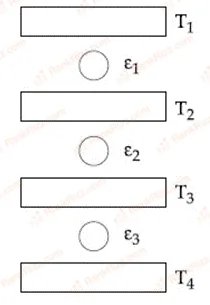
Three Carnot engines operate in series between a heat source at a temperature and a heat sink at temperature (see figure). There are two other reservoirs at temperature and , as shown, with . The three engines are equally efficient if:

Two carnot engines and are operated in series. The first one, , receives heat at and rejects to a reservoir at temperature . The second engine receives heat rejected by the first engine and, in turn, rejects to a heat reservoir at . Calculate the temperature if the work outputs of the two engines are equal:
500 K
400 K
300 K
600 K
A Carnot's engine works as a refrigerator between 250 K and 300 K. It receives 500 cal heat from the reservoir at the lower temperature. The amount of work done in each cycle to operate the refrigerator is:
420 J
2100 J
772 J
2520 J
Two Carnot engines A and B are operated in series. Engine A receives heat from a reservoir at 600 K and rejects heat to a reservoir at temperature T. Engine B receives heat rejected by engine A and in turn rejects it to a reservoir at 100 K. If the efficiencies of the two engines A and B are represented by and respectively, then what is the value of ?
A Carnot freezer takes heat from water at inside it and rejects it to the room at a temperature of . The latent heat of ice is J kg. If 5 kg of water at is converted into ice at by the freezer, then the energy consumed by the freezer is close to:
J
J
J
J
A Carnot engine absorbs 1000 J of heat energy from a reservoir at 127°C and rejects 600 J of heat energy during each cycle. The efficiency of engine and temperature of sink will be:
20% and °C
40% and °C
50% and °C
70% and °C
A Carnot engine, whose efficiency is , takes in heat from a source maintained at a temperature of . It is desired to have an engine of efficiency . Then, the intake temperature for the same exhaust (sink) temperature must be
efficiency of Carnot engine cannot be made larger than
This question has Statement 1 and Statement 2. Of the four choices given after the Statements, choose the one that best describes the two Statements. Statement 1: An inventor claims to have constructed an engine that has an efficiency of when operated between the boiling and freezing points of water. This is not possible. Statement 2: The efficiency of a real engine is always less than the efficiency of a Carnot engine operating between the same two temperatures.
Statement 1 is true, Statement 2 is true, Statement 2 is not the correct explanation of Statement 1.
Statement 1 is true, Statement 2 is false.
Statement 1 is false, Statement 2 is true.
Statement 1 is true, Statement 2 is true, Statement 2 is the correct explanation of Statement 1.
A Carnot engine operating between temperatures and has efficiency . When is lowered by , its efficiency increases to . Then and are, respectively:
and
and
and
and