JEE MAIN 2023 · 13 APR S2Thin lenses: lens formula, lens maker's formula and power
A bi convex lens of focal length cm is cut in two identical parts along a plane perpendicular to the principal axis. The power of each lens after cut is _____ D.
Thin lenses: lens formula, lens maker's formula and power has been asked 98 times in JEE Main, in 16 different years between 2005 and 2026, and in all of the last five exam years (2022–2026), 57 questions in all. That is 36% of Ray Optics & Optical Instruments, its most-asked topic. Last asked in JEE Main 08 Apr 2026, Shift 2. 74 are multiple choice and 24 numerical-value; 22 easy, 71 medium and 3 hard by our difficulty labels. All of them are below, newest first, free to read.
Questions
98
Years asked
16
Since
2005
Of the chapter
36%
41–60 OF 98 · NEWEST FIRST
A bi convex lens of focal length cm is cut in two identical parts along a plane perpendicular to the principal axis. The power of each lens after cut is _____ D.
Two convex lenses of focal length cm each are placed coaxially with a separation of cm between them. The image of the distant object formed by the combination is at _____ cm from the first lens.
The radius of curvature of each surface of a convex lens having refractive index 1.8 is 20 cm. The lens is now immersed in a liquid of refractive index 1.5. The ratio of power of lens in air to its power in the liquid will be : 1. The value of is _______
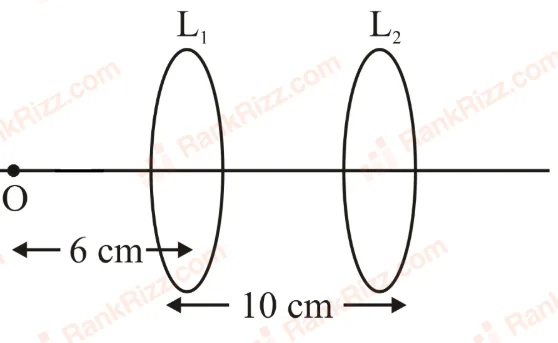
A point object O is placed in front of two thin symmetrical coaxial convex lenses and with focal length 24 cm and 9 cm respectively. The distance between two lenses is 10 cm and the object is placed 6 cm away from lens as shown in the figure. The distance between the object and the image formed by the system of two lenses is _______ cm.
A person has been using spectacles of power diopter for distant vision and a separate reading glass of power diopters. What is the least distance of distinct vision for this person:
cm
cm
cm
cm
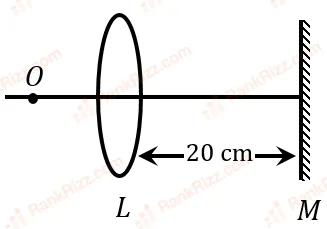
An object is placed on the principal axis of convex lens of focal length 10 cm as shown. A plane mirror is placed on the other side of lens at a distance of 20 cm. The image produced by the plane mirror is 5 cm inside the mirror. The distance of the object from the lens is _____ cm.
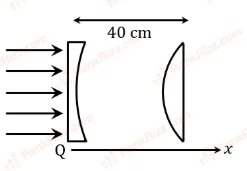
As shown in the figure, a combination of a thin plano-concave lens and a thin plano-convex lens is used to image an object placed at infinity. The radius of curvature of both the lenses is 30 cm and refraction index of the material for both the lenses is 1.75. Both the lenses are placed at distance of 40 cm from each other. Due to the combination, the image of the object is formed at distance ______ cm, from concave lens.
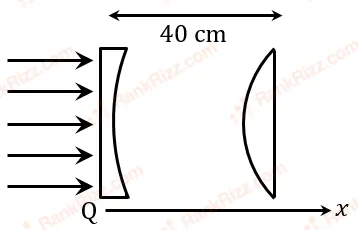
As shown in the figure, a combination of a thin plano-concave lens and a thin plano-convex lens is used to image an object placed at infinity. The radius of curvature of both the lenses is 30 cm and refraction index of the material for both the lenses is 1.75. Both the lenses are placed at distance of 40 cm from each other. Due to the combination, the image of the object is formed at distance x = _____ cm, from concave lens.
A convex lens of refractive index 1.5 and focal length 18 cm in air, is immersed in water. The change in the focal length of the lens will be _____ cm.
(Given refractive index of water = )
The power of a lens (biconvex) is 1.25 m in particular medium. Refractive index of the lens is 1.5 and radii of curvature are 20 cm and 40 cm respectively. The refractive index of surrounding medium:
1.0
In an experiment with a convex lens, the plot of the image distance () against the object distance () measured from the focus gives a curve . If all the distances are measured in cm. The magnitude of the focal length of the lens is _____ cm.
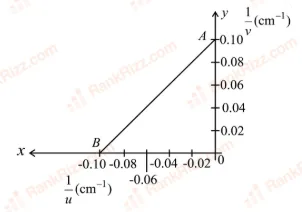
The graph between and for a thin convex lens in order to determine its focal length is plotted as shown in the figure. The refractive index of lens is and its both the surfaces have same radius of curvatures . The value of will be ______ cm. (Where = object distance, = image distance)
For an object placed at a distance from a lens, a sharp focused image is observed on a screen placed at a distance from the lens. A glass plate of refractive index and thickness is introduced between lens and screen such that the glass plate plane faces parallel to the screen. By what distance should the object be shifted so that a sharp focused image is observed again on the screen?
A convex lens of focal length is placed in front of convex mirror with principal axis coinciding each other. The distance between the lens and mirror is . A point object is placed on principal axis at a distance of from the convex lens. The image formed by combination coincides the object itself. The focal length of the convex mirror is ______ cm.
A parallel beam of light is allowed to fall on a transparent spherical globe of diameter 30 cm and refractive index 1.5. The distance from the centre of the globe at which beam of light can converge is ______ mm.
A convex lens has power . It is cut into two halves along its principal axis. Further one piece (out of the two halves) is cut into two halves perpendicular to the principal axis (as shown in figures). Choose the incorrect option for the reported pieces.
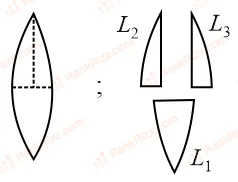
Power of
Power of
Power of
Power of
Two identical thin biconvex lenses of focal length cm and refractive index are in contact with each other. The space between the lenses is filled with a liquid of refractive index . The focal length of the combination is ______ cm.
An object is placed at the focus of concave lens having focal length . What is the magnification and distance of the image from the optical centre of the lens?
Very high,
Find the distance of the image from object , formed by the combination of lenses in the figure:
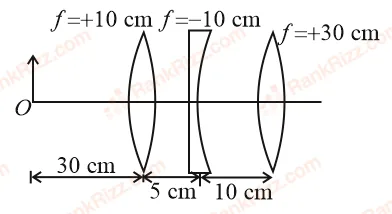
75 cm
10 cm
infinity
20 cm
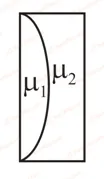
Curved surfaces of a plano-convex lens of refractive index and a plano-concave lens of refractive index have equal radius of curvature as shown in figure. Find the ratio of radius of curvature to the focal length of the combined lenses.
RELATED RAY OPTICS & OPTICAL INSTRUMENTS TOPICS