JEE MAIN 2025 · 29 JAN S1Thin lenses: lens formula, lens maker's formula and power
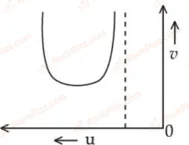
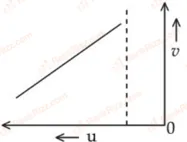
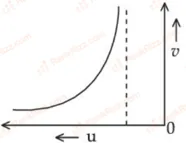
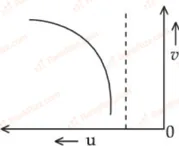
Let u and be the distances of the object and the image from a lens of focal length . The correct graphical representation of u and for a convex lens when , is
- A
- B
- C
- D
Thin lenses: lens formula, lens maker's formula and power has been asked 98 times in JEE Main, in 16 different years between 2005 and 2026, and in all of the last five exam years (2022–2026), 57 questions in all. That is 36% of Ray Optics & Optical Instruments, its most-asked topic. Last asked in JEE Main 08 Apr 2026, Shift 2. 74 are multiple choice and 24 numerical-value; 22 easy, 71 medium and 3 hard by our difficulty labels. All of them are below, newest first, free to read.
Questions
98
Years asked
16
Since
2005
Of the chapter
36%
21–40 OF 98 · NEWEST FIRST
Let u and be the distances of the object and the image from a lens of focal length . The correct graphical representation of u and for a convex lens when , is
Two identical symmetric double convex lenses of focal length f are cut into two equal parts by AB plane and by XY plane as shown in figure respectively. The ratio of focal lengths of lenses and is
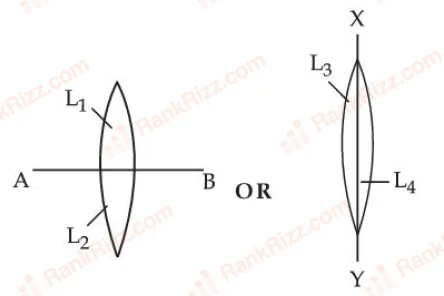
1:1
1:2
1:4
2:1
A convex lens made of glass (refractive index = 1.5) has focal length 24 cm in air. When it is totally immersed in water (refractive index 1.33), its focal length changes to
24 cm
96 cm
48 cm
72 cm
What is the relative decrease in focal length of a lens for an increase in optical power by from
0.01
0.04
0.40
0.1
A thin plano convex lens made of glass of refractive index 1.5 is immersed in a liquid of refractive index 1.2. When the plane side of the lens is silver coated for complete reflection, the lens immersed in the liquid behaves like a concave mirror of focal length 0.2 m. The radius of curvature of the curved surface of the lens is
0.20 m
0.25 m
0.15 m
0.10 m
A plano-convex lens having radius of curvature of first surface exhibits focal length in air. Another plano-convex lens with first surface radius of curvature has focal length when it is immersed in a liquid of refractive index If both the lenses are made of same glass of refractive index then the ratio will be:
1 : 2
1 : 3
3 : 5
2 : 3
Given a thin convex lens (refractive index ), kept in a liquid (refractive index ) having radii of curvatures and . Its second surface is silver polished. Where should an object be placed on the optic axis so that a real and inverted image is formed at the same place?
Given is a thin convex lens of glass (refractive index ) and each side having radius of curvature R. One side is polished for complete reflection. At what distance from the lens, an object be placed on the optic axis so that the image gets formed on the object itself ?
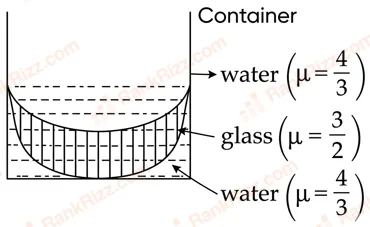
In the diagram given below, there are three lenses formed. Considering negligible thickness of each of them as compared to , i.e., the radii of curvature for upper and lower surfaces of the glass lens, the power of the combination is
A symmetric thin biconvex lens is cut into four equal parts by two planes AB and CD as shown in figure. If the power of original lens is 4 D then the power of a part of the divided lens is
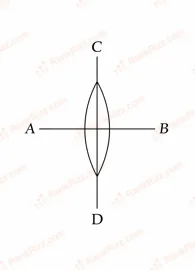
D
8D
2D
4D
Given below are two statements :
Statement (I) : When an object is placed at the centre of curvature of a concave lens, image is formed at the centre of curvature of the lens on the other side.
Statement (II) : Concave lens always forms a virtual and erect image.
In the light of the above statements, choose the correct answer from the options given below :
Both Statement I and Statement II are true
Both Statement I and Statement II are false
Statement I is true but Statement II is false
Statement I is false but Statement II is true
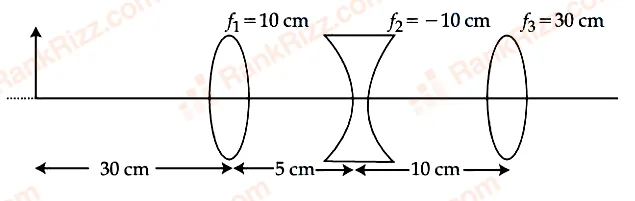
The following figure represents two biconvex lenses and having focal length and respectively. The distance between & is
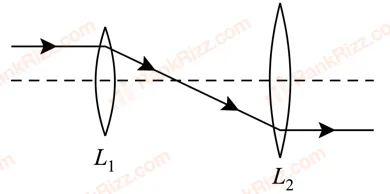
The position of the image formed by the combination of lenses is
15 cm (right of second lens)
30 cm (left of third lens)
15 cm (left of second lens)
30 cm (right of third lens)
For the thin convex lens, the radii of curvature are at and respectively. The focal length the lens is . The refractive index of the material is :
An effective power of a combination of 5 identical convex lenses which are kept in contact along the principal axis is 25D. Focal length of each of the convex lens is:
The distance between object and its times magnified virtual image as produced by a convex lens is cm. The focal length of the lens used is ________ cm.
The distance between object and its two times magnified real image as produced by a convex lens is . The focal length of the lens used is ________ cm.
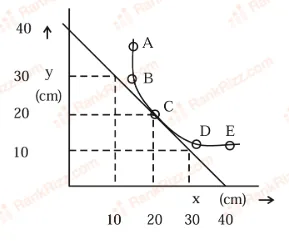
In an experiment to measure the focal length of a convex lens, the magnitude of object distance and the image distance are measured with reference to the focal point of the lens. The plot is shown in figure. The focal length of the lens is ____ cm.
A biconvex lens of refractive index has a focal length of cm in air. Its focal length when immersed in a liquid of refractive index will be:
cm
cm
cm
cm
A convex lens of focal length cm forms an image of an extended source of light on a photoelectric cell. A current is produced. The lens is replaced by another convex lens having the same diameter but focal length cm. The photoelectric current now is
RELATED RAY OPTICS & OPTICAL INSTRUMENTS TOPICS