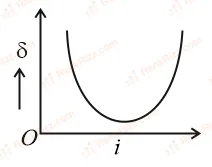
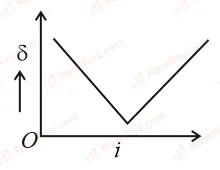
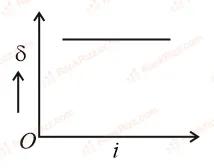
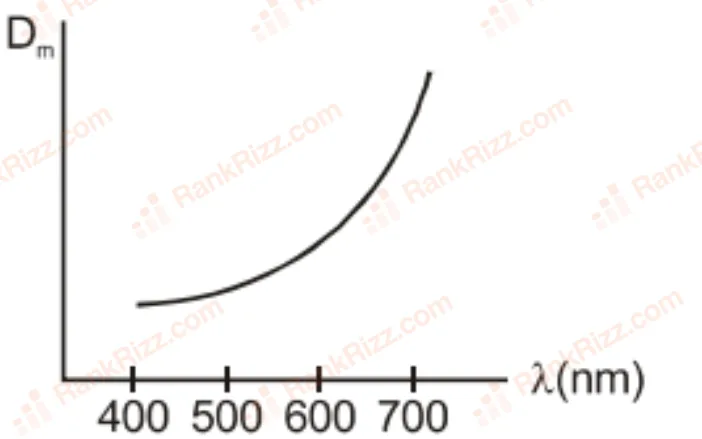
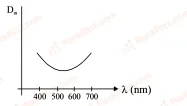
The variation of refractive index of a crown glass thin prism with wavelength of the incident light is shown. Which of the following graphs is the correct one, if is the angle of minimum deviation?
- A
- B
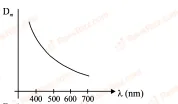
- C
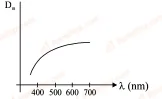
- D
Refraction at plane surfaces, Snell's law and apparent depth has been asked 96 times in JEE Main, in 16 different years between 2010 and 2026, and in all of the last five exam years (2022–2026), 60 questions in all. That is 35% of Ray Optics & Optical Instruments, one of its three most-asked topics. Last asked in JEE Main 08 Apr 2026, Shift 2. 71 are multiple choice and 25 numerical-value; 28 easy, 62 medium and 3 hard by our difficulty labels. All of them are below, newest first, free to read.
Questions
96
Years asked
16
Since
2010
Of the chapter
35%
81–96 OF 96 · NEWEST FIRST
The variation of refractive index of a crown glass thin prism with wavelength of the incident light is shown. Which of the following graphs is the correct one, if is the angle of minimum deviation?


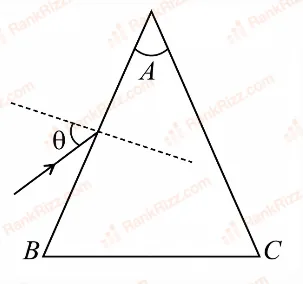
A monochromatic light is incident at a certain angle on an equilateral triangular prism and suffers minimum deviation. If the refractive index of the material of the prism is , then the angle of incidence is:
A ray of light is incident at an angle of 60 on one face of a prism of angle 30. The emergent ray of light makes an angle of 30 with incident ray. The angle made by the emergent ray with second face of prism will be:
0
90
30
45
Let the refractive index of a denser medium with respect to a rarer medium be and its critical angle be . At an angle of incidence when light is travelling from denser medium to rarer medium, a part of the light is reflected and the rest is refracted and the angle between reflected and refracted rays is 90°. Angle is given by:
To determine refractive index of glass slab using a travelling microscope, minimum number of readings required are:
Two
Four
Three
Five
In an experiment for determination of refractive index of glass of a prism by i v/s plot, it was found that a ray incident at angle 35°, suffers a deviation of 40° and that it emerges at angle 79°. In that case which of the following is closest to the maximum possible value of the refractive index?
1.7
1.8
1.5
1.6
Monochromatic light is incident on a glass prism of angle A. If the refractive index of the material of the prism is , a ray, incident at an angle , on the face AB would get transmitted through the face AC of the prism provided:

A diver looking up through the water sees the outside world contained in a circular horizon. The refractive index of water is , and the diver's eyes are 15 cm below the surface of the water. Then the radius of the circle is:
cm
cm
cm
cm
A green light is incident from the water to the air-water interface at the critical angle (). Select the correct statement.
The entire spectrum of visible light will come out of the water at an angle of 90° to the normal
The spectrum of visible light whose frequency is less than that of green light will come out to the air medium
The spectrum of visible light whose frequency is more than that of green light will come out to the air medium
The entire spectrum of visible light will come out of the water at various angles to the normal
A printed page is pressed by a glass of water. The refractive index of the glass and water is 1.5 and 1.33, respectively. If the thickness of the bottom of glass is 1 cm and depth of water is 5 cm, how much the page will appear to be shifted if viewed from the top?
1.033 cm
3.581 cm
1.3533 cm
1.90 cm
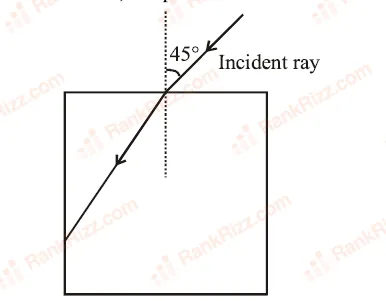
A light ray falls on a square glass slab as shown in the diagram. The index of refraction of the glass, if total internal reflection is to occur at the vertical face, is equal to :

Light is incident from a medium into air at two possible angles of incidence (A) 20° and (B) 40°. In the medium light travels 3.0 cm in 0.2 ns. The ray will :
suffer total internal reflection in both cases (A) and (B)
suffer total internal reflection in case (B) only
have partial reflection and partial transmission in case (B)
have 100% transmission in case (A)
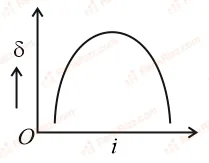
The graph between angle of deviation () and angle of incidence () for a triangular prism is represented by :


Let the plane be the boundary between two transparent media. Medium 1 in has a refractive index of and medium 2 with has a refractive index of . A ray of light in medium 1 given by the vector is incident on the plane of separation. The angle of refraction in medium 2 is:
An initially parallel cylindrical beam travels in a medium of refractive index , where and are positive constants and is the intensity of the light beam. The intensity of the beam is decreasing with increasing radius. As the beam enters the medium, it will
diverge
converge
diverge near the axis and converge near the periphery
travel as a cylindrical beam
An initially parallel cylindrical beam travels in a medium of refractive index , where and are positive constants and is the intensity of the light beam. The intensity of the beam is decreasing with increasing radius. The speed of light in the medium is
minimum on the axis of the beam
the same everywhere in the beam
directly proportional to the intensity
maximum on the axis of the beam
RELATED RAY OPTICS & OPTICAL INSTRUMENTS TOPICS