Refraction at plane surfaces, Snell's law and apparent depth — JEE Main Previous Year Questions
Refraction at plane surfaces, Snell's law and apparent depth has been asked 96 times in JEE Main, in 16 different years between 2010 and 2026, and in all of the last five exam years (2022–2026), 60 questions in all. That is 35% of Ray Optics & Optical Instruments, one of its three most-asked topics. Last asked in JEE Main 08 Apr 2026, Shift 2. 71 are multiple choice and 25 numerical-value; 28 easy, 62 medium and 3 hard by our difficulty labels. All of them are below, newest first, free to read.
Every Refraction at plane surfaces, Snell's law and apparent depth question
61–80 OF 96 · NEWEST FIRST
JEE MAIN 2021 · 01 SEP S2Refraction at plane surfaces, Snell's law and apparent depth
A glass tumbler having inner depth of 17.5 cm is kept on a table. A student starts pouring water (μ=34) into it while looking at the surface of water from the above. When he feels that the tumbler is half filled, he stops pouring water. Up to what height, the tumbler is actually filled?
JEE MAIN 2021 · 31 AUG S2Refraction at plane surfaces, Snell's law and apparent depth
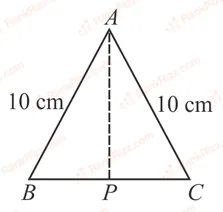
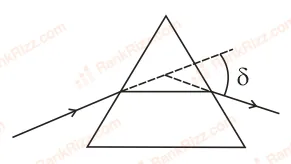
Cross-section view of a prism is the equilateral triangle ABC shown in the figure. The minimum deviation is observed using this prism when the angle of incidence is equal to the prism angle. The time taken by light to travel from P (midpoint of BC) to A is _________ ×10−10 s. (Given, speed of light in vacuum = 3×10⁸ m s−1 and cos30°=23)
JEE MAIN 2021 · 27 JUL S1Refraction at plane surfaces, Snell's law and apparent depth
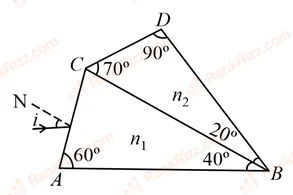
A prism of refractive index n1 and another prism of refractive index n2 are stuck together (as shown in the figure). n1 and n2 depend on λ, the wavelength of light, according to the relation n1=1.2+λ210.8×10⁻¹⁴ and n2=1.45+λ21.8×10⁻¹⁴ The wavelength for which rays incident at any angle on the interface BC pass through without bending at that interface will be _________ nm.
JEE MAIN 2021 · 25 JUL S1Refraction at plane surfaces, Snell's law and apparent depth
A ray of laser of a wavelength 630 nm is incident at an angle of 30∘ at the diamond-air interface. It is going from diamond to air. The refractive index of diamond is 2.42 and that of air is 1. Choose the correct option.
JEE MAIN 2021 · 25 JUL S2Refraction at plane surfaces, Snell's law and apparent depth
A prism of refractive index μ and angle of prism A is placed in the position of minimum angle of deviation. If minimum angle of deviation is also A, then in terms of refractive index,
JEE MAIN 2021 · 25 JUL S2Refraction at plane surfaces, Snell's law and apparent depth
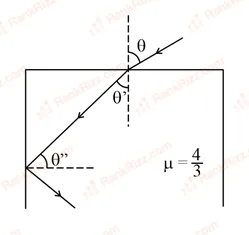
A ray of light entering from air into a denser medium of refractive index 34, as shown in figure. The light ray suffers total internal reflection at the adjacent surface as shown. The maximum value of angle θ should be equal to:
JEE MAIN 2021 · 22 JUL S1Refraction at plane surfaces, Snell's law and apparent depth
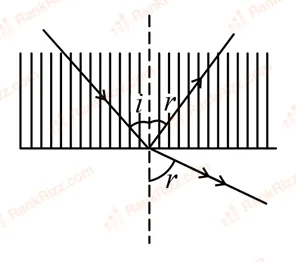
A ray of light passes from a denser medium to a rarer medium at an angle of incidence i. The reflected and refracted rays make an angle of 90∘ with each other. The angle of reflection and refraction are respectively r and r′. The critical angle is given by,
JEE MAIN 2021 · 22 JUL S1Refraction at plane surfaces, Snell's law and apparent depth
A ray of light passing through a prism (μ=3) suffers minimum deviation. It is found that the angle of incidence is double the angle of refraction within the prism. Then, the angle of prism is ___ (in degrees).
JEE MAIN 2021 · 18 MAR S2Refraction at plane surfaces, Snell's law and apparent depth
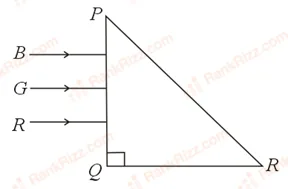
Three rays of light, namely red (R), green (G) and blue (B) are incident on the face PQ of a right angled prism PQR as shown in figure.
The refractive indices of the material of the prism for red, green and blue wavelength are 1.27, 1.42 and 1.49 respectively. The colour of the ray(s) emerging out of the face PR is :
JEE MAIN 2021 · 17 MAR S2Refraction at plane surfaces, Snell's law and apparent depth
The image of an object placed in air formed by a convex refracting surface is at a distance of 10 m behind the surface. The image is real and is at 32rd of the distance of the object from the surface. The wavelength of light inside the surface is 32 times the wavelength in air. The radius of the curved surface is 13x m, the value of x is ________.
JEE MAIN 2021 · 16 MAR S1Refraction at plane surfaces, Snell's law and apparent depth
The angle of deviation through a prism is minimum when
(A) Incident ray and emergent ray are symmetric to the prism (B) The refracted ray inside the prism becomes parallel to its base (C) Angle of incidence is equal to that of the angle of emergence (D) When angle of emergence is double the angle of incidence Choose the correct answer from the options given below:
JEE MAIN 2021 · 16 MAR S2Refraction at plane surfaces, Snell's law and apparent depth
A deviation of 2° is produced in the yellow ray when prism of crown and flint glass are achromatically combined. Taking dispersive powers of crown and flint glass are 0.02 and 0.03 respectively and refractive index for yellow light for these glasses are 1.5 and 1.6 respectively. The refracting angles for crown glass prism will be ________° (in degree). (Round off to the Nearest Integer)
JEE MAIN 2020 · 03 SEP S1Refraction at plane surfaces, Snell's law and apparent depth
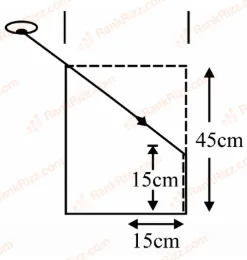
An observer can see through a small hole on the side of a jar (radius 15 cm) at a point at height of 15 cm from the bottom (see figure). The hole is at a height of 45 cm. When the jar is filled with a liquid up to a height of 30 cm the same observer can see the edge at the bottom of the jar. If the refractive index of the liquid is 100N, where N is an integer, the value of N i
JEE MAIN 2020 · 09 JAN S1Refraction at plane surfaces, Snell's law and apparent depth
A vessel of depth 2h is half filled with a liquid of refractive index 22 and the upper half with another liquid of refractive index 2. The liquids are immiscible. The apparent depth of the inner surface of the bottom of the vessel will be:
JEE MAIN 2020 · 09 JAN S2Refraction at plane surfaces, Snell's law and apparent depth
There is a small source of light at some depth below the surface of water (refractive index =34) in a tank of large cross sectional surface area. Neglecting any reflection from the bottom and absorption by water, percentage of light that emerges out of surface is (nearly): [Use the fact that surface area of a spherical cap of height h and radius of curvature r is 2πrh]
JEE MAIN 2019 · 12 APR S1Refraction at plane surfaces, Snell's law and apparent depth
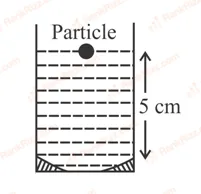
A concave mirror has radius of curvature of 40 cm. It is at the bottom of a glass that has water filled up to 5 cm (see figure). If a small particle is floating on the surface of water, its image as seen, from directly above the glass, is at a distance d from the surface of water. The value of d is close to: (Refractive index of water = 1.33)
JEE MAIN 2019 · 12 APR S2Refraction at plane surfaces, Snell's law and apparent depth
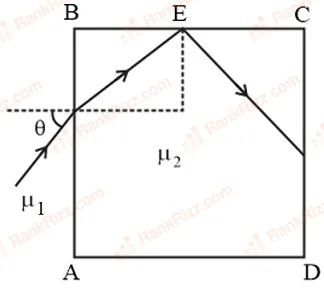
A transparent cube of side d, made of a material of refractive index μ2, is immersed in a liquid of refractive index μ1 (μ1<μ2). A ray is incident on the face AB at an angle θ (shown in the figure). Total internal reflection takes place at point E on the face BC.
JEE MAIN 2019 · 08 APR S1Refraction at plane surfaces, Snell's law and apparent depth
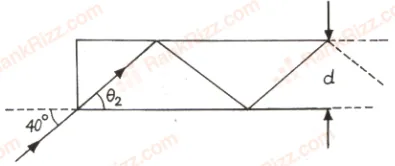
In figure, the optical fiber is l=2 m long and has a diameter of d=20μm. If a ray of light is incident on one end of the fiber at angle θ1=40°, the number of reflections it makes before emerging from the other end is close to: (refractive index of fiber is 1.31, sin 40° = 0.64 and sin−1(0.49) = 30°.)