JEE MAIN 2021 · 27 AUG S1Ideal gas equation and gas laws
An ideal gas is expanding such that = constant. The coefficient of volume expansion of the gas is:
- A
- B
- C
- D
Ideal gas equation and gas laws has been asked 38 times in JEE Main, in 15 different years between 2004 and 2026, and in all of the last five exam years (2022–2026), 19 questions in all. That is 20% of Kinetic Theory of Gases, one of its three most-asked topics. Last asked in JEE Main 06 Apr 2026, Shift 1. 31 are multiple choice and 7 numerical-value; 16 easy, 17 medium and 2 hard by our difficulty labels. All of them are below, newest first, free to read.
Questions
38
Years asked
15
Since
2004
Of the chapter
20%
21–38 OF 38 · NEWEST FIRST
An ideal gas is expanding such that = constant. The coefficient of volume expansion of the gas is:
A balloon carries a total load of 185 kg at normal pressure and temperature of 27°C. What load will the balloon carry on rising to a height at which the barometric pressure is 45 cm of Hg and the temperature is -7°C. Assuming the volume constant?
214.15 kg
123.54 kg
219.07 kg
181.46 kg
A cylindrical container of volume m contains one mole of hydrogen and two moles of carbon dioxide. Assume the temperature of the mixture is 400 K. The pressure of the mixture of gases is:
[Take gas constant as 8.3 J mol K]
Pa
Pa
Pa
24.9 Pa
Which of the following graphs represent the behaviour of an ideal gas? Symbols have their usual meaning.
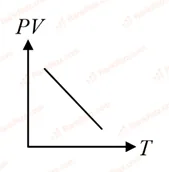
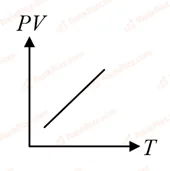
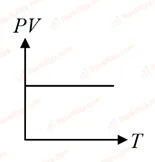
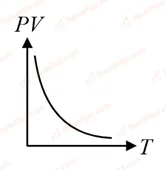
The volume of an enclosure contains a mixture of three gases, 16 g of oxygen, 28 g of nitrogen and 44 g of carbon dioxide at absolute temperature . Consider as universal gas constant. The pressure of the mixture of gases is:
Initially a gas of diatomic molecules is contained in a cylinder of volume at a pressure and temperature . Assuming that of the molecules get dissociated causing a change in number of moles. The pressure of the resulting gas at temperature , when contained in a volume is given by . The ratio is ___
A closed vessel contains 0.1 mole of a monoatomic ideal gas at 200 K. If 0.05 mole of the same gas at 400 K is added to it, the final equilibrium temperature (in K) of the gas in the vessel will be close to __________
The change in the magnitude of the volume of an ideal gas when a small additional pressure is applied at a constant temperature, is the same as the change when the temperature is reduced by a small quantity at constant pressure. The initial temperature and pressure of the gas were 300 K and 2 atm respectively. If then value of C in (K/atm) is __________
The number density of molecules of a gas depends on their distance r from the origin as, . Then the numer of molecules is proportional to:
A vertical closed cylinder is separated into two parts by a frictionless piston of mass m and of negligible thickness. The piston is free to move along the length of the cylinder. The length of the cylinder above piston is , and that below the piston is , such that . Each part of the cylinder contains n moles of an ideal gas at equal temperature T. If the piston is stationary, its mass m will be given by: (R is universal gas constant and g is the acceleration due to gravity)
The temperature of an open room of volume 30 m increases from 17°C to 27°C due to the sunshine. The atmospheric pressure in the room remains Pa. If and are the number of molecules in the room before and after heating, then will be:
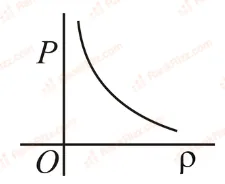
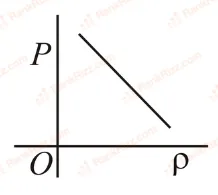
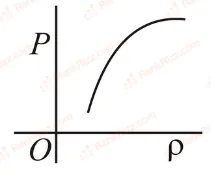
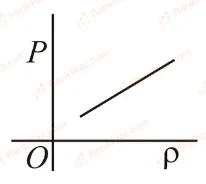
Which of the following shows the correct relationship between the pressure and density of an ideal gas at constant temperature?
An ideal monoatomic gas is confined in a cylinder by a spring loaded piston of cross section m. Initially the gas is at 300 K and occupies a volume of m and the spring is in its relaxed state as shown in figure. The gas is heated by a small heater until the piston moves out slowly by 0.1 m. The force constant of the spring is 8000 N/m and the atmospheric pressure is N/m. The cylinder and the piston are thermally insulated. The piston and the spring are massless and there is no friction between the piston and the cylinder. The final temperature of the gas will be: (Neglect the heat loss through the lead wires of the heater. The heat capacity of the heater coil is also negligible).
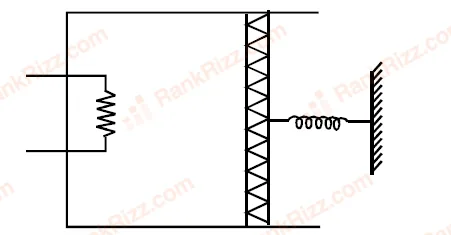
300 K
800 K
500 K
1000 K
Modern vacuum pumps can evacuate a vessel down to a pressure of atm. at room temperature (300 K). Taking R = 8.3 JK mole, 1 atm = Pa and mole, the mean distance between molecules of gas in an evacuated vessel will be of the order of:
0.2 m
0.2 mm
0.2 cm
0.2 nm
A thin tube sealed at both ends is 100 cm long. It lies horizontally, the middle 20 cm containing mercury and two equal ends containing air at standard atmospheric pressure. If the tube is now turned to a vertical position, by what amount will the mercury be displaced?
(Given : cross-section of the tube can be assumed to be uniform)
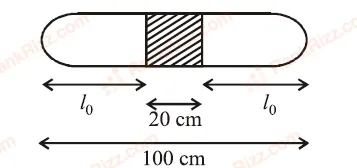
2.95 cm
5.18 cm
8.65 cm
0.0 cm
A perfect gas at C is heated at constant pressure so as to double its volume. The final temperature of the gas will be, close to
C
C
C
C
An insulated container of gas has two chambers separated by an insulating partition. One of the chambers has volume and contains ideal gas at pressure and temperature . The other chamber has volume and contains ideal gas at pressure and temperature . If the partition is removed without doing any work on the gas, the final equilibrium temperature of the gas in the container will be
Two thermally insulated vessels 1 and 2 are filled with air at temperatures , volume and pressure respectively. If the valve joining two vessels is opened, the temperature inside the vessel at equilibrium will be
RELATED KINETIC THEORY OF GASES TOPICS