RankRizz

Electric potential and potential energy — JEE Main Previous Year Questions

Electric potential and potential energy has been asked 62 times in JEE Main, in 17 different years between 2004 and 2026, and in all of the last five exam years (2022–2026), 28 questions in all. That is 21% of Electrostatics, its most-asked topic. Last asked in JEE Main 06 Apr 2026, Shift 1. 54 are multiple choice and 8 numerical-value; 21 easy, 33 medium and 1 hard by our difficulty labels. All of them are below, newest first, free to read.

Questions

62

Years asked

17

Since

2004

Of the chapter

21%

Every Electric potential and potential energy question

21–40 OF 62 · NEWEST FIRST

JEE MAIN 2023 · 08 APR S2Electric potential and potential energy

Electric potential at a point PP due to a point charge of 5×10−95 \times 10^{-9} C is 50 V. The distance of PP from the point charge is:
(Assume, 14πε0=9×10⁹\frac{1}{4\pi\varepsilon_0} = 9 \times 10^9 N m2^2 C−2^{-2})

  1. A

    9 cm

  2. B

    3 cm

  3. C

    0.9 cm

  4. D

    90 cm

JEE MAIN 2023 · 06 APR S1Electric potential and potential energy

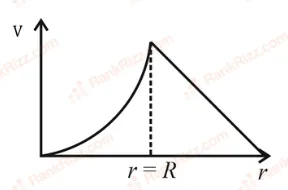
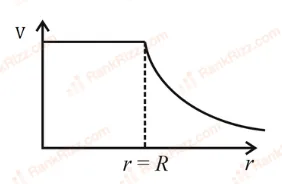
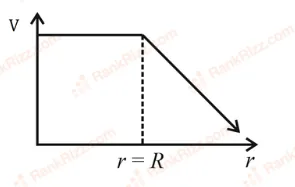
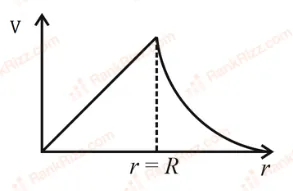
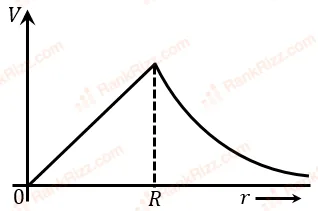
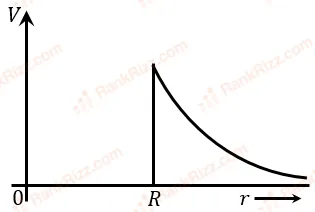
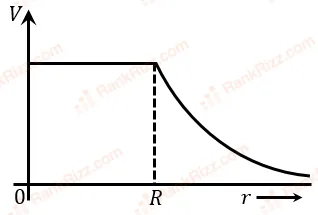
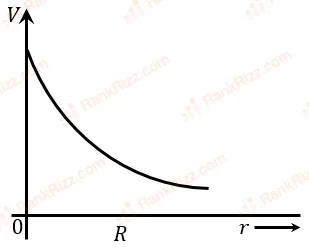
For a uniformly charged thin spherical shell, the electric potential VV radially away from the centre OO of shell can be graphically represented as
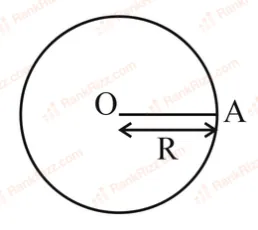
Figure for JEE Main 2023 Physics question on Electric potential and potential energy


(1)

Figure for JEE Main 2023 Physics question on Electric potential and potential energy


(2)

Figure for JEE Main 2023 Physics question on Electric potential and potential energy


(3)

Figure for JEE Main 2023 Physics question on Electric potential and potential energy


(4)

Figure for JEE Main 2023 Physics question on Electric potential and potential energy
  1. A

    Graph (1)

  2. B

    Graph (2)

  3. C

    Graph (3)

  4. D

    Graph (4)

JEE MAIN 2023 · 31 JAN S1Electric potential and potential energy

Which of the following correctly represents the variation of electric potential (V)(V) of a charged spherical conductor of radius (R)(R) with radial distance (r)(r) from the centre?

  1. A
    Figure for JEE Main 2023 Physics question on Electric potential and potential energy
  2. B
    Figure for JEE Main 2023 Physics question on Electric potential and potential energy
  3. C
    Figure for JEE Main 2023 Physics question on Electric potential and potential energy
  4. D
    Figure for JEE Main 2023 Physics question on Electric potential and potential energy
JEE MAIN 2023 · 29 JAN S2Electric potential and potential energy

For a charged spherical ball, electrostatic potential inside the ball varies with rr as V=2ar2+bV = 2ar^2 + b. Here, aa and bb are constant and rr is the distance from the center. The volume charge density inside the ball is −λaε-\lambda a\varepsilon. The value of λ\lambda is ______.
ε\varepsilon = permittivity of medium.

JEE MAIN 2023 · 24 JAN S2Electric potential and potential energy

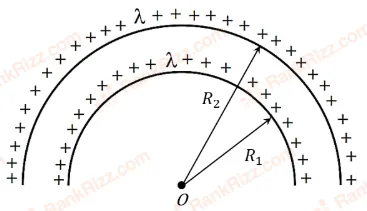
The electric potential at the centre of two concentric half rings of radii R1R_1 and R2R_2, having same linear charge density λ\lambda is

Figure for JEE Main 2023 Physics question on Electric potential and potential energy
  1. A

    2λϵ0\frac{2\lambda}{\epsilon_0}

  2. B

    λ2ϵ0\frac{\lambda}{2\epsilon_0}

  3. C

    λ4ϵ0\frac{\lambda}{4\epsilon_0}

  4. D

    λϵ0\frac{\lambda}{\epsilon_0}

JEE MAIN 2022 · 29 JUL S1Electric potential and potential energy

Given below are two statements.
Statement I: Electric potential is constant within and at the surface of each conductor.
Statement II: Electric field just outside a charged conductor is perpendicular to the surface of the conductor at every point.
In the light of the above statements, choose the most appropriate answer from the options given below.

  1. A

    Both statement I and statement II are correct

  2. B

    Both statement I and statement II are incorrect

  3. C

    Statement I is correct but statement II is incorrect

  4. D

    Statement I is incorrect but statement II is correct

JEE MAIN 2022 · 29 JUN S2Electric potential and potential energy

If the electric potential at any point (x,y,z)(x, y, z) m in space is given by V=3x2V = 3x^2 volt. The electric field at the point (1,0,3)(1, 0, 3) m will be:

  1. A

    3 Vm−1^{-1}, directed along positive xx-axis.

  2. B

    3 Vm−1^{-1}, directed along negative xx-axis.

  3. C

    6 Vm−1^{-1}, directed along negative xx-axis.

  4. D

    6 Vm−1^{-1}, directed along positive xx-axis.

JEE MAIN 2022 · 25 JUN S2Electric potential and potential energy

2727 identical drops are charged at 2222 V each. They combine to form a bigger drop. The potential of the bigger drop will be ______ V.

JEE MAIN 2021 · 26 AUG S2Electric potential and potential energy

The two thin coaxial rings, each of radius aa and having charges +Q+Q and −Q-Q respectively are separated by a distance of ss. The potential difference between the centres of the two rings is:

  1. A

    Q2πε0[1a−1s2+a2]\frac{Q}{2\pi\varepsilon_0}\left[\frac{1}{a} - \frac{1}{\sqrt{s^2 + a^2}}\right]

  2. B

    Q4πε0[1a−1s2+a2]\frac{Q}{4\pi\varepsilon_0}\left[\frac{1}{a} - \frac{1}{\sqrt{s^2 + a^2}}\right]

  3. C

    Q4πε0[1a+1s2+a2]\frac{Q}{4\pi\varepsilon_0}\left[\frac{1}{a} + \frac{1}{\sqrt{s^2 + a^2}}\right]

  4. D

    Q2πε0[1a+1s2+a2]\frac{Q}{2\pi\varepsilon_0}\left[\frac{1}{a} + \frac{1}{\sqrt{s^2 + a^2}}\right]

JEE MAIN 2021 · 26 FEB S2Electric potential and potential energy

27 similar drops of mercury are maintained at 10 V each. All these spherical drops combine into a single big drop. The potential energy of the bigger drop is ______ times that of a smaller drop.

JEE MAIN 2021 · 25 FEB S1Electric potential and potential energy

512 identical drops of mercury are charged to a potential of 2 V each. The drops are joined to form a single drop. The potential of this drop is ______ V in Volt.

JEE MAIN 2020 · 05 SEP S1Electric potential and potential energy

A solid sphere of radius RR carries a charge Q+qQ + q distributed uniformly over its volume. A very small point like piece of it of mass mm gets detached from the bottom of the sphere and falls down vertically under gravity. This piece carries charge qq. If it acquires a speed vv when it has fallen through a vertical height yy (see figure), then (assume the remaining portion to be spherical)
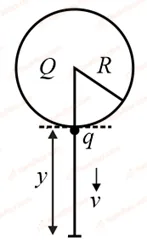
Figure for JEE Main 2020 Physics question on Electric potential and potential energy
  1. A

    v2=y[qQ4πε0R2ym+g]v^2 = y\left[\frac{qQ}{4\pi\varepsilon_0 R^2 ym} + g\right]

  2. B

    v2=y[qQ4πε0R(R+y)m+g]v^2 = y\left[\frac{qQ}{4\pi\varepsilon_0 R(R+y)m} + g\right]

  3. C

    v2=2y[QqR4πε0(R+y)3m+g]v^2 = 2y\left[\frac{QqR}{4\pi\varepsilon_0(R+y)^3 m} + g\right]

  4. D

    v2=2y[qQ4πε0R(R+y)m+g]v^2 = 2y\left[\frac{qQ}{4\pi\varepsilon_0 R(R+y)m} + g\right]

JEE MAIN 2020 · 05 SEP S2Electric potential and potential energy

Ten charges are placed on the circumference of a circle of radius R with constant angular separation between successive charges. Alternate charges 1, 3, 5, 7, 9 have charge (+q)(+q) each, while 2, 4, 6, 8, 10 have charge (−q)(-q) each. The potential V and the electric field E at the centre of the circle are respectively: (Take V=0V = 0 at infinity)

  1. A

    V=10q4πε0RV = \frac{10q}{4\pi\varepsilon_0 R}; E=0E = 0

  2. B

    V=0V = 0, E=10q4πε0R2E = \frac{10q}{4\pi\varepsilon_0 R^2}

  3. C

    V=0V = 0; E=0E = 0

  4. D

    V=10q4πε0RV = \frac{10q}{4\pi\varepsilon_0 R}; E=10q4πε0R2E = \frac{10q}{4\pi\varepsilon_0 R^2}

JEE MAIN 2020 · 04 SEP S1Electric potential and potential energy

A two point charges 4q4q and −q-q are fixed on the xx-axis at x=−d2x = \frac{-d}{2} and x=d2x = \frac{d}{2}, respectively. If the third point charge 'q' is taken from the origin to x=dx = d along the semicircle as shown in the figure, the energy of the charge will:
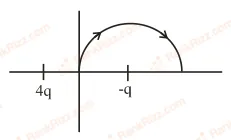
Figure for JEE Main 2020 Physics question on Electric potential and potential energy
  1. A

    Increase by 3q24πε0d\frac{3q^2}{4\pi\varepsilon_0 d}

  2. B

    Increase by 2q23πε0d\frac{2q^2}{3\pi\varepsilon_0 d}

  3. C

    decrease by q24πε0d\frac{q^2}{4\pi\varepsilon_0 d}

  4. D

    decrease by 4q23πε0d\frac{4q^2}{3\pi\varepsilon_0 d}

JEE MAIN 2020 · 03 SEP S1Electric potential and potential energy

Two isolated conducting spheres S1S_1 and S2S_2 of radius 23R\frac{2}{3}R and 13R\frac{1}{3}R have 12 μC\mu C and −3-3 μC\mu C charges, respectively, and are at a large distance from each other. They are now connected by a conducting wire. A long time after this is done the charges on S1S_1 and S2S_2 are respectively:

  1. A

    4.54.5 μC\mu C of both

  2. B

    +4.5+4.5 μC\mu C and −4.5-4.5 μC\mu C

  3. C

    33 μC\mu C and 66 μC\mu C

  4. D

    66 μC\mu C and 33 μC\mu C

JEE MAIN 2020 · 03 SEP S2Electric potential and potential energy

Hydrogen ion and singly ionized helium atom are accelerated, from rest, through the same potential difference. The ratio of final speeds of hydrogen and helium ions is close to:

  1. A

    1:21 : 2

  2. B

    10:710 : 7

  3. C

    2:12 : 1

  4. D

    5:75 : 7

JEE MAIN 2020 · 03 SEP S2Electric potential and potential energy

Concentric metallic hollow spheres of radii R and 4R hold charges Q1Q_1 and Q2Q_2 respectively. Given that surface charge densities of the concentric spheres are equal, the potential difference V(R) - V(4R) is:

  1. A

    Q24πε0R\frac{Q_2}{4\pi\varepsilon_0 R}

  2. B

    3Q24πε0R\frac{3Q_2}{4\pi\varepsilon_0 R}

  3. C

    3Q116πε0R\frac{3Q_1}{16\pi\varepsilon_0 R}

  4. D

    3Q14πε0R\frac{3Q_1}{4\pi\varepsilon_0 R}

JEE MAIN 2020 · 02 SEP S2Electric potential and potential energy

A charge Q is distributed over two concentric conducting thin spherical shells radii r and R (R > r). If the surface charge densities on the two shells are equal, the electric potential at the common centre is:
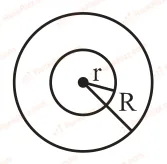
Figure for JEE Main 2020 Physics question on Electric potential and potential energy
  1. A

    14πϵ0(R+r)2(R2+r2)Q\frac{1}{4\pi\epsilon_0}\frac{(R+r)}{2(R^2+r^2)}Q

  2. B

    14πϵ0(2R+r)(R2+r2)Q\frac{1}{4\pi\epsilon_0}\frac{(2R+r)}{(R^2+r^2)}Q

  3. C

    14πϵ0(R+2r)Q2(R2+r2)\frac{1}{4\pi\epsilon_0}\frac{(R+2r)Q}{2(R^2+r^2)}

  4. D

    14πϵ0(R+r)(R2+r2)Q\frac{1}{4\pi\epsilon_0}\frac{(R+r)}{(R^2+r^2)}Q

JEE MAIN 2020 · 08 JAN S2Electric potential and potential energy

Consider two charged metallic spheres S1S_1 and S2S_2 of radii R1R_1 and R2R_2, respectively. The electric fields E1E_1 (on S1S_1) and E2E_2 (on S2S_2) on their surfaces are such that E1E2=R1R2\frac{E_1}{E_2} = \frac{R_1}{R_2}. Then the ratio V1V_1 (on S1S_1)/V2V_2 (on S2S_2) of the electrostatic potentials on each sphere is:

  1. A

    R1R2\frac{R_1}{R_2}

  2. B

    (R1R2)2\left(\frac{R_1}{R_2}\right)^2

  3. C

    (R2R1)\left(\frac{R_2}{R_1}\right)

  4. D

    (R1R2)3\left(\frac{R_1}{R_2}\right)^3

JEE MAIN 2019 · 10 APR S1Electric potential and potential energy

A uniformly charged ring of radius 3a and total charge q is placed in x-y plane centred at origin. A point charge q is moving towards the ring along the z-axis and has speed v at z = 4a. The minimum value of v such that it crosses the origin is:

  1. A

    2m(115⋅q24πε0a)1/2\sqrt{\frac{2}{m}}\left(\frac{1}{15}\cdot\frac{q^2}{4\pi\varepsilon_0 a}\right)^{1/2}

  2. B

    2m(415⋅q24πε0a)1/2\sqrt{\frac{2}{m}}\left(\frac{4}{15}\cdot\frac{q^2}{4\pi\varepsilon_0 a}\right)^{1/2}

  3. C

    2m(15⋅q24πε0a)1/2\sqrt{\frac{2}{m}}\left(\frac{1}{5}\cdot\frac{q^2}{4\pi\varepsilon_0 a}\right)^{1/2}

  4. D

    2m(215⋅q24πε0a)1/2\sqrt{\frac{2}{m}}\left(\frac{2}{15}\cdot\frac{q^2}{4\pi\varepsilon_0 a}\right)^{1/2}