Three point charges of magnitude , and are located at the vertices , , of a right angled triangle whose sides are , and and point is the right angle corner. Charge at point experiences ______ N of electrostatic force due to the other two charges.
Electric charge and Coulomb's law has been asked 42 times in JEE Main, in 14 different years between 2004 and 2026, and in all of the last five exam years (2022–2026), 24 questions in all. That is 14% of Electrostatics, one of its three most-asked topics. Last asked in JEE Main 08 Apr 2026, Shift 2. 29 are multiple choice and 13 numerical-value; 13 easy and 23 medium by our difficulty labels. All of them are below, newest first, free to read.
Questions
42
Years asked
14
Since
2004
Of the chapter
14%
21–40 OF 42 · NEWEST FIRST
Three point charges of magnitude , and are located at the vertices , , of a right angled triangle whose sides are , and and point is the right angle corner. Charge at point experiences ______ N of electrostatic force due to the other two charges.
Two point charges each are placed at a distance apart. A third point charge is placed at a distance from mid-point on the perpendicular bisector. The value of at which charge will experience the maximum Coulomb's force is:
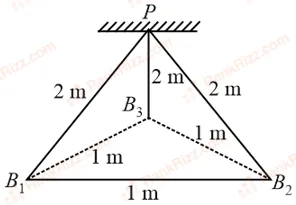
Three identical charged balls each of charge are suspended from a common point by silk threads of m each (as shown in figure). They form an equilateral triangle of side m. The ratio of net force on a charged ball to the force between any two charged balls will be

Two identical charged particles each having a mass g and charge C are placed on a horizontal table with a separation of between them such that they stay in limited equilibrium. If the coefficient of friction between each particle and the table is , find the value of . [Use ms]
12 cm
10 cm
8 cm
5 cm
Two identical tennis balls each having mass and charge are suspended from a fixed point by threads of length . What is the equilibrium separation when each thread makes a small angle with the vertical?
A particle of mass 1 mg and charge is lying at the mid-point of two stationary particles kept at a distance 2 m when each is carrying same charge . If the free charged particle is displaced from its equilibrium position through distance ( m). The particle executes SHM. Its angular frequency of oscillation will be ___ rad s (if )
A certain charge is divided into two parts and . How should the charges and be divided so that and placed at a certain distance apart experience maximum electrostatic repulsion?
An infinite number of point charges, each carrying charge, are placed along the y-axis at m, 2 m, 4 m, 8 m .....
The total force on a 1 C point charge, placed at the origin, is N. The value of , to the nearest integer, is ___.
[Take N m C]
Two small spheres each of mass 10 mg are suspended from a point by threads 0.5 m long. They are equally charged and repel each other to a distance of 0.20 m. The charge on each of the sphere is C. The value of will be ______. [Given m s]
Two identical conducting spheres with negligible volume have 2.1 nC and nC charges, respectively. They are brought into contact and then separated by a distance of 0.5 m. The electrostatic force acting between the spheres is ______ N.
[Given : = SI Units}]
Two electrons each are fixed at a distance 2d. A third charge proton placed at the midpoint is displaced slightly by a distance perpendicular to the line joining the two fixed charges. Proton will execute simple harmonic motion having angular frequency:
( = mass of charged particle)
Three charges , , are placed respectively, at distance, , and from the origin, on the -axis. If the net force experienced by , placed at , is zero, then value of is:
Charge is distributed within a sphere of radius with a volume charge density , where and are constants. If is the total charge of this charge distribution, the radius is:
Two identical conducting spheres A and B carry an equal charge. They are separated by a distance much larger than their diameters, and the force between them is F. A third identical conducting sphere, C, is uncharged. Sphere C is first touched to A, then to B, and then removed. As a result, force between A and B would be equal to:
F
Two balls of same mass and carrying equal charge are hung from a fixed support of length . At electrostatic equilibrium, assuming that angles made by each thread is small, the separation, x between the balls is proportional to :
Two charges, each equal to q, are kept at and on the x-axis. A particle of mass m and charge is placed at the origin. If charge is given a small displacement () along the y-axis, the net force acting on the particle is proportional to :
Two identical charged spheres suspended from a common point by two massless strings of length are initially a distance apart because of their mutual repulsion. The charge begins to leak from both the spheres at a constant rate. As a result the charges approach each other with a velocity . Then as a function of distance between them,
Two identical charged spheres are suspended by strings of equal lengths. The strings make an angle of with each other. When suspended in a liquid of density g cm, the angle remains the same. If density of the material of the sphere is g cm, the dielectric constant of the liquid is
4
3
2
1
A charge is placed at each of the opposite corners of a square. A charge is placed at each of the other two corners. If the net electrical force on is zero, then the equals
If and are the accelerations due to gravity on the surfaces of the earth and the moon respectively and if Millikan's oil drop experiment could be performed on the two surfaces, one will find the ratio to be
1
0
RELATED ELECTROSTATICS TOPICS