If one were to apply the Bohr model to a particle of mass and charge moving in a plane under the influence of a magnetic field 'B', the energy of the charged particle in the level will be:
- A
- B
- C
- D
Hydrogen spectrum and spectral series has been asked 116 times in JEE Main, in 18 different years between 2005 and 2026, and in all of the last five exam years (2022–2026), 66 questions in all. That is 38% of Atoms & Nuclei, its most-asked topic. Last asked in JEE Main 06 Apr 2026, Shift 1. 87 are multiple choice and 29 numerical-value; 48 easy, 59 medium and 2 hard by our difficulty labels. All of them are below, newest first, free to read.
Questions
116
Years asked
18
Since
2005
Of the chapter
38%
101–116 OF 116 · NEWEST FIRST
If one were to apply the Bohr model to a particle of mass and charge moving in a plane under the influence of a magnetic field 'B', the energy of the charged particle in the level will be:
As an electron makes a transition from an excited state to the ground state of a hydrogen-like atom/ion
kinetic energy and total energy decrease but potential energy increases
its kinetic energy increases but potential energy and total energy decrease
kinetic energy, potential energy and total energy decrease
kinetic energy decreases, potential energy increases but total energy remains same
If the binding energy of the electron in a hydrogen atom is 13.6 eV, the energy required to remove the electron from the first excited state of Li is:
13.6 eV
3.4 eV
122.4 eV
30.6 eV
The radiation corresponding to transition of hydrogen atom falls on a metal surface to produce photoelectrons. These electrons are made to enter a magnetic field of T. If the radius of the largest circular path followed by these electrons is 10.0 mm, the work function of the metal is close to:
1.8 eV
1.1 eV
0.8 eV
1.6 eV
Hydrogen (), Deuterium (), singly ionised Helium () and doubly ionised lithium () all have one electron around the nucleus. Consider an electron transition from to . If the wave lengths of emitted radiation are , , and respectively then approximately which one of the following is correct?
A 12.5 eV electron beam is used to bombard gaseous hydrogen at room temperature. It will emit:
2 lines in the Lyman series and 1 line in the Balmer series
3 lines in the Lyman series
1 line in the Lyman series and 2 lines in the Balmer series
3 lines in the Balmer series
In the Bohr's model of hydrogen-like atom the force between the nucleus and the electron is modified as , where is a constant. For this atom, the radius of the orbit in terms of the Bohr radius is :
In the Bohr model an electron moves in a circular orbit around the proton. Considering the orbiting electron to be a circular current loop, the magnetic moment of the hydrogen atom, when the electron is in excited state, is :
In a hydrogen like atom electron makes transition from an energy level with quantum number n to another with quantum number (n - 1). If n >> 1, the frequency of radiation emitted is proportional to :
Hydrogen atom is excited from ground state to another state with principal quantum number equal to . Then the number of spectral lines in the emission spectra will be
The electron of a hydrogen atom makes a transition from the orbit to the orbit. For large the wavelength of the emitted radiation is proportional to
A hypothetical atom has only three energy levels. The ground level has energy, eV. The two excited states have energies, eV and eV. Then which of the following wavelengths will not be present in the emission spectrum of this atom?
nm
nm
nm
nm
A doubly ionised Li atom is excited from its ground state () to state. The wavelengths of the spectral lines are given by , and . The ratio and are, respectively
The transition from the state to in a hydrogen like atom results in ultraviolet radiation. Infrared radiation will be obtained in the transition from
Which of the following transitions in hydrogen atoms emit photons of highest frequency?
to
to
to
to
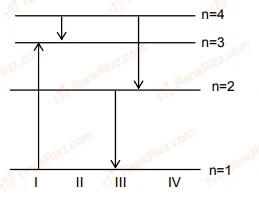
The diagram shows the energy levels for an electron in a certain atom. Which transition shown represents the emission of a photon with the most energy? 
III
IV
I
II