JEE MAIN 2020 · 08 JAN S2Hydrogen spectrum and spectral series
The first member of the Balmer series of hydrogen atom has a wavelength of 6561 . The wavelength of the second member of the Balmer series (in nm) is
Hydrogen spectrum and spectral series has been asked 116 times in JEE Main, in 18 different years between 2005 and 2026, and in all of the last five exam years (2022–2026), 66 questions in all. That is 38% of Atoms & Nuclei, its most-asked topic. Last asked in JEE Main 06 Apr 2026, Shift 1. 87 are multiple choice and 29 numerical-value; 48 easy, 59 medium and 2 hard by our difficulty labels. All of them are below, newest first, free to read.
Questions
116
Years asked
18
Since
2005
Of the chapter
38%
81–100 OF 116 · NEWEST FIRST
The first member of the Balmer series of hydrogen atom has a wavelength of 6561 . The wavelength of the second member of the Balmer series (in nm) is
The time period of revolution of electron in its ground state orbit in a hydrogen atom is s. The frequency of revolution of the electron in its first excited state (in s) is:
An excited He ion emits two photons in succession, with wavelengths 108.5 nm and 30.4 nm in making a transition to the ground state. The quantum number n, corresponding to its initial excited state is
(for a photon of wavelength , energy E = )
n = 6
n = 5
n = 7
n = 4
Consider an electron in a hydrogen atom, revolving in its second excited state (having radius 4.65 Å). The de-Broglie wavelength of this electron is:
12.9 Å
6.6 Å
9.7 Å
3.5 Å
The electron in a hydrogen atom first jumps from the third excited state to the second excited state and subsequently to the first excited state. The ratio of the respective wavelengths, , of the photons emitted in this process is:
In Li, electron in first Bohr orbit is excited to a level by a radiation of wavelength . When the ion gets de-excited to the ground state in all possible ways (including intermediate emissions), a total of six spectral lines are observed. What is the value of ?
(Given: h = J s; c = m s)
10.8 nm
9.4 nm
11.4 nm
12.3 nm
Taking the wavelength of first Balmer line in hydrogen spectrum (n = 3 to n = 2) as 660 nm, the wavelength of the 2nd Balmer line (n = 4 to n = 2) will be:
889.2 nm
488.9 nm
388.9 nm
642.7 nm
A He ion is in its first excited state. Its ionization energy is:
13.60 eV
48.36 eV
54.40 eV
6.04 eV
Radiation coming from transitions to of hydrogen atoms fall on He ions in and states. The possible transition of helium ions as they absorb energy from the radiation is:
A particle of mass m moves in a circular orbit in a central potential field . If Bohr's quantization conditions are applied, radii of possible orbitals and energy levels vary with quantum number n as:
,
,
,
,
A hydrogen atom, initially in the ground state is excited by absorbing a photon of wavelength 980 . The radius of the atom in the excited state, in terms of Bohr radius , will be:
None of the above
In a hydrogen like atom, when an electron jumps from the M-shell to the L-shell, the wavelength of emitted radiation is . If an electron jumps from N-shell to the L-shell, the wavelength of emitted radiation will be:
The energy required to remove the electron from a singly ionized Helium atom is 2.2 times the energy required to remove an electron from Helium atom. The total energy required to ionize the Helium atom completely is:
20 eV
79 eV
109 eV
34 eV
Muon () is negatively charged (|q| = |e|) with a mass m = 200 m, where m is the mass of the electron and e is the electronic charge. If is bound to a proton to form a hydrogen like atom, identify the correct statements:
(A) Radius of the muonic orbit is 200 times smaller than that of the electron
(B) The speed of the in the nth orbit is times that of the electron in the nth orbit
(C) The ionization energy of muonic atom is 200 times more than that of an hydrogen atom
(D) The momentum of the muon in the nth orbit is 200 times more than that of the electron
(A), (B), (D)
(B), (D)
(C), (D)
(A), (C), (D)
The acceleration of an electron in the first orbit of the hydrogen atom () is:
According to Bohr's theory, the time averaged magnetic field at the centre (i.e., nucleus) of a hydrogen atom due to the motion of electrons in the orbit is proportional to: ( = principal quantum number)
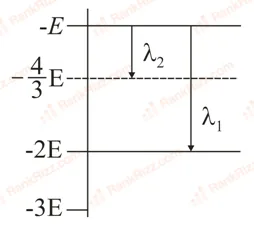
Some energy levels of a molecule are shown in the figure. The ratio of the wavelengths , is given by:
A neutron moving with a speed 'v' makes a head on collision with a stationary hydrogen atom in ground state. The minimum kinetic energy of the neutron for which perfectly inelastic collision will take place is:
20.4 eV
10.2 eV
12.1 eV
16.8 eV
An electron in a hydrogen atom makes a transition from to and emits a photon. This photon strikes a doubly ionized lithium atom which was already in an excited state and completely removes the orbiting electron. The least quantum number for the excited state of the lithium-ion for the process is
2
4
5
3
The de-Broglie wavelength associated with the electron in the level is:
Half of the de-Broglie wavelength of the electron in the ground state
Four times the de-Broglie wavelength of the electron in the ground state
th of the de-Broglie wavelength of the electron in the ground state
Two times the de-Broglie wavelength of the electron in the ground state